Pellets of power designed to deliver hydrogen for tomorrow's vehicles
Hydrogen may prove to be the fuel of the future in powering the effi cient, eco-friendly fuel cell vehicles of tomorrow. Developing a method to safely store, dispense and easily “refuel” the vehicle’s storage material with hydrogen has baffl ed researchers for years. However, a new and attractive storage medium being developed by Pacific Northwest National Laboratory scientists may provide the “power of pellets” to fuel future transportation needs.
The Department of Energy’s Chemical Hydrogen Storage Center of Excellence is investigating a hydrogen storage medium that holds promise in meeting long-term targets for transportation use. As part of the center, PNNL scientists are using solid ammonia borane, or AB, compressed into small pellets to serve as a hydrogen storage material.
Each milliliter of AB weighs about three-quarters of a gram and harbors up to 1.8 liters of hydrogen. Researchers expect that a fuel system using small AB pellets will occupy less space and be lighter in weight than systems using pressurized hydrogen gas, thus enabling fuel cell vehicles to have room, range and performance comparable to today’s automobiles.
“With this new understanding and our improved methods in working with ammonia borane,” said PNNL scientist Dave Heldebrant, “we’re making positive strides in developing a viable storage medium to provide reliable, environmentally friendly hydrogen power generation for future transportation needs.”
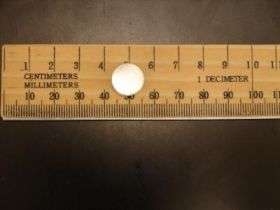
A small pellet of solid ammonia borane (240 mg), as shown, is capable of storing relatively large quantities of hydrogen (0.5 liter) in a very small volume.
PNNL scientists are learning to manipulate the release of hydrogen from AB at predictable rates. By varying temperature and manipulating AB feed rates to a reactor, researchers envision controlling the production of hydrogen and thus fuel cell power, much like a gas pedal regulates fuel to a car’s combustion engine.
“Once hydrogen from the storage material is depleted, the AB pellets must be safely and effi ciently regenerated by way of chemical processing,” said PNNL scientist Don Camaioni. “This ‘refueling’ method requires chemically digesting or breaking down the solid spent fuel into chemicals that can be recycled back to AB with hydrogen.”
Don Camaioni and Dave Heldebrant will make their presentations at the 234th American Chemical Society National Meeting in Boston, Mass., on Tuesday, August 21.
Source: Pacific Northwest National Laboratory


