Computational actinide chemistry: Are we there yet?
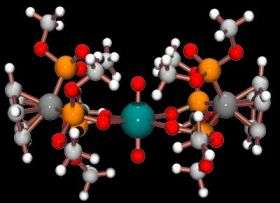
Ever since the Manhattan project in World War II, actinide chemistry has been essential for nuclear science and technology. Yet scientists still seek the ability to interpret and predict chemical and physical properties of actinide compounds and materials using first principle theory. Computational actinide chemistry may bring that goal closer to achievement.
PNNL scientist Jun Li will provide an overview of developments in computational actinide chemistry at the national meeting of the American Chemical Society.
Progress in relativistic quantum chemistry, computer hardware and computational chemistry software has enabled computational actinide chemistry to emerge as a powerful and predictive tool for research in actinide chemistry.
“These discoveries will have deep impact for heavy-element science and will greatly improve the fundamental understanding of actinides essential to develop advanced nuclear energy systems, atomic weapons and environmental remediation technologies,” Li said. Li’s presentation will focus on applications of relativistic ab initio and density functional theory (DFT) methodologies to actinide complexes. Special emphasis will be given to applications of DFT methods to the geometries, electronic structures, spectroscopy and excited-state properties of various actinide compounds, from small actinide-containing molecules to large organoactinide systems.
Researchers are identifying molecules such as the so-called Klaui ligand that can effectively extract uranium and other actinides from their natural environment.
Source: Pacific Northwest National Laboratory


