'Clutter detector' could cut confusion
August 21, 2007
'Clutter detector' could cut confusion

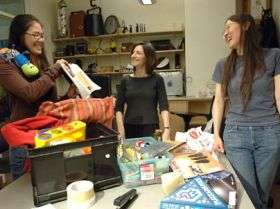
MIT student Lisa Nakano, left, a senior in brain and cognitive sciences; Ruth Rosenholtz, principal research scientist; and graduate student Yuan Zhen laugh at the clutter in an office. The three have identified a way to measure visual clutter. Photo / Donna Coveney

The danger of clutter--especially on a visual screen--is that it causes confusion that affects how well we perform tasks. To that end, visual clutter is a challenge for fighter pilots picking out a target, for people seeking important information in a user interface, and for web site and map designers, among others.

Now, a team of MIT scientists has identified a way to measure visual clutter. Their research, published Aug. 16 in the Journal of Vision, could lead to more user-friendly displays and maps, as well as tips for designers seeking to add an attention-grabbing element to a display.

"We lack a clear understanding of what clutter is, what features, attributes and factors are relevant, why it presents a problem and how to identify it," said Ruth Rosenholtz, principal research scientist in MIT's Department of Brain and Cognitive Sciences (BCS) and the paper's lead author.

The fact that one person's clutter is the next person's organized workspace makes it hard to come up with a universal measure of clutter. Rosenholtz and colleagues modeled what makes items in a display harder or easier to pick out. They used this model, which incorporates data on color, contrast and orientation, to come up with a software tool to measure visual clutter.

To be useful, such a tool has to capture the effect of clutter on performance. In their paper, Rosenholtz and her colleagues-- MIT BCS graduate student Yuanzhen Li and BCS undergraduate Lisa Nakano--tested the influence of clutter on searching for a symbol in a map, like an arrow indicating "you are here." They found good correlation between the time it takes to find a symbol in a map and the amount of clutter according to their measure.

In earlier work they also showed that their clutter detector correlates well with human subjective judgments of clutter. In that case, the team asked 20 people to rank 25 maps of the United States and San Francisco in order from most cluttered to least cluttered. The maps ranged from a gray and green map of the 50 states to a San Francisco Bay area map overlaid with lines, words and colors.

Although there was a fair bit of disagreement among the people being tested about what constituted clutter, when the researchers compared results from their clutter measure to those of their human subjects, they found a good correlation.

Rosenholtz next plans to offer this visual clutter tool, as well as other tools developed in her lab, to designers as part of a user study. She hopes to learn what insights designers get from knowledge of how a user will likely perceive their designs, and how best to present this information to the designers.

Rosenholtz provides free software written in MATLAB to anyone interested in generating color and contrast "clutter maps" to gauge the clutter level of a display. The tool is available at web.mit.edu/rruth/www .

Source: MIT

3.3 /5 (8 votes)  

Rank 3.3 /5 (8 votes)
Tags

Relevant PhysicsForums posts

More news stories

A frank discussion of the power law and linking correlation to causation

(PhysOrg.com) -- Michael Stumpf a mathematics professor at Imperial College in London, and Mason Porter a lecturer at Oxford have teamed together to write and publish a perspective piece in Science regarding the in ...

Other Sciences / Mathematics

created Feb 10, 2012 | popularity 5 / 5 (5) | comments 10 | with audio podcast report

Employers feel no love for unscrupulous practice of 'service sweethearting'

A new study led by two Florida State University marketing professors finds that some frontline service employees who are rewarded for hikes in customer loyalty and satisfaction also may engage in "service ...

Other Sciences / Economics & Business

created Feb 10, 2012 | popularity 3.3 / 5 (3) | comments 10

US workers are 'giving away the store,' costing firms billions

Nearly 70 percent of the nation's service employees give away free goods and services – from hamburgers to cable TV – costing companies billions of dollars a year, according to a groundbreaking study.

Other Sciences / Economics & Business

created Feb 09, 2012 | popularity 3.5 / 5 (4) | comments 10

New insights into how to correct false knowledge

The abundance of false information available on the Internet, in movies and on TV has created a big challenge for educators.

Other Sciences / Social Sciences

created Feb 07, 2012 | popularity 4.9 / 5 (7) | comments 9 | with audio podcast

Neanderthal demise due to many influences, including cultural changes: study

As an ice age crept upon them thousands of years ago, Neanderthals and modern human ancestors expanded their territory ranges across Asia and Europe to adapt to the changing environment.

Other Sciences / Archaeology & Fossils

created Feb 07, 2012 | popularity 4.4 / 5 (5) | comments 8 | with audio podcast


Scientists discover molecular secrets of 2,000-year-old Chinese herbal remedy

For roughly two thousand years, Chinese herbalists have treated Malaria using a root extract, commonly known as Chang Shan, from a type of hydrangea that grows in Tibet and Nepal. More recent studies suggest that halofuginone, ...

New method to examine batteries -- MRI from the inside

There is an ever-increasing need for advanced batteries for portable electronics, such as phones, cameras, and music players, but also to power electric vehicles and to facilitate the distribution and storage of energy derived ...

Google might launch Drive for cloud storage soon

(PhysOrg.com) -- Google's next big move, according to the Wall Street Journal, is a cloud storage service called Drive. Hardly first to the plate, Google is simply catching up to introducing its cloud reposi ...

Lab study raises questions over nano-particle impact

Tests involving chickens have raised questions about the impact on health from engineered nano-particles, the ultra-fine grains commonly used in drugs and processed foods, scientists said on Sunday.

A mitosis mystery solved: How chromosomes align perfectly in a dividing cell

Although the process of mitotic cell division has been studied intensely for more than 50 years, Whitehead Institute researchers have only now solved the mystery of how cells correctly align their chromosomes during symmetric ...

Starve a virus, feed a cure? Findings show how some cells protect themselves against HIV

A protein that protects some of our immune cells from the most common and virulent form of HIV works by starving the virus of the molecular building blocks that it needs to replicate, according to research published online ...