Researchers help to make cars smarter
August 21, 2007 Researchers help to make cars smarter

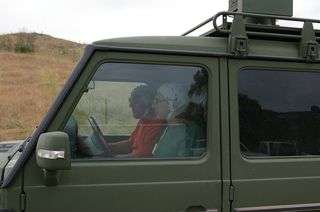
Sandia researcher Chris Forsythe, foreground, and companion drive a modified military vehicle as part of an experiment with smart cars. Credit: SNL

Cars already automatically lock doors when they sense motion and turn on warning lights if they detect potential engine problems. But they are about to get smarter.

The augmented cognition research team at Sandia National Laboratories is designing cars capable of analyzing human behavior.

The car of the future they are developing may, for example, deduce from your driving that you’re become tired, or during critical situations, tell your cell phone to hold an incoming call so you won’t be distracted.

The project started about five years ago with funding by the Defense Advanced Research Projects Agency (DARPA). Four years ago Sandia partnered with a major commercial automobile manufacturer, and three years ago did actual experiments on European roadways.

“We utilized data that already existed on the car’s computer to collect a wide range of physical data such as brake pedal force, acceleration, steering wheel angle, and turn signaling,” says Kevin Dixon, principal investigator. “And specialized sensors including a pressure sensitive chair and an ultrasonic six-degree-of freedom head tracking system measured driver posture.”

Five drivers were fitted with caps connected to electroencephalogram (EEG) (brainwave) electrodes to gauge electrical activity of the brain as they performed driving functions.

The researchers collected several hours of data in unstructured driving conditions that were imputed into Sandia software, referred to as “classifiers,” that categorized driving behavior. These classifiers could detect certain driving situations such as approaching a slow-moving vehicle or changing lanes in preparation to pass another vehicle.

The system detects the difficulty and stress of the task the driver is attempting. It then tries to modify the tasks and/or environment to lower the stress and improved specified performance parameters.

Similar experiments were conducted for off-road driving where conditions were much less structured than typical roadways.

“The beauty of this is that we aren’t doing anything new or different to the car,” Dixon says. “All the software that can make the determination of ‘dangerous’ or ‘safe’ driving situations would all be placed in the computer that already exists in the car. It’s almost like there is another human in the car.”

More recently, the researchers conducted experiments at Camp Pendleton with Marine Corps personnel driving a modified military vehicle. Once again the driver and a passenger sitting in the passenger’s seat were fitted with EEGs. The software classifier determined how difficult the driving situation was and who the best person of the two was to perform a task. For example, during a difficult driving maneuver, it might be best for the passenger to receive radio transmissions in order to not distract the driver

“Every year tens of thousands of people die in automobile crashes, many caused by driver distraction,” Dixon says. “If our algorithms can identify dangerous situations before they happen and alert drivers to them, we will help save lives.”

Source: Sandia National Laboratory


print this article email this article download pdf blog this article bookmark this article     Stumble it Digg this share on Facebook retweet share on Reddit add to delicious
Rate this story - 4.1 /5 (15 votes)


August 21, 2007 all stories

Comments: 0

4.1 /5 (15 votes)
  • Stumble this up

  • Digg this

  • share this

  • hide
  • Related Stories

  • Materials Innovations: Sandia creates Kevlar gauntlets to protect arms of soldiers in combat
    created Jul 17, 2004 | popularity not rated yet | comments 0
  • Software takes a hard look at traffic fatalities
    created 6 hours ago | popularity not rated yet | comments 0
  • Pulling the plug on hybrid myths
    created Nov 19, 2009 | popularity not rated yet | comments 0
  • Eco-Friendly SUV Gets a Hydrogen Mileage Boost (w/ Video)
    created Nov 17, 2009 | popularity not rated yet | comments 0
  • Road trains may be coming soon to Europe (w/ Video)
    created Nov 13, 2009 | popularity not rated yet | comments 0


  • hide
  • Relevant PhysicsForums posts

  • Control System
    created 17 hours ago
  • Base Isolation Systems in Skyscrapers?
    created Nov 23, 2009
  • Need to interview a Computer Hardware Engineer for school project
    created Nov 23, 2009
  • transient heat transfer
    created Nov 23, 2009
  • More from Physics Forums - General Engineering

Other News

AT&T and Verizon ads duel on airwaves and in court

Technology / Business

created 58 minutes ago | popularity not rated yet | comments 0

(AP) -- What would the holidays be without bickering between siblings? AT&T and Verizon are swamping TV with ads attacking facets of each other's wireless networks. While the ads stick fairly close to the truth, there's ...


The number of text messages that a mobile user in S.Korea can send out a day has been restricted to 500, down from 1,000

S.Korea halves ceiling on text messages to fight spam

Technology / Telecom

created 45 minutes ago | popularity not rated yet | comments 0

South Korean authorities on Wednesday halved the daily limit on text messages sent out by mobile phones as part of a campaign against spam, officials said.


New computer cluster gets its grunt from games

New computer cluster gets its grunt from games

Technology / Computer Sciences

created 38 minutes ago | popularity not rated yet | comments 0

Technology designed to blast aliens in computer games is part of a new GPU (Graphics Processing Units) computer cluster that will process CSIRO research data thousands of times faster and more efficiently ...


Selling chip makers on optical computing

Selling chip makers on optical computing

Technology / Semiconductors

created 15 hours ago | popularity 4.9 / 5 (8) | comments 1

(PhysOrg.com) -- Computer chips that transmit data with light instead of electricity consume much less power than conventional chips, but so far, they've remained laboratory curiosities. Professors Vladimir ...


Facebook creates dual-class structure, but no IPO (AP)

Facebook creates dual-class structure, but no IPO

Technology / Business

created 11 hours ago | popularity 1 / 5 (1) | comments 0

(AP) -- Facebook has created a dual-class stock structure designed to give founder Mark Zuckerberg and other existing shareholders control over the company.