Area responsible for 'self-control' found in the human brain
August 21, 2007 Area responsible for 'self-control' found in the human brain

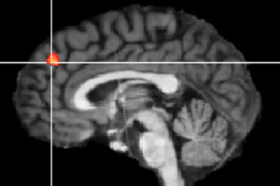
Brain area in the fronto-median cortex that was activated when participants intentionally withhold a planned action in the last moment. Image: Max Planck Instiute for Human Cognitive and Brain Sciences

The area of the brain responsible for self-control—where the decision not to do something occurs after thinking about doing it—is separate from the area associated with taking action, scientists say in the August 22 issue of The Journal of Neuroscience.

“The results illuminate a very important aspect of the brain's control of behavior, the ability to hold off doing something after you've developed the intention to do it—one might call it ‘free won't’ as opposed to free will,” says Martha Farah, PhD, of the University of Pennsylvania. “It is very important to identify the circuits that enable ‘free won’t’ because of the many psychiatric disorders for which self-control problems figure prominently—from attention deficit disorder to substance dependence and various personality disorders.” Farah was not involved in the experiment.

The findings broaden understanding of the neural basis for decision making, or free will, and may help explain why some individuals are impulsive while others are reluctant to act, says lead author Marcel Brass, PhD, of the Max Planck Institute for Human Cognitive and Brain Sciences and Ghent University. Brass and Patrick Haggard, PhD, of University College London, used functional magnetic resonance imaging (fMRI) to study the brain activity of participants pressing a button at times they chose themselves. They compared data from these trials to results when the participants prepared to hit the button, then decided to hold back or veto the action.

Fifteen right-handed participants were asked to press a button on a keyboard. They were asked to choose some cases in which they stopped just before pressing the button. Participants also indicated on a clock the time at which they intended to press the button or decided to hold back. When Brass and Haggard compared fMRI images of the two scenarios, they found that pulling back yielded activity in the dorsal fronto-median cortex (dFMC), an area on the midline of the brain directly above the eyes, which did not show up when participants followed through and made the action. In addition, those who chose to stop the intended action most often showed greatest contrast in dFMC activity.

“The capacity to withhold an action that we have prepared but reconsidered is an important distinction between intelligent and impulsive behavior,” says Brass, “and also between humans and other animals.”

Future study will involve methods with a better time resolution such as EEG to determine whether the inhibitory process could operate in the brief time period between the time of conscious intention and the point of no return for motor output.

Source: Society for Neuroscience


print this article email this article download pdf blog this article bookmark this article     Stumble it Digg this share on Facebook retweet share on Reddit add to delicious
Rate this story - 4.4 /5 (21 votes)


August 21, 2007 all stories

Comments: 0

4.4 /5 (21 votes)
  • Stumble this up

  • Digg this

  • share this

  • hide
  • Related Stories


  • hide
  • Relevant PhysicsForums posts

  • nesfatin
    created 10 hours ago
  • Obsessive Compulsive Disorder
    created Nov 20, 2009
  • West's zone 2 starling resistor respiratory physiology
    created Nov 18, 2009
  • 50-0-50 rule
    created Nov 18, 2009
  • More from Physics Forums - Medical Sciences

Other News

New cancer target for non-Hodgkin's lymphoma

Medicine & Health / Cancer

created 10 hours ago | popularity 5 / 5 (1) | comments 0

Physician-scientists from Weill Cornell Medical College have discovered a molecular mechanism that may prove to be a powerful target for the treatment of non-Hodgkin's lymphoma, a type of cancer that affects lymphocytes, ...


Surface bacteria maintain skin's healthy balance

Medicine & Health / Research

created 11 hours ago | popularity 5 / 5 (4) | comments 0

On the skin's surface, bacteria are abundant, diverse and constant, but inflammation is undesirable. Research at the University of California, San Diego School of Medicine now shows that the normal bacteria living on the ...


Gene mismatch influences success of bone marrow transplants

Medicine & Health / Genetics

created 11 hours ago | popularity 4 / 5 (1) | comments 0

A commonly inherited gene deletion can increase the likelihood of immune complications following bone marrow transplantation, an international team of researchers reports in the November 22 advance online issue of Nature Ge ...


New understanding about mechanism for cell death after stroke leads to possible therapy

Medicine & Health / Research

created 11 hours ago | popularity not rated yet | comments 0

Scientists at the Brain Research Centre, a partnership of the University of British Columbia Faculty of Medicine and Vancouver Coastal Health Research Institute, have uncovered new information about the mechanism by which ...


Cancer metabolism discovery uncovers new role of IDH1 gene mutation in brain cancer

Medicine & Health / Cancer

created 11 hours ago | popularity not rated yet | comments 0

Agios Pharmaceuticals today announced that its scientists have established, for the first time, that the mutated IDH1 gene has a novel enzyme activity consistent with a cancer-causing gene, or oncogene. This breakthrough ...