Challenges remain in reintroducing American chestnut
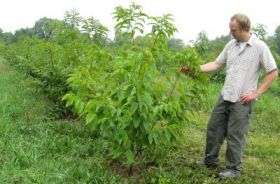
Researchers have developed a breed of American chestnut that is resistant to the fungal blight that decimated its population in the early 1900s.
But the return of this "king of trees," so-called for its picturesque form and towering height of more than 100 feet, remains hampered by a slew of obstacles, said a Purdue University researcher.
"We are on the verge of overcoming chestnut blight, but there is a whole new set of obstacles to get past yet," said Douglass Jacobs, an associate professor of forestry and natural resources who is helping develop the blight-resistant chestnut.
To reintroduce the American chestnut, he said, researchers must get past several policy limitations, gather new data, educate the public about the species and address new threats posed by exotic pests. He details these and other challenges in a paper published in July's issue of the journal Biological Conservation.
Once a dominant forest species throughout much of the Eastern United States, ranging from Maine to Mississippi and concentrated in the Appalachian regions, the American chestnut was known for its annual largesse of nuts, rot-resistant wood and sheer size. An introduced Asian fungus nearly eliminated the tree.
A breeding program begun by the American Chestnut Foundation recently produced a blight-resistant hybrid tree that derives its resistance from the Asian chestnut and contains 94 percent of the American chestnut's genetic material, Jacobs said.
Nevertheless, the supply of blight-resistant trees remains low, and the tree isn't likely to be available to the public for about a decade. More resources need to be directed toward breeding programs, he said.
More existing trees also need to be included in breeding programs as soon as possible to produce a genetically diverse population, Jacobs said. Although few adult chestnuts remain throughout the tree's native territory, a significant number of sprouts persist from old tree roots, which grow for years before becoming reinfected. These sprouts comprise a level of genetic diversity that is vital for widespread reintroduction and need to be included before they die out altogether, Jacobs said.
One of the biggest obstacles is the host of laws and regulations that now govern the forests - or former forests - in the chestnut's original range, Jacobs said. In many public lands where the chestnut used to thrive, such as the Great Smoky Mountains National Park, human interference is strongly discouraged and often illegal. But Jacobs said some interference and harvesting will be necessary to reintroduce the chestnut, calling for a unified and proactive approach and exceptions to certain laws that govern public lands.
Jacobs said that some might consider the blight-resistant chestnut hybrid as a cultivar or new species, which could hamper reintroduction to public lands. However, he stressed that just because the tree is crossed with the Asian chestnut to attain resistance, its physical traits and appearance should be indistinguishable from a pure American chestnut.
"This is as close to the real thing as it gets," Jacobs said. "Any closer and it wouldn't be blight-resistant."
Further breeding should produce even higher quality trees, he said.
In the early 1900s, the blight hit so fast that researchers didn't have time to study the American chestnut's ecology or interactions with its environment, Jacobs said. Thus, more research is needed to better understand the species and determine how to best reintroduce it into existing forests.
Jacobs recently conducted a study in Wisconsin where the fungus hadn't yet spread, demonstrating that the chestnut grew extremely fast, outcompeting native black walnut and red oak trees. The average chestnut grew to 23 feet by age 8.
"This confirmed what we had thought," Jacobs said. "The American chestnut is very fast-growing and competitive, has excellent timber and has great wildlife properties, all which make it a desirable species for reintroduction."
However, new exotic pests also threaten the chestnut. Blight-resistant hybrids have already proven susceptible to Phytophthora cinnamomi, or root rot, which preys upon tree roots in mostly wet, southern soils.
"This threatens to be almost as bad as the fungal blight," Jacobs said. "In the future, we may need to select for this resistance in new hybrids. Luckily, the Asian chestnut shows some resistance to this fungus as well, although the breeding process would take a long time."
Jacobs said the tree could be ecologically less desirable in some areas.
"It's a natural choice for hardwood plantations in the Midwest and Mississippi Valley, but these areas are largely outside its native range," he said.
The chestnut could threaten native species outside its range since it is competitive and quick-growing, he said.
If individuals or groups decided not to accept the hybrid American chestnut as a native species, and this in turn impeded its reintroduction, it would likely encourage more research into ways to genetically engineer the tree, especially since it has potential as a profitable species, Jacobs said.
"This would likely be less acceptable to those who would think twice about reintroducing a hybrid of a native tree, and it would be difficult to prevent without a better alternative," he said.
Source: Purdue University


