August 22, 2007 feature
Scientists interpret physics behind invisibility cloaks
Is a perfect invisible cloak theoretically possible? Are there certain wavelengths—such as those in the visible spectrum—that can’t be made invisible? How will using imperfect materials affect the performance of a cloak? Scientists from Zhejiang University and MIT have recently analyzed the physics behind invisibility cloaks in an attempt to answer some of these questions.
Hongsheng Chen, Bae-Ian Wu, Baile Zhang, and Jin Au Kong have published their research on invisibility cloaks in a recent issue of Physical Review Letters. The group analytically demonstrated how electromagnetic waves interact with invisibility cloaks made of metamaterials, an interaction that is often different from conventional scattering with regular particles. Their findings will hopefully be useful for cloak design and applications, an exciting research area that is still in its early stages.
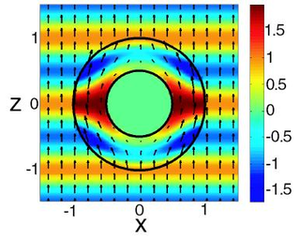
“When an electromagnetic wave is incident onto a conventional sphere, part of the radiation will be scattered in all directions; while for a metamaterial cloak, the incident wave will smoothly pass through the cloak undeflected,” Chen explained to PhysOrg.com. “It is very interesting that a perfect metamaterial cloak shows no reflection or absorption but rather allows the Poynting power to bypass the hidden object. Our research also shows that the Poynting power inside of the cloak is not uniform: when close to the inner boundary of the cloak, the power flow density is close to zero, while near the outer boundary of the cloak, the power flow density becomes large.”
The first invisible cloak made of metamaterials was created last year by Duke University researchers Shurig et al. Metamaterials, which are composed of a man-made matrix of tiny metal wires and loops that control electromagnetic waves, can create an area in space where no electromagnetic waves propagate. The light waves flow around the cloaked object like water in a creek flows around a rock, appearing on the other side in such a way that an observer can’t tell that the waves flowed around an obstacle.
In the first experimental trial, the cloak hid the concealed object from the electromagnetic microwaves in two dimensions. Chen and his colleagues wanted to know if perfect invisibility could be achieved under any wavelength. The scientists explained that perfect invisibility is achieved when the scattering cross section is zero, which indicates that the cloak exhibits zero scattering. The group found that the parameters for a perfect cloak are very difficult to realize, and that when some specific type of loss is included, the three dimensional spherical cloak wrapped around a hidden object exhibits zero backscattering while a two dimensional cylindrical cloak does not.
“The cloak is both anisotropic and inhomogeneous: all of the components in the permittivity and permeability tensor are functions of the radius, which implies that the perfect invisibility cloak is very difficult to design,” Chen explained. “If we introduce a specific type of loss both in a spherical cloak and a cylindrical cloak, only the spherical cloak exhibits a zero backscattering, which indicates only the spherical cloak can still be rendered invisible with a monostatic (transmitter and receiver in the same location) detection. This is because the impedance of the spherical cloak is still matched to the free space in this particular loss case.”
Because they have less stringent requirements, imperfect cloaks may offer a more realistic alternative for engineers. Although imperfect cloaks have non-zero scattering, the objects they cloak can still appear isolated from the outside field under certain specific conditions and the incident fields cannot penetrate into the hidden object. Besides, for an imperfect cloak with matched impedance, it can still be rendered invisible with monostatic detection, which is most widely used in current radar.
“For a monostatic detection, no reflection wave will be received by the detector if the imperfect cloak has a matched impedance with the free space,” Chen explained. “Therefore, the imperfect cloak, even with its parameters deviated far from the ideal parameters, still can be made completely invisible with the monostatic detection as long as it satisfied the impedance requirement.”
Since almost all current radars belong to the monostatic class, Chen explained that this research can offer a more realistic alternative for engineers. In the future, applications of invisible cloaks could include military uses such as making planes and weapons invisible to radar, enabling the possibility of looking out walls as if they were windows, and hiding ugly factories for aesthetic reasons.
“The effectiveness of the cloak based on the analytical solutions of the electromagnetic wave interactions with metamaterial cloaks (ideal or non-ideal) can be quantitatively provided,” Chen said. “Our research work therefore provides a new way for the cloak design and to qualify the effectiveness or performance of a non-ideal cloak.”
Citation: Chen, Hongsheng, Wu, Bae-Ian, Zhang, Baile, and Kong, Jin Au. “Electromagnetic Wave Interactions with a Metamaterial Cloak.” Physical Review Letters 99, 063903 (2007).
Copyright 2007 PhysOrg.com.
All rights reserved. This material may not be published, broadcast, rewritten or redistributed in whole or part without the express written permission of PhysOrg.com.


