Folate mystery finally solved
August 22nd, 2007 Folate Biosynthesis

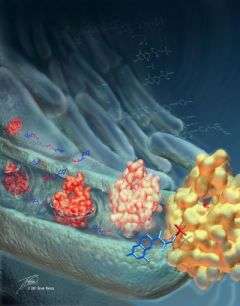
The accompanying image illustrates the stages of enzyme activity of the first step of folate biosynthesis: free enzyme (orange), enzyme with substrate bound (salmon), and enzyme with pyrophosphate bound (gold), superimposed on a drawing of E. coli and the folate biosynthetic pathway. The free floating substrate is shown in blue, with the phosphates in red. Credit: The rendition was contributed by Devon Nikasa an alumna of the Art as Applied to Medicine Program at Hopkins.

Some biochemical processes, especially those in bacteria, have been so well studied it’s assumed that no discoveries are left to be made. Not so, it turns out, for Johns Hopkins researchers who have stumbled on the identity of an enzyme that had been a mystery for more than 30 years. The report appears in the May 15 issue of Structure.

“It was really quite a surprise when we realized we had discovered the unknown player in how bacteria make the B vitamin folate, a player that we’ve known of since 1974,” says study author L. Mario Amzel, Ph.D., professor and director of biophysics and biophysical chemistry at Hopkins. “Basic research can be so serendipitous at times.”

Amzel and colleague Maurice Bessman and their labs were in the middle of systematically characterizing how members of a family of related enzymes in bacteria can recognize specific molecules. With each family member, they isolated purified enzyme, grew crystals of pure enzyme, and figured out the enzyme’s 3-D structure by using techniques that use X-rays.

Armed with the 3-D structure, they then used computer modeling to analyze how the enzyme binds to and acts on another molecule, its substrate.

“We still didn’t know that it was anything special until Maurice started searching old publications,” says study author Sandra Gabelli, Ph.D. “As it turns out, Suzuki and coworkers in 1974 had published evidence of an enzyme in the bacteria E. coli with similar characteristics to ours that could initiate folate biosynthesis.”

“So we had to ask, Can the bacteria make folate if we remove the orf17 gene"” says Amzel. Bessman and colleagues then “knocked-out” the gene and, predictably, the bacteria made 10 times less folate than usual.

“It was such a sweet discovery,” says Gabelli. “It’s scientific discovery the old-fashioned way, finding something we weren’t looking for.”

The mechanics behind how bacteria make folate are of particular interest to scientists who want to design more powerful antibacterial drugs. Humans cannot make folate because they do not have any of the same molecular machinery. Therefore, it’s possible to design drugs that target the bacterial folate machinery that would not lead to side effects in humans.

Their discovery, says Amzel, identifies yet another potential antibacterial target. “We are not in that business of drug design—we’re focused on the basics, figuring out how things work,” he says. “We do hope that others can use what we find to make new drugs.”

Source: Johns Hopkins Medical Institutions


print this article email this article download pdf blog this article bookmark this article     Digg this Stumble it share on Facebook share on Reddit add to delicious save to Yahoo! bookmarks
4.6/5 after 15 votes


August 22nd, 2007 all stories
Chemistry /

Comments: 0
Rank: 4.6/5 after 15 votes

  • Stumble this up

  • Digg this

  • Share it:
  • share on Facebook
  • share on MySpace
  • share on Slashdot
  • rss-newsfeed
  • share on Google
  • share on Reddit
  • add to delicious
  • save to Yahoo! bookmarks
  • share on Windows Live
  • Add to Mixx!
Rating: 4.6/5 after 15 votes

  • Related Stories

  • The good news in our DNA: Defects you can fix with vitamins and minerals
    created Jun 02, 2008 | popularity not rated yet | comments 0
  • Researchers find new chink in a 'superbug's' armor
    created Dec 08, 2006 | popularity not rated yet | comments 0
  • Some neural tube defects in mice linked to enzyme deficiency
    created May 25, 2009 | popularity not rated yet | comments 0
  • Colon cancer and the microbes in your gut
    created Mar 31, 2009 | popularity not rated yet | comments 0
  • Key site in iron metabolism aids in diagnosing anemia of chronic disease
    created Aug 05, 2008 | popularity not rated yet | comments 0

Tags


  • Physicists Demonstrate Quantum Memory with Matter Qubits
    Physicists Demonstrate Quantum Memory with Matter Qubits
    Physics / General Physics
    created Jul 03, 2009 | popularity 4.4 / 5 (17) | comments 1
  • 'Holey' Nanosheets for Wastewater Dye Removal
    Nanotechnology / Nanomaterials
    created Jul 01, 2009 | popularity 5 / 5 (5) | comments 1
  • Jellyfish Robot Swims Like its Biological Counterpart
    Jellyfish Robot Swims Like its Biological Counterpart
    Electronics / Robotics
    created Jun 26, 2009 | popularity 4.4 / 5 (8) | comments 1
  • Could Maxwell's Demon Exist in Nanoscale Systems?
    Could Maxwell's Demon Exist in Nanoscale Systems?
    Physics / General Physics
    created Jun 24, 2009 | popularity 4.4 / 5 (18) | comments 29
  • Living Safely with Robots, Beyond Asimov's Laws
    Living Safely with Robots, Beyond Asimov's Laws
    Electronics / Robotics
    created Jun 22, 2009 | popularity 4.6 / 5 (52) | comments 40
  • Other News

    Scientists find molecule that regulates heart size by using zebrafish screening model

    Chemistry / Biochemistry

    created 11 hours ago | popularity not rated yet | comments 0

    Using zebrafish, researchers at the University of Pittsburgh have identified and described an enzyme inhibitor that allows them to increase the number of cardiac progenitor cells and therefore influence the size of the developing ...


    urine

    Producing hydrogen from urine

    Chemistry / Analytical Chemistry

    created Jul 03, 2009 | popularity 4.6 / 5 (34) | comments 18

    (PhysOrg.com) -- You do two things at motorway services: fill up one tank and empty another. US chemists have combined refuelling your car and relieving yourself by creating a new catalyst that can extract ...


    Scientists find a biological 'fountain of youth' in new world bat caves

    Chemistry / Biochemistry

    created Jun 30, 2009 | popularity 3.9 / 5 (27) | comments 29

    Scientists from Texas are batty over a new discovery which could lead to the single most important medical breakthrough in human history -- significantly longer lifespans. The discovery, featured on the cover of the July ...


    Stanford researchers find a quicker, cheaper way to sort isotopes

    Researchers find quicker, cheaper way to sort isotopes

    Chemistry / Analytical Chemistry

    created Jun 29, 2009 | popularity 5 / 5 (2) | comments 3

    (PhysOrg.com) -- Whether it's the summer grass that tickles your feet or the red Bordeaux smacking on your palette, nearly every part of the world around you carries special chemical markers. These markers, ...


    Oxygen key to 'cut and paste' of genes

    Oxygen key to 'cut and paste' of genes

    Chemistry / Biochemistry

    created Jul 03, 2009 | popularity 4.5 / 5 (4) | comments 0

    (PhysOrg.com) -- An oxygen-sensitive enzyme has been found to play a key role in how genes create the many different proteins that make up our bodies.