Engineers construct 220 million pixel computer display
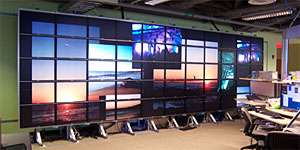
Engineers at the University of California, San Diego have constructed the highest-resolution computer display in the world – with a screen resolution up to 220 million pixels.
The system located at the UCSD division of the California Institute for Telecommunications and Information Technology (Calit2) is also linked via optical fiber to Calit2’s building at UC Irvine, which boasts the previous record holder. The combination – known as the Highly Interactive Parallelized Display Space (HIPerSpace) – can deliver real-time rendered graphics simultaneously across 420 million pixels to audiences in Irvine and San Diego.
“We don’t intend to stop there,” said Falko Kuester, Calit2 professor for visualization and virtual reality and associate professor of structural engineering in UCSD’s Jacobs School of Engineering. “HIPerSpace provides a unique environment for visual analytics and cyberinfrastructure research and we are now seeking funding to double the size of the system at UC San Diego alone to reach half a billion pixels with a one gigapixel distributed display in sight.”
Kuester is the chief architect of the systems deployed in both Calit2 buildings. Until last week, UC Irvine’s Highly Interactive Parallelized Display Wall (HIPerWall) – built in 2005 with funding from the National Science Foundation (NSF) – held the record of 200 million pixels for a tiled display system. It is located in the Calit2 Center of Graphics, Visualization and Imaging Technology (GRAVITY), which Kuester directs. When Kuester’s group moved to UCSD in 2006 they began work on the next generation of massively tiled display walls, which now serve as a prototype for ultra-high resolution OptIPortal tiled displays developed by the NSF-funded OptIPuter project (led by Calit2 director Larry Smarr).
The new HIPerSpace system between Irvine and San Diego is joined together via high-performance, dedicated optical networking that clocks in at up to two gigabits per second (2Gbps). The systems use the same type of graphics rendering technology, from industry partner NVIDIA. The “graphics super cluster” being developed at UCSD consists of 80 NVIDIA Quadro FX 5600 graphics processing units (GPUs). “The graphics and computational performance of these cards is quite astounding,” said Kuester. “Putting the theoretical computational performance of the cluster at almost 40 teraflops. To put that into context, the top-rated supercomputer in the world five years ago was operating at that same speed. While these are purely theoretical numbers, the comparison clearly hints at capabilities of this new cluster that go far beyond generating impressive visual information.”
The processing power will come in handy for the kinds of large-scale applications that are likely to make use of the HIPerSpace system. Calit2 will make the displays available to teams of scientists or engineers dealing with very large data sets, from multiple gigabytes to terabytes, notably in the Earth sciences, climate prediction, biomedical engineering, genomics, and brain imaging. “The higher-resolution displays allow researchers to take in both the broad view of the data and the minutest details, all at the same time,” said Kuester. “HIPerSpace also allows us to experiment on the two campuses with distributed teams that can collaborate and share insights derived from a better understanding of complex results. This capability will allow researchers at two UC campuses to collaborate more intensively with each other, and eventually with other campuses, thanks to the rapid rollout of OptIPortals outside of California.”
In San Diego, the OptIPortal is deployed on the second floor of Atkinson Hall, next to the offices of the NEES Cyberinfrastructure Center (NEESit), which supports the NSF-funded George E. Brown, Jr. Network for Earthquake Engineering Simulation (NEES) and its 15 sites around the country. “Structural engineering simulations require a massive amount of data processing and visualization, especially if you need to crunch data coming in from all of the NEES participating sites,” said Kuester. “We are also using the system for a large-scale, global seismicity visualization using data collected over the past thirty years.”
“I am excited that UC Irvine’s HIPerWall is now networked to its larger sibling,” said Stephen Jenks, professor of electrical engineering and computer science at UC Irvine and a participant in Calit2 at UCI. “With the high-speed OptIPuter network between the two Calit2 buildings, we will be able to virtually join the display walls at a distance of nearly 100 miles, so they can work together to show different parts of a huge data set or each can replicate parts of the other. We look forward to exploring remote collaboration technology and how the two systems can help researchers understand data better than ever before.”
UCSD’s HIPerSpace OptIPortal is similar to the HIPerWall because both are tiled display systems, but with different hardware. Irvine’s version is constructed with 50 Apple 30-inch Cinema Displays, powered by 25 Power Mac G5s running the Mac OS X operating system. UCSD’s Linux-based OptIPortal consists of 55 Dell displays driven by 18 Dell XPS personal computers. The system at UCSD uses the San Diego Supercomputer Center’s new 64-bit version of grid-computing middleware known as ROCKS released in early August and Calit2’s Cluster GL for heterogeneous systems (CGLX) framework, which is capable of supporting both systems concurrently.
"The usability of high-performance visualization clusters such as HiPerSpace is bound tightly to the accessibility of its resources, so cumbersome script configuration and specially-written software are no longer viable,” said Calit2 postdoctoral researcher Kai-Uwe Doerr. “The visualization software developed here at Cailt2 was designed to provide an efficient and transparent mechanism to grant access to available graphics resources and make the transition of a desktop application to a cluster seamless and uncomplicated – with minimal or no changes to the original code." Doerr and Kuester are part of a large team making HIPerSpace a reality.
Source: UCSD


