The nanoworld of corrosion
February 9, 2006 The nanoworld of corrosion

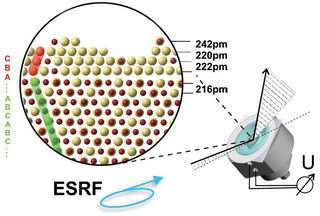
Structural model of the ultrathin passivation layer resulting from the fit to the X-ray diffraction data. Au atoms are represented by yellow spheres, and Cu atoms by red spheres. The ABC stacking of the substrate is inverted in the single crystalline overlayer. The two topmost layers are only partially occupied. A schematic view of the in situ X-ray diffraction cell is included.

The effect of corrosion has an impact on about 3% of the world's Gross Domestic Product. From a positive point of view, however, chemical attack of metal surfaces may result into surface nano-structures with very interesting technological applications such as catalysts and sensors. Therefore, a better understanding of corrosion processes is required to both prevent it and make the most of it.

Scientists from Germany and the European Synchrotron Radiation Facility (ESRF) have highlighted a self-organization process on the surface of a metal alloy, which is of crucial importance in determining the response to corrosion of this material. In fact, this study, providing a structural description with atomic-scale resolution thanks to the X-rays from the ESRF synchrotron, unvealed the chemical composition and structure of a protective surface layer which hinders further corrosion. The authors publish their results in Nature this week.
The nanoworld of corrosion

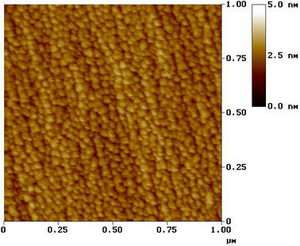
Ex situ atomic force microscope image (1 µm x1 µm) after applying a potential of 450 mV versus Ag/AgCl; in this potential regime the formation of 2–3 nm-thick pure Au islands was observed in the X-ray diffraction experiments, which is a typical corrugation of the surface.

Researchers from Max Planck Institute, the University of Ulm (Germany), and the ESRF used the European synchrotron light source to reproduce in situ the onset of the corrosive process in a gold-copper alloy. Gold is a very noble metal, which doesn't corrode, whilst copper is less noble and, thus, more prone to chemical attack. At the first moments of corrosion, the copper-gold alloy develops a mechanism to protect itself with an extremely thin gold-rich layer.

This layer has an unexpected crystalline and well-ordered structure. When the corrosion process proceeds, this alloy layer transforms into gold nano-islands of 20 to 1.5 nanometres. These islands eventually develop into a porous gold metal layer, which may have technological applications: "Understanding and controlling the formation of the first layer and the nano-islands may help to produce nano-materials with specific properties", explains Jorg Zegenhagen, one of the authors of the paper.

In order to carry out these experiments, researchers placed the samples in an electrochemical cell filled with sulphuric acid, in which voltage can be applied, and monitored the early corrosion process. "We found a vast amount of detail on structural evolution and chemical information by combining detailed 3D analysis of the structure with additional anomalous scattering experiments before more severe corrosion happened", explains Frank Renner, first author of the paper.

These new insights can be applied to a variety of different alloys used in corrosive environments and to materials that can exploit such degradation to form porous metals of technological interest. Although understanding the process of corrosion in gold-copper alloy has only become possible now, the process itself is many centuries old. Ancient Incas metal-smiths stretched their supplies of precious gold by mixing it with copper, and then surrounding the alloy with salty substances. This created an acidic environment that dissolved the copper from the top layer, leaving a gold-rich surface ready for polishing.

Source: European Synchrotron Radiation Facility


print this article email this article download pdf blog this article bookmark this article     Stumble it Digg this share on Facebook retweet share on Reddit add to delicious
Rate this story - 3.9 /5 (10 votes)


February 9, 2006 all stories

Comments: 0

3.9 /5 (10 votes)
  • Stumble this up

  • Digg this

  • share this

  • hide
  • Related Stories

  • Scientists replace chrome coatings with safer metal alloys
    created May 20, 2009 | popularity not rated yet | comments 0
  • Scientists develop life-saving chrome
    created Sep 21, 2005 | popularity not rated yet | comments 0
  • Battery Research Aims To Store Renewable Energy
    created Nov 19, 2009 | popularity not rated yet | comments 0
  • INL, ISU team on nanoparticle production breakthrough
    created Oct 19, 2009 | popularity not rated yet | comments 0
  • Weathering System Cuts Product Testing Time
    created Sep 28, 2009 | popularity not rated yet | comments 0


Other News

Nanoparticles used in common household items caused genetic damage in mice

Nanotechnology / Bio & Medicine

created Nov 16, 2009 | popularity 4.7 / 5 (23) | comments 11

Titanium dioxide (TiO2) nanoparticles, found in everything from cosmetics to sunscreen to paint to vitamins, caused systemic genetic damage in mice, according to a comprehensive study conducted by researchers at UCLA's Jonsson ...


Using superconducting probes to get a picture of what it's like inside CNTs

Nanotechnology / Nanophysics

created Nov 20, 2009 | popularity 4.9 / 5 (8) | comments 0

(PhysOrg.com) -- "Carbon nanotubes are exciting for fundamental physics, and for potential technological applications," Nadya Mason tells PhysOrg.com. "However, we are generally limited in the way that we can study them. ...


Nanotube defects equal better energy and storage systems

Nanotube defects equal better energy and storage systems

Nanotechnology / Nanomaterials

created Nov 19, 2009 | popularity 4.4 / 5 (10) | comments 2

(PhysOrg.com) -- Most people would like to be able to charge their cell phones and other personal electronics quickly and not too often. A recent discovery made by UC San Diego engineers could lead to carbon ...


New study confirms exotic electric properties of graphene

New study confirms exotic electric properties of graphene

Nanotechnology / Nanomaterials

created Nov 17, 2009 | popularity 4.8 / 5 (23) | comments 1

(PhysOrg.com) -- First, it was the soccer-ball-shaped molecules dubbed buckyballs. Then it was the cylindrically shaped nanotubes. Now, the hottest new material in physics and nanotechnology is graphene: ...


When It Comes to Drug Delivery, Size Matters

Nanotechnology / Bio & Medicine

created Nov 20, 2009 | popularity 5 / 5 (1) | comments 0

(PhysOrg.com) -- One of the great promises of nanotechnologies lies in its ability to create drug-containing nanoparticles decorated with targeting molecules that recognize and bind to cancer cells, providing drug delivery ...