Single-incision belly-button surgery to remove kidney performed first at UT Southwestern
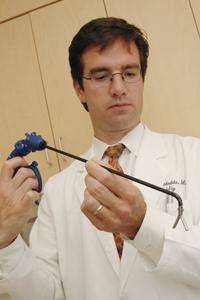
Surgeons specializing in laparoscopic procedures at UT Southwestern Medical Center have successfully removed a patient’s kidney by performing a unique nephrectomy entirely through the belly button.
Dr. Jeffrey Cadeddu, associate professor of urology and radiology, performed the “single keyhole access” surgery, the first of its kind involving a kidney. The entire procedure was completed with only one incision and will leave the patient with a barely noticeable scar tucked in the umbilicus, or navel.
“We are proud of this novel surgical technique,” said Dr. Cadeddu, who leads the Clinical Center for Minimally Invasive Treatment of Urologic Cancer. “Laparoscopic surgery already gives patients smaller incisions, less pain and a faster recovery. This transumbilical technique is a further extension of laparoscopic surgery, which essentially removes scarring from the patient’s skin.”
Dr. Claus Roehrborn, chairman of urology at UT Southwestern, said, “Single-access surgery is the next major advance in making surgery even less invasive. For Dr. Cadeddu to be the first to perform such a surgery and remove the intact organ in this manner is a testament to the tremendous advances in clinical medicine that are being made at UT Southwestern and in our department.” Dr. Roehrborn is director of the Sarah M. and Charles E. Seay Center for Pediatric Urology.
Dr. Cadeddu performed the surgery with a newly developed set of high-dexterity instrumentation known as RealHand, manufactured by Novare Surgical Systems. The instruments enable surgeons to perform more difficult maneuvers that otherwise could not be completed. The high-dexterity instruments make it easy to manipulate and complete tasks regardless of whether the appliance is positioned over, under or around internal organs.
Using the high-dexterity instrumentation, Dr. Cadeddu, who does not receive support from Novare, was able to place all of the standard laparoscopic entry points at the umbilicus.
“The umbilicus is a circle. We put three holes next to each other – one at 12 o’clock, one at three o’clock, and one at six o’clock. I then connected the three of them together to make the hole large enough to take the kidney out,” Dr. Cadeddu said.
Most people have two kidneys, one on each side of the spine just above the waist. Each kidney is about the size of a small adult fist.
Tumors and a rare kidney cancer, called transitional cell cancer, are the primary reasons for kidney removal. Historically, kidneys have been removed through an 8- to 10-inch incision from the middle of the abdomen to the back.
Dr. Cadeddu said he believes the success of this new laparoscopic procedure and others like it are imperative as more physicians explore their options concerning natural orifice surgery.
“We can now perform procedures using only one opening in the body, which can be hidden in a cosmetically advantageous or less painful location,” Dr. Cadeddu said. “Our efforts to minimize invasive surgery led us to reduce the incision to a single hole.”
Source: UT Southwestern Medical Center


