HAWK-I takes off
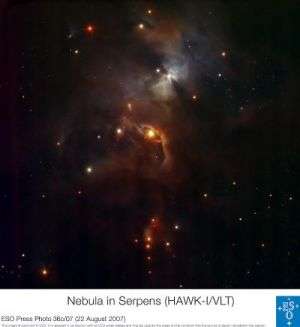
Europe's flagship ground-based astronomical facility, the ESO VLT, has been equipped with a new 'eye' to study the Universe. Working in the near-infrared, the new instrument - dubbed HAWK-I - covers about 1/10th the area of the Full Moon in a single exposure. It is uniquely suited to the discovery and study of faint objects, such as distant galaxies or small stars and planets.
After three years of hard work, HAWK-I (High Acuity, Wide field K-band Imaging) saw First Light on Yepun, Unit Telescope number 4 of ESO's VLT, on the night of 31 July to 1 August 2007. The first images obtained impressively demonstrate its potential.
"HAWK-I is a credit to the instrument team at ESO who designed, built and commissioned it," said Catherine Cesarsky, ESO's Director General. "No doubt, HAWK-I will allow rapid progress in very diverse areas of modern astronomy by filling a niche of wide-field, well-sampled near-infrared imagers on 8-m class telescopes."
"It's wonderful; the instrument's performance has been terrific," declared Jeff Pirard, the HAWK-I Project Manager. "We could not have hoped for a better start, and look forward to scientifically exciting and beautiful images in the years to come."
During this first commissioning period all instrument functions were checked, confirming that the instrument performance is at the level expected. Different astronomical objects were observed to test different characteristics of the instrument. For example, during one period of good atmospheric stability, images were taken towards the central bulge of our Galaxy. Many thousands of stars were visible over the field and allowed the astronomers to obtain stellar images only 3.4 pixels (0.34 arcsecond) wide, uniformly over the whole field of view, confirming the excellent optical quality of HAWK-I.
HAWK-I takes images in the 0.9 to 2.5 micron domain over a large field-of-view of 7.5 x 7.5 arcminutes. This is nine times larger than that of ISAAC, another near-infrared imager on the VLT that went into operation in late 1998. ISAAC has shown how deep near-infrared images can contribute uniquely to the discovery and study of large, distant galaxies, and to the study of discs around stars or even very low mass objects, down to a few Jupiter masses.
HAWK-I will build on this experience by being able to study much larger areas with an excellent image quality. HAWK-I has four 2k x 2k array detectors, i.e. a total of 16 million 0.1 arcsecond pixels.
"Until the availability of the James Webb Space Telescope in the next decade, it is clear that 8-m class telescopes will provide the best sensitivity achievable in the near-infrared below 3 microns," explained Mark Casali, the ESO scientist responsible for the instrument.
Given the wide field, fine sampling and the high sensitivity of HAWK-I, the deepest scientific impact is expected in the areas of faint sources. "With its special filter set, HAWK-I will allow us to peer into the most distant Universe," said Markus Kissler-Patig, the Instrument Scientist. "In particular, with HAWK-I, we will scrutinise the very first objects that formed in the Universe."
HAWK-I will also be very well suited for the search for the most massive stars and for the least massive objects in our Galaxy, such as hot Jupiters. But HAWK-I will also be a perfect instrument for the study of outer Solar System bodies, such as distant, icy asteroids and comets.
HAWK-I is the eleventh instrument to be installed at ESO's VLT. It bridges the gap between the first and the second generation instruments to be installed on this unique facility.
Source: ESO


