The car that diagnoses its own servicing needs
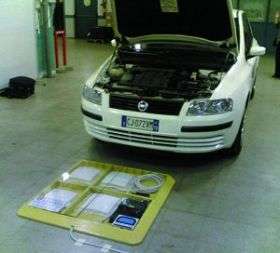
An intelligent system that could before long enable cars to tell mechanics which of their parts need servicing has been unveiled by engineers at the University of Cambridge.
The specially-adapted Fiat prototype, which was presented at a European technology show, can tell garage staff about the state of its components in seconds by using electronic tags inside its engine.
The system has been designed by academics at the Institute for Manufacturing, part of the Department of Engineering. In conjunction with sophisticated software, it could be used to speed up servicing, and identify which parts can be recycled or reused when the vehicle reaches the end of its life. Combining such information from many vehicles would pinpoint which parts of a car need redesigning.
In those rare cases that a faulty batch of cars are actually sent to showrooms, the technique could instantly single out which models need to be recalled before they hit the road.
Radio-Frequency Identification (RFID) tags, each with its own unique identification number, are attached to the car’s engine parts. The vehicle is then driven at low speed over a one-metre square servicing pad, which is fitted with an Ultra-High Frequency reader and four antennae.
As the car passes over the pad, the readers transmit the ID number from the electronic tags to a computer. By cross-referring this information with a computerised database – for example one showing the parts’ date and manufacturer – mechanics would be able to identify those parts that needed to be checked for wear at the click of a mouse.
Professor Duncan McFarlane, from the University of Cambridge’s Institute of Manufacturing, said; “Ultimately motorists could be driving into a garage over the same sort of sensor, which would instantly tell both the driver and the garage staff which parts needed replacing and which might be good for several thousand miles more.
“But there are potentially great benefits beyond this as well. When the car is sent to be scrapped, for example, RFID tagging could be used to identify which parts still have a useful life left in them. The system will tell the car producer whether separate parts can be reused, recycled, or need to be disposed of in landfill. It will also highlight which parts need improving for a longer life.”
This demonstrator forms part of a EU funded project called ‘Product Lifecycle Management and Information Tracking Using Smart Embedded Systems’, conveniently abbreviated to PROMISE. The system has already been demonstrated at Fiat’s research centre in Turin.
“The PROMISE system has much wider potential as well,” Professor McFarlane added. “It allows us to trace and update information about any product, after its delivery to the customer and up to the end of its useful life. In time it could be possible to tag all sorts of products, components, and even airport baggage and boarding passes.”
Source: University of Cambridge


