Astronomers get first look at Uranus's rings as they swing edge-on to Earth
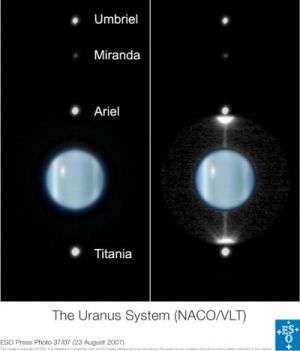
As the rings of Uranus swing edge-on to Earth - a short-lived view we get only once every 42 years - astronomers observing the event are getting an unprecedented, glare-free view of the rings and the fine dust that permeates them.
The rings were discovered in 1977, so this is the first opportunity astronomers have had to observe a Uranus ring crossing and perhaps to discover a new moon or two.
While the Keck II telescope and the Hubble Space Telescope have been looking at the planet for years in anticipation of this event, ground-based telescopes in Chile and southern California have targeted the planet during the actual ring crossing.
Based on the Keck observations, a team of astronomers led by Imke de Pater of University of California, Berkeley, reports today (Thursday, Aug. 23) in Science Express, the online edition of Science magazine, that the rings of micron-sized dust have changed significantly since the Voyager 2 spacecraft photographed the Uranus system 21 years ago. She will discuss the results during a talk today at the European Planetary Science Congress 2007 meeting in Potsdam, Germany.
The inner rings are much more prominent than expected, revealing material in otherwise empty regions of the system of rings.
"People tend to think of the rings as unchanging, but our observations show that not to be the case," said de Pater, a UC Berkeley professor of astronomy. "There are a lot of forces acting on small dust grains, so it is not that crazy to find that the arrangement of rings has changed."
Using the near infrared camera (NIRC2) and adaptive optics on the Keck II telescope on May 28, the team took striking images of the nearly edge-on ring appearing as a bright line bisecting a dim Uranus, which appears dark in the infrared. The observations were conducted during an engineering run by Marcos van Dam, adaptive optics scientist at the W. M. Keck Observatory, after the installation of a new wavefront sensor.
"The improvements to the adaptive optics systems allowed us to capture unbelievably crisp images of Uranus; it was as if the Keck telescope was orbiting in space," said van Dam.
On Aug. 14, the Hubble Space Telescope also imaged the planet very near the moment when the rings were perfectly aligned with Earth, showing similar features but also including some recently-discovered outer rings. The image was released today by the Space Telescope Science Institute.
"The outermost ring is not visible in our infrared images," said de Pater's co-author, Heidi B. Hammel of the Space Science Institute in Boulder, Colo. "This ring is very blue, and therefore harder to see in the infrared. We may detect it when the rings are fully edge-on and when we can observe it for several hours."
With further analysis of the Hubble data, astronomer Mark Showalter of the SETI Institute hopes to detect some of the small moons, and perhaps some not seen before, that shepherd the debris into distinct rings.
"Two little satellites called Cordelia and Ophelia straddle the brightest ring, the epsilon ring, and keep it in place, but people have always assumed there must be a bunch more of these satellites that are confining the nine other narrow rings," Showalter said. "This is the unique viewing geometry that only comes along once in 42 years, when we have a chance of imaging these tiny satellites, because normally they are lost in the glare of the rings. Now, the rings are essentially invisible."
Astronomers at the Very Large Telescope (VLT) in Chile, run by the European Southern Observatory (ESO), and at the Palomar Observatory in southern California operated by the California Institute of Technology, also observed Uranus during the current crossing.
"The VLT took data at the precise moment when the rings were edge-on to Earth," said de Pater, who worked with two team members observing in Chile: Daphne Stam of the Technical University of Delft in the Netherlands and Markus Hartung of ESO. Meanwhile, astronomers Philip Nicholson of Cornell University in New York and Keith Matthews of Caltech observed from atop Mt. Palomar.
Until Voyager flew by in January 1986, the rings were only known from the way they temporarily blocked the light of stars passing behind Uranus. Earth-based images have been too blurry until recently, with the advent of Keck adaptive optics and the Advanced Camera for Surveys of the Hubble telescope. Nevertheless, when the sunlit side of Uranus's rings are in full view of Earth, the densely-packed rings reflect so much light that their glare completely dominates the fainter glow from micron-sized dust.
Earth's orbit around the sun permits three opportunities to view the rings edge-on: Uranus made its first ring crossing as seen from Earth on May 3, it made its second crossing on Aug. 16, and will cross for the third and last time on Feb 20, 2008. Though the last ring crossing relative to Earth will be hidden behind the sun, most of Earth's premier telescopes, including Keck, Hubble, VLT and Palomar, plan to focus on the planet again in the days following Dec. 7.
"December 7 is the Uranian equinox, when the rings are perfectly edge-on to the sun, and after that, there is a brief period again when we will view the dark side of the rings, before they become illuminated again for another 42 years," Hammel said.
The advantage of observations at a ring-plane crossing is that it becomes possible to look at the rings from the shadowed side. From that vantage, the normally-bright outer rings grow fainter because their centimeter- to meter-sized rocks obscure one another, while the dim inner rings get brighter as their material merges into a thin band along the line of sight.
The dust belts that Voyager saw differ radically from today's dust distribution, according to coauthors de Pater and Showalter. Most interesting is a broad, inner ring called zeta, whose position today is several thousand kilometers farther from the planet than when it was discovered by Voyager.
"The ring may have moved, or it may be an entirely new ring," noted Showalter.
Similar, dramatic changes in dust distribution have also been observed recently in Saturn's and Neptune's rings. This is not surprising, because gravity keeps the larger ring particles in orbit, but other smaller forces can nudge the tiny dust grains around, de Pater said. These forces include pressure from sunlight, drag produced as the dust plows through ionized plasma around Uranus, and even drag from the planet's magnetic field.
"Impacts into the larger bodies in the system also could knock dust off and create new rings," de Pater said.
"With further observations, the time scales over which these variations occur should provide new insight into the physical processes at work," the authors concluded.
Source: University of California - Berkeley


