Astronomers find gaping hole in the Universe
August 23rd, 2007 Astronomers find gaping hole in the Universe

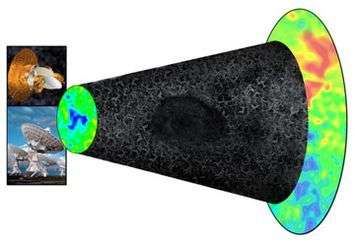
llustration of the effect of intervening matter in the cosmos on the cosmic microwave background (CMB). On the right, the CMB is released shortly after the Big Bang, with tiny ripples in temperature due to fluctuations in the early Universe. As this radiation traverses the Universe, filled with a web of galaxies, clusters, superclusters and voids, it experiences slight perturbations. In the direction of the giant newly-discovered void, the WMAP satellite (top left) sees a cold spot, while the VLA (bottom left) sees fewer radio galaxies. (Credit: Bill Saxton, NRAO/AUI/NSF, NASA)

University of Minnesota astronomers have found an enormous hole in the Universe, nearly a billion light-years across, empty of both normal matter such as stars, galaxies and gas, as well as the mysterious, unseen “dark matter.” While earlier studies have shown holes, or voids, in the large-scale structure of the Universe, this new discovery dwarfs them all.

“Not only has no one ever found a void this big, but we never even expected to find one this size,” said Lawrence Rudnick of the University of Minnesota astronomy professor. Rudnick, along with grad student Shea Brown and associate professor Liliya Williams, also of the University of Minnesota, reported their findings in a paper accepted for publication in the Astrophysical Journal.

Astronomers have known for years that, on large scales, the Universe has voids largely empty of matter. However, most of these voids are much smaller than the one found by Rudnick and his colleagues. In addition, the number of discovered voids decreases as the size increases.

“What we’ve found is not normal, based on either observational studies or on computer simulations of the large-scale evolution of the Universe,” Williams said.

The astronomers drew their conclusion by studying data from the NRAO VLA Sky Survey (NVSS), a project that imaged the entire sky visible to the Very Large Array (VLA) radio telescope, part of the National Science Foundation's National Radio Astronomy Observatory (NRAO). Their study of the NVSS data showed a remarkable drop in the number of galaxies in a region of sky in the constellation Eridanus, southwest of Orion.

“We already knew there was something different about this spot in the sky,” Rudnick said. The region had been dubbed the “WMAP Cold Spot,” because it stood out in a map of the Cosmic Microwave Background (CMB) radiation made by the Wilkinson Microwave Anisotopy Probe (WMAP) satellite, launched by NASA in 2001. The CMB, faint radio waves that are the remnant radiation from the Big Bang, is the earliest “baby picture” available of the Universe. Irregularities in the CMB show structures that existed only a few hundred thousand years after the Big Bang.

The WMAP satellite measured temperature differences in the CMB that are only millionths of a degree. The cold region in Eridanus was discovered in 2004.

Astronomers wondered if the cold spot was intrinsic to the CMB, and thus indicated some structure in the very early Universe, or whether it could be caused by something more nearby through which the CMB had to pass on its way to Earth. Finding the dearth of galaxies in that region by studying NVSS data resolved that question.

“Although our surprising results need independent confirmation, the slightly lower temperature of the CMB in this region appears to be caused by a huge hole devoid of nearly all matter roughly 6-10 billion light-years from Earth,” Rudnick said.

How does a lack of matter cause a lower temperature in the Big Bang’s remnant radiation as seen from Earth"

The answer lies in dark energy, which became a dominant force in the Universe very recently, when the Universe was already three-quarters of the size it is today. Dark energy works opposite gravity and is speeding up the expansion of the Universe. Thanks to dark energy, CMB photons that pass through a large void just before arriving at Earth have less energy than those that pass through an area with a normal distribution of matter in the last leg of their journey.

In a simple expansion of the universe, without dark energy, photons approaching a large mass -- such as a supercluster of galaxies -- pick up energy from its gravity. As they pull away, the gravity saps their energy, and they wind up with the same energy as when they started.

But photons passing through matter-rich space when dark energy became dominant don't fall back to their original energy level. Dark energy counteracts the influence of gravity and so the large masses don’t sap as much energy from the photons as they pull away. Thus, these photons arrive at Earth with a slightly higher energy, or temperature, than they would in a dark energy-free Universe.

Conversely, photons passing through a large void experience a loss of energy. The acceleration of the Universe's expansion, and thus dark energy, were discovered less than a decade ago. The physical properties of dark energy are unknown, though it is by far the most abundant form of energy in the Universe today. Learning its nature is one of the most fundamental current problems in astrophysics.

Source: University of Minnesota


print this article email this article download pdf blog this article bookmark this article     Digg this Stumble it share on Facebook share on Reddit add to delicious save to Yahoo! bookmarks
4.5/5 after 243 votes

Rank Filter

Move the slider to adjust rank threshold, so that you can hide some of the comments.


Display comments: newest first


August 23rd, 2007 all stories
Space & Earth / Astronomy

Comments: 3
Rank: 4.5/5 after 243 votes

  • Stumble this up

  • Digg this

  • Share it:
  • share on Facebook
  • share on MySpace
  • share on Slashdot
  • rss-newsfeed
  • share on Google
  • share on Reddit
  • add to delicious
  • save to Yahoo! bookmarks
  • share on Windows Live
  • Add to Mixx!
Rating: 4.5/5 after 243 votes

  • Related Stories

  • Queen's astronomers propose new supernova interpretation
    created Jun 09, 2009 | popularity not rated yet | comments 0
  • Radio telescopes extend astronomy's best 'yardstick'
    created Jun 08, 2009 | popularity not rated yet | comments 0
  • Keck Study Sheds New Light on "Dark" Gamma-ray Bursts
    created Jun 08, 2009 | popularity not rated yet | comments 0
  • Celebrating gravity’s light-bending landmark
    created May 29, 2009 | popularity not rated yet | comments 0
  • Better Supernovae Measurements Aim To Improve Understanding of Dark Energy
    created May 22, 2009 | popularity not rated yet | comments 0

Tags


  • Physicists Demonstrate Quantum Memory with Matter Qubits
    Physicists Demonstrate Quantum Memory with Matter Qubits
    Physics / General Physics
    created 16 hours ago | popularity 4.8 / 5 (8) | comments 1
  • 'Holey' Nanosheets for Wastewater Dye Removal
    Nanotechnology / Nanomaterials
    created Jul 01, 2009 | popularity 5 / 5 (5) | comments 1
  • Jellyfish Robot Swims Like its Biological Counterpart
    Jellyfish Robot Swims Like its Biological Counterpart
    Electronics / Robotics
    created Jun 26, 2009 | popularity 4.4 / 5 (7) | comments 1
  • Could Maxwell's Demon Exist in Nanoscale Systems?
    Could Maxwell's Demon Exist in Nanoscale Systems?
    Physics / General Physics
    created Jun 24, 2009 | popularity 4.4 / 5 (18) | comments 29
  • Living Safely with Robots, Beyond Asimov's Laws
    Living Safely with Robots, Beyond Asimov's Laws
    Electronics / Robotics
    created Jun 22, 2009 | popularity 4.6 / 5 (50) | comments 39
  • Other News

    Global warming tactic cools climate but won’t help corals, say researchers

    Space & Earth / Earth Sciences

    created 13 hours ago | popularity 3 / 5 (2) | comments 5

    (PhysOrg.com) -- “Geoengineering” experiments proposed to reduce global warming by blocking sunlight with atmosphere-injected particles may cool the world but still leave carbon dioxide levels dangerously high, Stanford scientists ...


    Coolest spacecraft ever in orbit around L2

    Coolest spacecraft ever in orbit around L2

    Space & Earth / Space Exploration

    created 15 hours ago | popularity 4.8 / 5 (4) | comments 3

    (PhysOrg.com) -- Last night, the detectors of Planck's High Frequency Instrument reached their amazingly low operational temperature of -273°C, making them the coldest known objects in space. The spacecraft ...


    Senator may have won fight over private rocket manufacturing

    Space & Earth / Space Exploration

    created 16 hours ago | popularity 4.5 / 5 (2) | comments 2

    For months, a powerful Republican senator from Alabama has fought the Obama administration to block $150 million that the White House wanted to spend to help private companies build rockets capable of reaching the international ...


    The least sea ice in 800 years

    The least sea ice in 800 years

    Space & Earth / Earth Sciences

    created Jul 01, 2009 | popularity 4.4 / 5 (56) | comments 42

    New research, which reconstructs the extent of ice in the sea between Greenland and Svalbard from the 13th century to the present indicates that there has never been so little sea ice as there is now. The ...


    Gas around young galaxy

    Intense heat killed the Universe's would-be galaxies, researchers say

    Space & Earth / Astronomy

    created Jul 01, 2009 | popularity 3.2 / 5 (17) | comments 23

    (PhysOrg.com) -- Our Milky Way galaxy only survived because it was already immersed in a large clump of dark matter which trapped gases inside it, scientists led by Durham University's Institute for Computational ...