Los Angeles enjoying 1,000 year seismic lull
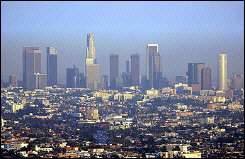
The Los Angeles basin appears to be in a seismic “lull” characterized by relatively smaller and infrequent earthquakes, according to a study in the September issue of Geology.
By contrast, the Mojave Desert is in a seismically active period. Seismic activity alternates between the two regions, the study suggests.
The lull in the Los Angeles basin began 1,000 years ago, said the authors, led by James Dolan, associate professor of earth sciences at the University of Southern California.
“The past 1,000 years has been relatively quiet,” Dolan said, referring to what he calls the “urban fault network” under the Los Angeles metropolitan area.
The claim will come as news to anyone who has lived through a big quake in Southern California.
But Dolan said that even the Northridge earthquake of 1994, the costliest natural disaster in U.S. history at the time, was “a drop in the bucket” compared to the massive jolts that would strike the basin during a period of high seismic activity.
The study comes with some caveats. Among them:
-- The urban fault network does not include the more distant San Andreas fault. Though the San Andreas is storing energy at a slower than average rate, a major quake along the fault is always possible. About 10 San Andreas “big ones” have occurred during the current lull on the urban fault network.
-- The authors developed their theory from the discovery of several “clusters” of intense seismic activity in the geological record. It is not yet known if the clusters are statistically significant.
The authors studied the geological record going back 12,000 years. During that period, they found several clusters of seismic “bursts,” with the most recent lasting 4,000 years and ending about 1,000 years ago.
The seismic clusters were separated by periods of relative calm lasting about 1,500 to 2,000 years.
Remarkably, the lulls in the Los Angeles region corresponded with seismic clusters in the Mojave Desert, as described in 2000 by Thomas Rockwell of San Diego State University and his colleagues.
“When we’re having earthquakes in L.A., generally we don’t have as many earthquakes in the Mojave,” and vice versa, Dolan said.
The study in Geology proposes a mechanism by which periods of high seismic activity alternate between the urban fault network and the Mojave Desert.
The two main cogs in the mechanism are the section of the San Andreas fault north of Los Angeles and the desert fault system known as the eastern California shear zone.
Rapid motion along one fault causes slower motion along the other, the authors suggest. During relatively rare periods when the San Andreas fault is moving slowly, the strain in the urban fault network drops accordingly, leading to a seismic lull in Los Angeles and to more seismic activity in the desert.
“The San Andreas is always dominant. It’s always the big brother,” Dolan said. “But at times the eastern California shear zone takes up its share of the load.”
During the current lull in Los Angeles, major earthquakes in the eastern California shear zone have included the magnitude 7.1 Hector Mine of 1999, the 7.3 Landers of 1992 and the 7.6 Owens Valley of 1872.
Each packed four to 20 times the energy of the Northridge quake.
While all three quakes occurred in sparsely populated areas, Palm Springs and other desert communities lie close to the eastern California shear zone and could be vulnerable.
“These are very large earthquakes,” Dolan said.
If the authors’ theory is confirmed, detecting the start and end of a lull will become extremely important. Predicting the end of the current lull is impossible at present, Dolan said.
“We do know that the Mojave part of the eastern California shear zone is still storing energy much more rapidly than usual (by a factor of about two), so I would tend to doubt that the recent 1994 (magnitude) 6.7 Northridge and 1971 (magnitude) 6.7 San Fernando earthquakes indicate that we are coming out of’ the current lull,” he said.
Dolan studies fault systems in Southern California and in Turkey, whose simpler fault geography helps Dolan to understand the “extremely complicated place” that he calls home.
In a study published in Science in 2003, he estimated the size and frequency of past earthquakes on the Puente Hills fault, one of the Los Angeles-area faults currently in a lull.
The study found that all four major earthquakes on the Puente Hills fault in the past 11,000 years exceeded magnitude 7.0.
“We’re stuck with living here, so we have to understand what we can about this system,” Dolan said.
Source: University of Southern California


