Scientists train nano-'building blocks' to take on new shapes
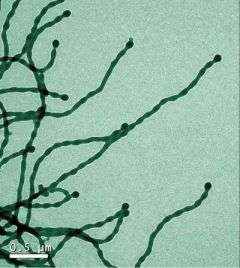
Researchers from the University of Delaware and Washington University in St. Louis have figured out how to train synthetic polymer molecules to behave--to literally “self-assemble” --and form into long, multicompartment cylinders 1,000 times thinner than a human hair, with potential uses in radiology, signal communication and the delivery of therapeutic drugs in the human body.
The discovery, a fundamental new tool for nanotechnology, is reported in the Aug. 3 issue of the prestigious journal Science.
Darrin Pochan, associate professor of materials science and engineering at the University of Delaware, and Karen Wooley, the James S. McDonnell Distinguished Professor of Arts & Sciences at Washington University in St. Louis, led the research effort, which also involved co-authors Honggang Cui, a recent doctoral graduate, and doctoral student Sheng Zhong at UD, and Zhiyun Chen, a doctoral advisee of Wooley's. The research was supported by a Nanoscale Interdisciplinary Research Team (NIRT) grant from the National Science Foundation.
The focus of the research was block copolymers, which are synthetic molecules that contain two or more chemically different segments bonded together. Block copolymers are used to make a variety of materials such as plastics, rubber soles for shoes, and more recently, portable memory sticks (“flash drives”) for computers.
“A block copolymer is a long-chain molecule, a length of which, or block, that is chemically different than the other,” Pochan said. “In our case, we took one block that loves water, and another part that does not. So when you put them in solution, the water-hating blocks try to get away from the water, and that's how you get different shapes, called micelles, to form.”
The system used by the scientists consisted of a tri-block copolymer composed of polyacrylic acid, polymethylacrylate, and polystyrene introduced into a solution of tetrahydrofuran and water, and organic diamines. The technique relied on divalent organic counter ions and solvent mixtures to drive the organization of the block copolymers down specific pathways into snake-like, one-dimensional structures.
Much of the research was conducted using the high-powered microscopes in the UD College of Engineering's W. M. Keck Electron Microscopy Facility, which is under the direction of Chaoying Ni. Technician Frank Kriss assisted the research team.
Wooley, who is an expert in polymer chemistry, and Pochan, who is a material scientist, met at research conferences, where they discussed their respective projects. She had been designing sphere-shaped micelles for use in drug delivery and radiology, but noticed under some solution conditions that her students could produce different shapes.
Although their labs are located some 900 miles apart, the scientists say their research has been a “great and synergistic collaboration.”
“In the world of self-assembly for nanotechnology, it's challenging to make something other than the shape of a ball,” Pochan noted. “If you put little balls full of a drug into the bloodstream, the body's organs and immune system will get rid of them in around a day. But if you place the molecules into long, floppy cylinders, they may stay in the body for weeks,” Pochan noted.
Changing the shape of the micelle could carry a drug in the human body for a long period of time, according to Pochan, potentially providing the sustained delivery of chemotherapy from a single injection.
“Moving from a sphere to a cylinder, you could conceivably deliver two or three or four different drugs in one injection, one to one part of the body and others to other parts of the body all through the same self-assembly,” he said.
Although the research is far from practical applications, the team's discovery has yielded a new, fundamental “bottom-up” technique for building nanostructures.
“It's all about constructing materials and nanostructures in an easy way,” Pochan said. “The goal is to design a molecule with all the rules--all the information it needs--to zip up into the desired shape and size that you want. Then you throw them in the water and see what you get--hopefully the desired, complex nanostructure.”
Ironically, Pochan thought he was done working with block copolymers when he was in graduate school years ago.
“I'm now building on stuff I did in grad school in the '90s on rubber and plastics,” he said. “However, if you look at block copolymers as a tool for self-assembly, there are many more potential applications than rubber for your boot or plastic coating for your floor,” he noted.
“We can use those same molecules, but train them to get something very useful as far as high technology goes,” he said. “It's funny how research comes back in style, and we find new uses for 'old tools.'”
Source: University of Delaware


