Aggressive bees may track future of flying robots
August 24, 2007 Bee

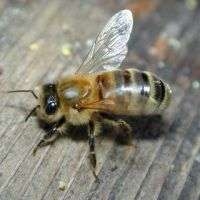
Angry bees that fly like mini-missiles could map the futures of unmanned aircraft and planetary explorer robots, thanks to new University of Queensland research backed by the Queensland Government.

Professor Mandyam Srinivasan, Professor of Visual Neuroscience at UQ's Queensland Brain Institute, will lead a $2.5 million project aiming to improve robot technology including unmanned aerial vehicles (UAVs), through better understanding of bee behaviour. Professor Srinivasan is winner of the $1.25 million 2007 Smart State Premier's Fellowship, which is matched by funding from UQ.

“Professor Srinivasan's unique marriage of biology and engineering will help to put Queensland on the map at a time where enhanced surveillance and security are key priorities for governments and leaders around the world,” Queensland Premier Peter Beattie said when announcing the award today.

Professor Srinivasan and his team have spent more than two decades unlocking the mysteries of bee vision and navigation, and are now investigating how bee emotions, particularly aggression, can improve robotics.

Research of aggressive bees is unprecedented, he said. Worker bees are generally docile – until a guard bee protecting the hive emits an alarm hormone to signal the hive is endangered.

“Normal bees are fairly peaceful when they go out hunting for food, but the moment they get a whiff of alarm pheromone from a guard bee the entire colony mobilizes.

“The flight dynamic changes and they become like little fighter aircraft or missiles,” Professor Srinivasan said.

Bees' small but smart brains and nervous systems have evolved a “visuomotor” system that enables them to track moving objects with pinpoint accuracy.

Professor Srinivasan's research has previously been funded by NASA and now has funding from the US Airforce, and its practical potential is diverse.

It could be used for aerial coastal surveillance, weather monitoring and minerals exploration. The technology also has potential to reduce the risk to soldiers involved in peace-keeping and combat situations, who might one day have portable UAVs to send on reconnaissance missions.

The research could also lead to planetary explorer robots that are able to behave autonomously, in the same way as insects. This would be much more effective than robots controlled remotely from Earth, given a long signal delay between Mars and Earth, Professor Srinivasan said.

Professor Srinivasan is the second UQ researcher to be awarded the Smart State Premier's Fellowship, which is now in its second year. Professor Ian Frazer, Director of UQ's Diamantina Institute for Cancer, Immunology and Metabolic Medicine, who co-invented the world's first vaccine for cervical cancer, became the first Fellow in 2006.

Source: UQ


print this article email this article download pdf blog this article bookmark this article     Stumble it Digg this share on Facebook retweet share on Reddit add to delicious
Rate this story - 3.6 /5 (5 votes)


August 24, 2007 all stories

Comments: 0

3.6 /5 (5 votes)
  • Stumble this up

  • Digg this

  • share this

  • hide
  • Related Stories

  • Insect world royalty shows they really count... up to four
    created Oct 28, 2008 | popularity not rated yet | comments 0
  • Sky's the limit for bee brain power
    created Mar 05, 2008 | popularity not rated yet | comments 0
  • Edge detection crucial to eyesight
    created Oct 07, 2009 | popularity not rated yet | comments 0
  • Glutamate identified as predictor of disease progression in multiple sclerosis
    created Apr 30, 2009 | popularity not rated yet | comments 0
  • Researchers create all seeing 'eye'
    created Jan 05, 2009 | popularity not rated yet | comments 0


  • hide
  • Relevant PhysicsForums posts

Other News

The skyline of Tokyo in Japan, where scientists have criticised the new government for plans to slash research budgets

Japan scientists attack govt research cut plans

Other Sciences / Other

created 6 hours ago | popularity 5 / 5 (1) | comments 0

Top Japanese scientists, including four Nobel laureates, have criticised the new government for plans to slash research budgets, warning the country will loose its high-tech edge.


Message gone viral? Blame it on altruistic, yet image-conscious Internet  'e-mavens'

Message gone viral? Blame it on altruistic, yet image-conscious Internet 'e-mavens'

Other Sciences / Economics

created 13 hours ago | popularity 3.5 / 5 (2) | comments 0

(PhysOrg.com) -- Why do some online ad campaigns go viral while other online marketing messages gather "cyber-dust" on the information superhighway? The key may lie in the motivation of Internet users to email ...


Researcher: Faint writing seen on Shroud of Turin (AP)

Researcher: Faint writing seen on Shroud of Turin (Update)

Other Sciences / Archaeology & Fossils

created Nov 20, 2009 | popularity 2.3 / 5 (31) | comments 44

(AP) -- A Vatican researcher has rekindled the age-old debate over the Shroud of Turin, saying that faint writing on the linen proves it was the burial cloth of Jesus. Experts say the historian may be reading ...


Explained: The Discrete Fourier Transform

Explained: The Discrete Fourier Transform

Other Sciences / Mathematics

created Nov 25, 2009 | popularity 4.3 / 5 (26) | comments 8

(PhysOrg.com) -- In 1811, Joseph Fourier, the 43-year-old prefect of the French district of Isčre, entered a competition in heat research sponsored by the French Academy of Sciences. The paper he submitted ...


Climate change could boost incidence of civil war in Africa

Other Sciences / Social Sciences

created Nov 23, 2009 | popularity 2.4 / 5 (16) | comments 9

Climate change could increase the likelihood of civil war in sub-Saharan Africa by over 50 percent within the next two decades, according to a new study led by a team of researchers at University of California, Berkeley, ...