Social parasites of the smaller kind
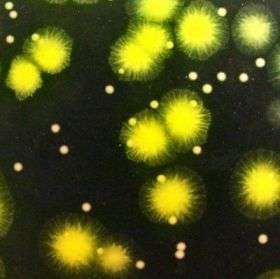
Cooperation is widespread in the natural world but so too are cheats – mutants that do not contribute to the collective good but simply reap the benefits of others’ cooperative efforts. In evolutionary terms, cheats should indeed prosper, so how cooperation persists despite the threat of cheat takeover is a fundamental question. Recently, biologists at the Universities of Edinburgh and Oxford have found that in bacteria, cheats actually orchestrate their own downfall.
In the study, reported in the September issue of The American Naturalist, the team explored the impact of cheats in populations of the notorious pathogen, Pseudomonas aeruginosa. These bacteria cooperate to scavenge iron from their environment, but mutant cheats do not contribute their fair share of scavenger molecules and instead simply steal the iron supplies of others.
“Cheats are kept in check by simple frequency dependence,” says Adin Ross-Gillespie, lead author of the study. “When rare, cheats prosper at the expense of cooperators, but as they become more common, the profitability of their strategy declines. At equilibrium, neither strategy has the upper hand, so the two coexist.”
But, the authors note, this pattern arises only under certain conditions. In this case, it arose because population productivity, too, was sensitive to the frequency of cheats. Cultures with few cheats grew rapidly and achieved larger absolute sizes in the time available, providing greater opportunity for cheats to exploit the situation. Meanwhile, cultures comprising high proportions of cheats grew poorly. “Too many cheats spoil the broth,” quips Ross-Gillespie.
Microbes cooperate extensively, and their social activities often have profound medical or economic importance. Studies such as this help us to better understand how cooperative traits evolve and persist. Who knows" Perhaps some day we will harness the power of cheats to direct the dynamics of bacterial populations.
Citation: Adin Ross-Gillespie, Andy Gardner, Stuart A. West, and Ashleigh S. Griffin, "Frequency dependence and cooperation: theory and a test with bacteria" The American Naturalist (2007) volume 170: 331–342. DOI: 10.1086/519860
Source: University of Chicago


