Volcanoes helped slow ocean warming trend, researchers find
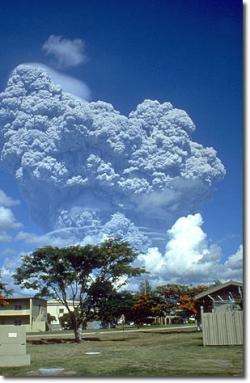
February 9, 2006 The June 12, 1991 eruption column from Mount Pinatubo, Philippines, as seen from Clark Air Base

The June 12, 1991 eruption column from Mount Pinatubo, Philippines, as seen from Clark Air Base. Credit: Richard P. Hoblitt/USGS

Ocean temperatures might have risen even higher during the last century if it weren't for volcanoes that spewed ashes and aerosols into the upper atmosphere, researchers have found. The eruptions also offset a large percentage of sea level rise caused by human activity.

Using 12 new state-of-the-art climate models, the researchers found that ocean warming and sea level rise in the 20th century were substantially reduced by the 1883 eruption of the Krakatoa volcano in Indonesia. Volcanic aerosols blocked sunlight and caused the ocean surface to cool.

“That cooling penetrated into deeper layers of the ocean, where it remained for decades after the event,” said Peter Gleckler, an atmospheric scientist at Lawrence Livermore National Laboratory (LLNL). “We found that volcanic effects on sea level can persist for many decades.”

Gleckler, along with LLNL colleagues Ben Santer, Karl Taylor and Krishna AchutaRao and collaborators from the National Center for Atmospheric Research, the University of Reading and the Hadley Centre, tested the effects of volcanic eruptions on recent climate models. They examined model simulations of the climate from 1880 to 2000, comparing them with available observations.

External “forcings,” such as changes in greenhouse gases, solar irradiance, sulphate and volcanic aerosols, were included in the models.

Oceans expand and contract depending on the ocean temperature. This causes sea level to increase when the water is warmer and to recede in cooler temperatures.

The volume average temperature of oceans (down to 300 meters) worldwide has warmed by roughly .037 degrees Celsius in recent decades due to increasing atmospheric greenhouse gases. While seemingly small, this corresponds to a sea level rise of several centimeters and does not include the effect of other factors such as melting glaciers. That sea level jump, however, would have been even greater if it weren't for volcanic eruptions over the last century, Gleckler said.

“The ocean warming suddenly drops,” he said. “Volcanoes have a big impact. The ocean warming and sea level would have risen much more if it weren't for volcanoes.”

Volcanic aerosols scatter sunlight and cause the ocean surface temperature to cool, an anomaly that is gradually subducted into deeper layers, where it remains for decades.

The experiments studied by Gleckler’s team also included the more recent 1991 Mt. Pinatubo eruption in the Philippines, which was comparable to Krakatoa in terms of its size and intensity. While similar ocean surface cooling resulted from both eruptions, the heat-content recovery occurred much more quickly in the case of Pinatubo.

“The heat content effects of Pinatubo and other eruptions in the late 20th century are offset by the observed warming of the upper ocean, which is primarily due to human influences,” Gleckler said.

The research appears in the Feb. 9 issue of the journal Nature.

Source: Lawrence Livermore National Laboratory


print this article email this article download pdf blog this article bookmark this article     Stumble it Digg this share on Facebook retweet share on Reddit add to delicious
Rate this story - 4.1 /5 (8 votes)


February 9, 2006 all stories

Comments: 0

4.1 /5 (8 votes)
  • Stumble this up

  • Digg this

  • share this

  • hide
  • Related Stories

  • Australian scientists call for urgent 'global cooling' to save coral reefs
    created 17 hours ago | popularity not rated yet | comments 0
  • 15,000 reasons to worry about invasive species
    created Nov 09, 2009 | popularity not rated yet | comments 0
  • Autosub6000 dives to depth of 3.5 miles
    created Oct 28, 2009 | popularity not rated yet | comments 0
  • World interest in Australian fishery impact test
    created Oct 27, 2009 | popularity not rated yet | comments 0
  • Philippines breathing easier as Typhoon Lupit turns north
    created Oct 24, 2009 | popularity not rated yet | comments 0


Other News

Climate studies to benefit from 12 years of satellite aerosol data

Climate studies to benefit from 12 years of satellite aerosol data

Space & Earth / Earth Sciences

created 1hour ago | popularity not rated yet | comments 0

Aerosols, very small particles suspended in the air, play an important role in the global climate balance and in regulating climate change. They are one of the greatest sources of uncertainty in climate change ...


Scientists prepare the Mini-Research Module 2 (MRM 2) "Poisk"

Rocket with new module for space station blasts off

Space & Earth / Space Exploration

created 7 minutes ago | popularity not rated yet | comments 0

A Soyuz rocket carrying a new Russian-made module for the International Space Station blasted off on Tuesday from the Baikonur space base in Kazakhstan, television pictures showed.


Swift, XMM-Newton satellites tune into a middleweight black hole

Swift, XMM-Newton satellites tune into a middleweight black hole

Space & Earth / Astronomy

created 2 hours ago | popularity 5 / 5 (1) | comments 1

(PhysOrg.com) -- While astronomers have studied lightweight and heavyweight black holes for decades, the evidence for black holes with intermediate masses has been much harder to come by. Now, astronomers ...


GOES satellite sees bulk of Ida's clouds and rain inland while center making landfall

GOES satellite sees bulk of Ida's clouds and rain inland while center making landfall

Space & Earth / Earth Sciences

created 2 hours ago | popularity not rated yet | comments 0

Tropical Storm Ida made landfall around 6:40 a.m. ET this morning on Dauphin Island, along the Alabama coastline. NASA's GOES Project created the latest image from Geostationary Operational Environmental Satellite ...


Additive copper-zinc interaction affects toxic response in soybean

Space & Earth / Environment

created 1hour ago | popularity 3 / 5 (1) | comments 0

Agricultural soils accumulate trace metals, particularly copper and zinc, as a result of their presence in wastes (sewage biosolids and manures) and fungicides that are applied over long periods of time. Regulations and guidelines ...