Northern Hemisphere getting warmer over a larger area due to global warming, report
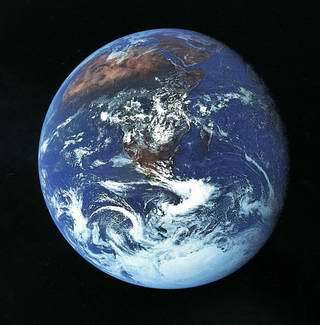
February 9, 2006 Earth from space

The temperature of the northern hemisphere has increased over a larger area in the last century than at any time in the past millennium a report published in Science reveals this week.

The study finds that the number of “hot spots” has increased dramatically in the Northern Hemisphere in the last century compared to the past 1200 years – adding to the growing evidence of wide-scale global warming.

Dr Tim Osborn and Prof Keith Briffa, of the Climatic Research Unit team at the University of East Anglia, analyzed thermometer measurements of temperature from 1856 onwards to establish the spatial extent of recent warming, and compared it with evidence from as far back as AD 800 (from tree rings, ice cores and shells).

The study found evidence for periods of significant warmth (890 – 1170) in the Northern Hemisphere during medieval times and for clearly colder periods (1580 – 1850) during the so-called “Little Ice Age”.

Their key conclusion was that the 20th century stands out as having unusually widespread warmth, compared to all of the natural warming and cooling episodes during the past 1,200 years.

The research team gathered climate change data from a number of regions in the Northern Hemisphere especially:

Long life evergreen trees growing in Scandinavia, Siberia and the Rockies, which had been cored to reveal the patterns of wide and narrow tree rings over time – wider rings relating to warmer temperatures.

Ice from cores drilled in the Greenland ice sheets revealed which years were warmer than others by the chemical composition of the ice.

They also used a record developed from diaries of people living in the Netherlands and Belgium over the past 750 years that revealed for example the years when the canals froze.

Source: University of East Anglia


print this article email this article download pdf blog this article bookmark this article     Stumble it Digg this share on Facebook retweet share on Reddit add to delicious
Rate this story - 3.9 /5 (9 votes)


February 9, 2006 all stories

Comments: 0

3.9 /5 (9 votes)
  • Stumble this up

  • Digg this

  • share this

  • hide
  • Related Stories


Other News

NOAA deploys new 'smart buoy' off Annapolis

Space & Earth / Environment

created 18 minutes ago | popularity not rated yet | comments 0

NOAA deployed the seventh in a series of "smart buoys" to monitor weather conditions and water quality in the Chesapeake Bay today. The buoy, located at the mouth of Severn River near Annapolis, Md., will be used by commercial ...


Rapid star formation spotted in 'stellar nurseries' of infant galaxies

Rapid star formation spotted in 'stellar nurseries' of infant galaxies

Space & Earth / Astronomy

created 6 hours ago | popularity not rated yet | comments 0

The Universe's infant galaxies enjoyed rapid growth spurts forming stars like our sun at a rate of up to 50 stars a year, according to scientists at Durham University.


Reducing greenhouse gases may not be enough to slow climate change

Space & Earth / Environment

created 5 hours ago | popularity 3 / 5 (2) | comments 1

Georgia Tech City and Regional Planning Professor Brian Stone publishes a paper in the December edition of Environmental Science and Technology that suggests policymakers need to address the influence of global deforestation ...


The Stars My Destination

The Stars My Destination

Space & Earth / Space Exploration

created 18 hours ago | popularity 4.9 / 5 (20) | comments 0

The Voyager spacecraft are now in the outermost layer of the heliosphere, traveling toward interstellar space - the first man-made spacecraft to travel such a vast distance from Earth.


Earth

Atomic Particles Help Solve Planetary Puzzle

Space & Earth / Earth Sciences

created 17 hours ago | popularity 4.7 / 5 (9) | comments 0

(PhysOrg.com) -- A University of Arkansas professor and his colleagues have shown that the Earth's mantle contains the same isotopic signatures from magnesium as meteorites do, suggesting that the planet formed ...