UM Team Devises Way to Use Metal in Micromachines
February 9, 2006
UM Team Devises Way to Use Metal in Micromachines

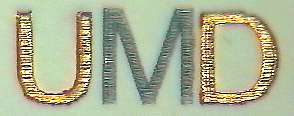
A human hair is about 100 microns wide. Each of these micro letters, created in the Fourkas lab, is 30 microns tall and 20 microns wide. With their new method of incorporating metal, the Fourkas team was able to coat the"U" and "D" with copper.

In the world of microtechnology, entire "machines," so tiny the naked eye can't see them, can be manufactured to create things like sensors that deploy car air bags. But conventional micromachine fabrication technologies have been based on silicon, limiting them when it comes to making complex, three-dimensional structures.

Now, a team of researchers, led by University Maryland chemistry professor John T. Fourkas, has developed a technique for creating microscopic structures from multiple materials, paving the way for the creation of entirely new types of micromachines.

In a paper appearing in the February 15 issue of the Journal of the American Chemical Society, Fourkas and fellow researchers describe their invention of a method that can incorporate a broad range of materials, including metal, into structures fabricated by multiphoton absorption polymerization (MAP), a technique being developed by a number of groups around the world.

MAP uses a laser to harden a special liquid to create microscopic 3-D structures that are composed of a material similar to plexiglass. "It's akin to the process that dentists use to harden composite fillings," said Fourkas, "except that the laser beam allows us to do the hardening on a point by point basis."
UM Team Devises Way to Use Metal in Micromachines

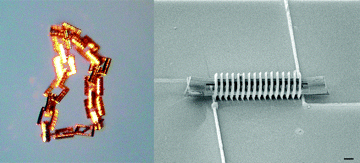
Selectively metallized microstructures created by the Fourkas team with MAP. Left, a gold-coated chain; each link is 70 microns long. Right, electron micrograph of a copper-coated, 16-turn acrylic inductor with a methacrylic support. Copyright © 2006 American Chemical Society

A major drawback of MAP, however, is that it has been limited to the creation of structures made only of plastic. "For many applications it is necessary to be able to include other materials as well," says Fourkas. "The ability to incorporate materials other than plastic is a crucial step forward for multiphoton fabrication."

To demonstrate their technique, Fourkas and his team deposited metal selectively on specific regions of 3-D microstructures. By metal-coating a plastic coil fabricated using MAP, they were able to create and measure the properties of an inductor, a component used in electronic devices such as cell phones, that was a tenth as long as the diameter of a human hair. "Although we demonstrated the deposition of metal to make electrical devices, the same basic strategy will work with other materials, such as biomolecules or even glass," Fourkas said. "This should make it possible to create a whole new generation of microscopic sensors, actuators, and other devices."

Also participating in the research were postdoctoral researcher Richard Farrer, graduate students Christopher LaFratta, Linjie Lie, and Julie Praino, and collaborators Michael Naughton of Boston College and Bahaa Saleh and Malvin Teich of Boston University.

Source: University of Maryland

4.6 /5 (12 votes)  

Rank 4.6 /5 (12 votes)
Tags

Relevant PhysicsForums posts

More news stories

Explained: Sigma

It's a question that arises with virtually every major new finding in science or medicine: What makes a result reliable enough to be taken seriously? The answer has to do with statistical significance -- but ...

Physics / General Physics

created Feb 09, 2012 | popularity 5 / 5 (18) | comments 59

Quantum physicist explains $100K offer for proof scaled-up quantum computing is impossible

(PhysOrg.com) -- MIT researcher Scott Aaronson has certainly riled the physics community with his offer this past Friday, of $100,000 to anyone who can prove that scaled-up quantum computing is impossible. ...

Physics / Quantum Physics

created Feb 08, 2012 | popularity 4.2 / 5 (13) | comments 34 | with audio podcast weblog

Diamond light, brighter than the sun

It’s the size of five football pitches and generates light 10 billion times brighter than the sun. As the Diamond Light Source celebrates its tenth anniversary this year, Penny Bailey visits one of the ...

Physics / General Physics

created Feb 07, 2012 | popularity 4.3 / 5 (7) | comments 15 | with audio podcast

Physicists 'record' magnetic breakthrough

An international team of scientists has demonstrated a revolutionary new way of magnetic recording which will allow information to be processed hundreds of times faster than by current hard drive technology.

Physics / General Physics

created Feb 07, 2012 | popularity 4.5 / 5 (39) | comments 14 | with audio podcast

Hints of the Higgs - papers are submitted

Back in December 2011, the ATLAS and CMS experiments at CERN presented some exciting results that provided tantalising hints of the Higgs boson.

Physics / General Physics

created Feb 08, 2012 | popularity 4.7 / 5 (6) | comments 10


Walney offshore wind farm is world's biggest (for now)

(PhysOrg.com) -- The Walney wind farm on the Irish Sea--characterized by high tides, waves and windy weather--officially opened this week. The farm is treated in the press as a very big deal as the Walney ...

GPS court ruling leaves US phone tracking unclear

A US Supreme Court decision requiring a warrant to place a GPS device on the car of a criminal suspect leaves unresolved the bigger issue of police tracking using mobile phones, legal experts say.

Europeans protest controversial Internet pact

Tens of thousands of people marched in protests in more than a dozen European cities Saturday against a controversial anti-online piracy pact that critics say could curtail Internet freedom.

Anonymous briefly knocks CIA website offline (Update 2)

The website of the Central Intelligence Agency was briefly inaccessible on Friday after the hacker group Anonymous claimed to have knocked it offline.

Study finds that anti-diabetic medication can prevent the long-term effects of maternal obesity

In a study to be presented today at the Society for Maternal-Fetal Medicine's annual meeting, The Pregnancy Meeting, in Dallas, Texas, researchers will report findings that show that short therapy with the anti-diabetic medication ...

Europe stakes billion-dollar bet on new rocket

A pencil-slim rocket is scheduled to lift into space from South America on Monday, carrying a billion-dollar bet that Europe can grab a juicy slice of the market to place satellites in low orbit.