Astronomers pioneer new method for probing exotic matter
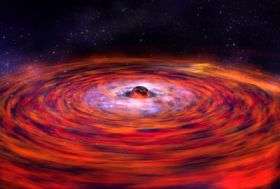
August 27th, 2007 Hot Gas Whipping Around a Neutron Star

An artist depicts a disk of hot gas whipping around a neutron star. The gas in the inner part of the disk whirls around the neutron star at about 40 percent the speed of light, so fast that it experiences effects predicted by Einstein's theories of relativity. Superheated iron atoms in this region emit X-rays at a characteristic wavelength, but the spectral feature is highly distorted by the relativistic effects. Credit: NASA/Dana Berry

Using European and Japanese/NASA X-ray satellites, astronomers have seen Einstein’s predicted distortion of space-time around three neutron stars, and in doing so they have pioneered a groundbreaking technique for determining the properties of these ultradense objects.

Neutron stars contain the most dense observable matter in the universe. They cram more than a sun’s worth of material into a city-sized sphere, meaning a few cups of neutron-star stuff would outweigh Mount Everest. Astronomers use these collapsed stars as natural laboratories to study how tightly matter can be crammed under the most extreme pressures that nature can offer.

"This is fundamental physics," says Sudip Bhattacharyya of NASA’s Goddard Space Flight Center in Greenbelt, Md. and the University of Maryland, College Park. "There could be exotic kinds of particles or states of matter, such as quark matter, in the centers of neutron stars, but it’s impossible to create them in the lab. The only way to find out is to understand neutron stars."

To address this mystery, scientists must accurately and precisely measure the diameters and masses of neutron stars. In two concurrent studies, one with the European Space Agency’s XMM-Newton X-ray Observatory and the other with the Japanese/NASA Suzaku X-ray observatory, astronomers have taken a big step forward.

Using XMM-Newton, Bhattacharyya and his NASA Goddard colleague Tod Strohmayer observed a binary system known as Serpens X-1, which contains a neutron star and a stellar companion. They studied a spectral line from hot iron atoms that are whirling around in a disk just beyond the neutron star’s surface at 40 percent the speed of light.

Previous X-ray observatories detected iron lines around neutron stars, but they lacked the sensitivity to measure the shapes of the lines in detail. Thanks to XMM-Newton’s large mirrors, Bhattacharyya and Strohmayer found that the iron line is broadened asymmetrically by the gas’s extreme velocity, which smears and distorts the line because of the Doppler effect and beaming effects predicted by Einstein’s special theory of relativity. The warping of space-time by the neutron star’s powerful gravity, an effect of Einstein’s general theory of relativity, shifts the neutron star’s iron line to longer wavelengths.

"We've seen these asymmetric lines from many black holes, but this is the first confirmation that neutron stars can produce them as well. It shows that the way neutron stars accrete matter is not very different from that of black holes, and it gives us a new tool to probe Einstein’s theory," says Strohmayer.

A group led by Edward Cackett and Jon Miller of the University of Michigan, which includes Bhattacharyya and Strohmayer, used Suzaku’s superb spectral capabilities to survey three neutron-star binaries: Serpens X-1, GX 349+2, and 4U 1820-30. This team observed a nearly identical iron line in Serpens X-1, confirming the XMM-Newton result. It detected similarly skewed iron lines in the other two systems as well.

"We’re seeing the gas whipping around just outside the neutron star’s surface," says Cackett. "And since the inner part of the disk obviously can’t orbit any closer than the neutron star’s surface, these measurements give us a maximum size of the neutron star’s diameter. The neutron stars can be no larger than 18 to 20.5 miles across, results that agree with other types of measurements."

"Now that we’ve seen this relativistic iron line around three neutron stars, we have established a new technique," adds Miller. "It’s very difficult to measure the mass and diameter of a neutron star, so we need several techniques to work together to achieve that goal."

Knowing a neutron star’s size and mass allows physicists to describe the "stiffness," or "equation of state," of matter packed inside these incredibly dense objects. Besides using these iron lines to test Einstein’s general theory of relativity, astronomers can probe conditions in the inner part of a neutron star’s accretion disk.

The XMM-Newton paper appeared in the August 1 Astrophysical Journal Letters. The Suzaku paper has been submitted for publication in the same journal.

Source: Goddard Space Flight Center


print this article email this article download pdf blog this article bookmark this article     Digg this Stumble it share on Facebook share on Reddit add to delicious save to Yahoo! bookmarks
4.7/5 after 36 votes


August 27th, 2007 all stories
Physics / General Physics

Comments: 0
Rank: 4.7/5 after 36 votes

  • Stumble this up

  • Digg this

  • Share it:
  • share on Facebook
  • share on MySpace
  • share on Slashdot
  • rss-newsfeed
  • share on Google
  • share on Reddit
  • add to delicious
  • save to Yahoo! bookmarks
  • share on Windows Live
  • Add to Mixx!
Rating: 4.7/5 after 36 votes

  • Related Stories

  • New technique improves estimates of pulsar ages
    created Jun 09, 2009 | popularity not rated yet | comments 0
  • Keck Study Sheds New Light on "Dark" Gamma-ray Bursts
    created Jun 08, 2009 | popularity not rated yet | comments 0
  • A new class of dim supernovae
    created Jun 05, 2009 | popularity not rated yet | comments 0
  • Rare radio supernova in nearby galaxy is nearest supernova in five years
    created May 27, 2009 | popularity not rated yet | comments 0
  • Studying the 'mountains' and 'starquakes' that develop on neutron stars
    created May 26, 2009 | popularity not rated yet | comments 0

Tags


  • Physicists Demonstrate Quantum Memory with Matter Qubits
    Physicists Demonstrate Quantum Memory with Matter Qubits
    Physics / General Physics
    created Jul 03, 2009 | popularity 4.4 / 5 (17) | comments 1
  • 'Holey' Nanosheets for Wastewater Dye Removal
    Nanotechnology / Nanomaterials
    created Jul 01, 2009 | popularity 5 / 5 (5) | comments 1
  • Jellyfish Robot Swims Like its Biological Counterpart
    Jellyfish Robot Swims Like its Biological Counterpart
    Electronics / Robotics
    created Jun 26, 2009 | popularity 4.4 / 5 (8) | comments 1
  • Could Maxwell's Demon Exist in Nanoscale Systems?
    Could Maxwell's Demon Exist in Nanoscale Systems?
    Physics / General Physics
    created Jun 24, 2009 | popularity 4.4 / 5 (18) | comments 29
  • Living Safely with Robots, Beyond Asimov's Laws
    Living Safely with Robots, Beyond Asimov's Laws
    Electronics / Robotics
    created Jun 22, 2009 | popularity 4.6 / 5 (53) | comments 40
  • Other News

    Physical reality of string theory demonstrated

    Physics / General Physics

    created 8 minutes ago | popularity 5 / 5 (1) | comments 0

    String theory has come under fire in recent years. Promises have been made that have not been lived up to. Leiden (The Netherlands) theoretical physicists have now for the first time used string theory to describe a physical ...


    UQ researchers break the law -- of physics

    Physics / General Physics

    created 5 hours ago | popularity 4.5 / 5 (10) | comments 3

    (PhysOrg.com) -- Two UQ Science researchers have proved two famous physical laws that have been widely used for the past 25 years do not always work.


    Scientists create first electronic quantum processor

    Scientists create first electronic quantum processor

    Physics / General Physics

    created Jun 28, 2009 | popularity 4.8 / 5 (54) | comments 42

    A team led by Yale University researchers has created the first rudimentary solid-state quantum processor, taking another step toward the ultimate dream of building a quantum computer.


    Science journals

    How to Spot an Influential Paper Based on its Citations

    Physics / General Physics

    created Jul 04, 2009 | popularity 3.9 / 5 (10) | comments 6

    (PhysOrg.com) -- At first it may seem that the number of citations received by a published scientific paper is directly related to that paper's quality of content. The higher the quality, the more people read ...


    Fermilab's CDF observes Omega-sub-b baryon

    Fermilab's CDF observes Omega-sub-b baryon

    Physics / General Physics

    created Jun 29, 2009 | popularity 4.7 / 5 (18) | comments 7

    (PhysOrg.com) -- At a recent physics seminar at the Department of Energy’s Fermi National Accelerator Laboratory, Fermilab physicist Pat Lukens of the CDF experiment announced the observation of a new particle, ...