How Snakes Survive Starvation
August 27, 2007
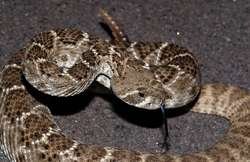
University of Arkansas researcher Marshall McCue studied Western timber rattlesnakes and two other species and found that they could lower their standard metabolic rates - a trait never seen before in vertebrates. Photo by James VanDyke.
Starving snakes employ novel survival strategies not seen before in vertebrates, according to research conducted by a University of Arkansas biologist. These findings could be used in conservation strategies to determine the health of snake populations.
"These animals take energy reduction to a whole new level," said Marshall McCue, a graduate student in biological sciences in the J. William Fulbright College of Arts and Sciences. He reported his findings in the journal Zoology.
While scientists knew that some snake species could survive for up to two years without a meal, no studies have examined the physiological changes that take place when a snake goes for prolonged periods without food. McCue examined three snake species - the ball python, the ratsnake and the western diamondback rattlesnake - to study their responses to prolonged periods without food.
The 62 snakes studied went about six months without eating - a time period that could well be duplicated in the wild, where food supplies can be scarce. McCue then looked at physiological, compositional and morphological changes in the snakes.
The results showed that the snakes could lower their standard metabolic rates, some by up to 72 percent.
"Snakes already had low energy demands. We didn't know they could go lower," McCue said.
Another surprising finding: The snakes continued to grow despite the lack of food - a counterintuitive finding, but a measurement that again does not appear in the research literature.
"To me, this suggests that there must be a strong selective advantage to growing longer," McCue said. It also means the snakes have become extremely efficient in their ability to use available resources.
To illustrate the strategies employed by snakes to combat starvation, McCue uses an economic analogy of supply and demand.
"When you're cut off from resources, you are an organism that still needs to expend energy," he said. The "demand" end is met by decreasing their metabolic rate. The "supply" end must be met by frugal use of resources they have at hand for energy, which comes from within.
The body composition of snakes includes water, ash, protein, fats and carbohydrates. McCue found that the snakes used up selected fat stores first during starvation, but he also found crucial differences between the snake species. The ratsnakes, which typically have a more abundant rodent supply in their natural environment, began to break down proteins faster than the pythons or rattlesnakes.
"The protein use was higher in the snakes less well adapted to starvation," McCue said.
Snakes are relatively new on the world scene, having been around for about 100 million years. Yet they currently comprise about half of all reptile species.
"Snakes are very evolutionarily successful," McCue said. Understanding the physiology that allows them to succeed in low-energy environments will help scientists further their understanding of the snakes' evolution and their adaptation to their current ecosystems.
Source: University of Arkansas
-
Pythons apparently wiping out Everglades mammals
Jan 30, 2012 |
5 / 5 (5) |
8
-
Snakes improve search-and-rescue robots
Jan 19, 2012 |
not rated yet |
0
-
Ruthless boas know when to ditch their squeeze
Jan 18, 2012 |
5 / 5 (1) |
0
-
US bans import of Burmese pythons
Jan 17, 2012 |
5 / 5 (1) |
2
-
Salt water alone unlikely to halt Burmese python invasion
Jan 04, 2012 |
5 / 5 (1) |
0
-
Engineers build first sub-10-nm carbon nanotube transistor
Feb 01, 2012 |
4.9 / 5 (31) |
30
-
Something old, something new: Evolution and the structural divergence of duplicate genes
Jan 31, 2012 |
4.6 / 5 (7) |
1
-
The hidden nanoworld of ice crystals: Revealing the dynamic behavior of quasi-liquid layers
Jan 30, 2012 |
5 / 5 (3) |
1
-
Stock market network reveals investor clustering
Jan 27, 2012 |
3.9 / 5 (23) |
8
-
Of microchemistry and molecules: Electronic microfluidic device synthesizes biocompatible probes
Jan 26, 2012 |
5 / 5 (1) |
0
More news stories
The power of estrogen -- male snakes attract other males
A new study has shown that boosting the estrogen levels of male garter snakes causes them to secrete the same pheromones that females use to attract suitors, and turned the males into just about the sexiest ...
5 hours ago |
not rated yet |
0
|
Experts reveal how plants don't get sunburn
(PhysOrg.com) -- Experts at the University of Glasgow have discovered how plants survive the harmful rays of the sun.
5 hours ago |
5 / 5 (2) |
0
|
Grass to gas: Researchers' genome map speeds biofuel development
Researchers at the University of Georgia have taken a major step in the ongoing effort to find sources of cleaner, renewable energy by mapping the genomes of two originator cells of Miscanthus x giganteus, a large perenn ...
2 hours ago |
5 / 5 (2) |
0
|
Protein libraries in a snap
(PhysOrg.com) -- A Rice University undergraduate will depart with not only a degree but also a possible patent for his invention of an efficient way to create protein libraries, an important component of biomolecular ...
8 hours ago |
5 / 5 (2) |
0
|
Miami battling invasion of giant African snails
No one knows how they got there. But an invasion of African giant snails has southern Florida in a panic over potential crop damage, disease and general yuckiness surrounding the slimy gastropods.
9 hours ago |
not rated yet |
2
Human cognitive performance suffers following natural disasters, researchers find
Not surprisingly, victims of a natural disaster can experience stress and anxiety, but a new study indicates that it might also cause them to make more errors - some serious - in their daily lives. In their upcoming Human Fa ...
"Twisted Metal" gamers get shot at real gunplay
Fans of "Twisted Metal" will get to welcome a long-awaited sequel of the car-battle videogame with a real-world bang by blasting an ice cream truck to bits with a machine gun.
Putting the squeeze on planets outside our solar system
(PhysOrg.com) -- Using high-powered lasers, scientists at Lawrence Livermore National Laboratory and collaborators discovered that molten magnesium silicate undergoes a phase change in the liquid state, abruptly ...
Both maternal and paternal age linked to autism
Older maternal and paternal age are jointly associated with having a child with autism, according to a recently published study led by researchers at The University of Texas Health Science Center at Houston (UTHealth).
New error-correcting codes guarantee the fastest possible rate of data transmission
Error-correcting codes are one of the triumphs of the digital age. Theyre a way of encoding information so that it can be transmitted across a communication channel such as an optical fiber o ...
Curry spice component may help slow prostate tumor growth
Curcumin, an active component of the Indian curry spice turmeric, may help slow down tumor growth in castration-resistant prostate cancer patients on androgen deprivation therapy (ADT), a study from researchers ...