Mars Rovers Resume Driving
August 27, 2007 NASA's Opportunity rover

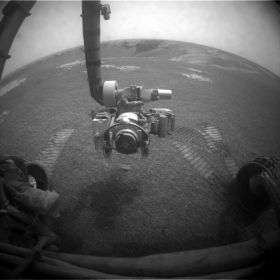
NASA's Opportunity rover used its front hazard-identification camera to obtain this image at the end of a drive on the rover's 1,271st sol, or Martian day (Aug. 21, 2007). Image credit: NASA/JPL-Caltech

After six weeks of hunkering down during raging dust storms that limited solar power, both of NASA's Mars Exploration Rovers, Spirit and Opportunity, have resumed driving.

Opportunity advanced 13.38 meters (44 feet) toward the edge of Victoria Crater on Aug. 21. Mission controllers were taking advantage of gradual clearing of dust from the sky while also taking precautions against buildup of dust settling onto the rover.

"Weather and power conditions continue to improve, although very slowly for both rovers," said John Callas of NASA's Jet Propulsion Laboratory, Pasadena, Calif, project manager for the rovers. With the improved energy supplies, both rovers are back on schedule to communicate daily. Opportunity had previously been conserving energy by going three or four days between communications.

No new storms have been lifting dust into the air near either solar-powered rover in the past two weeks. Skies are gradually brightening above both Spirit and Opportunity. "The clearing could take months," said rover Project Scientist Bruce Banerdt. "There is a lot of very fine material suspended high in the atmosphere."

As that material does settle out of the air, the powdery dust is accumulating on surfaces such as the rovers' solar panels and instruments. More dust on the solar panels lessens the panels' capacity for converting sunlight to electricity, even while more sunlight is getting through the clearer atmosphere.

Opportunity's daily supply of electricity from its solar panels reached nearly 300 watt-hours on Aug. 23. That is more than twice as much as five weeks ago, but still less than half as much as two months ago. It is enough to run a 100-watt bulb for three hours.

One reason the rover team chose to drive Opportunity closer to the crater rim was to be prepared, if the pace of dust accumulation on the solar panels increases, to drive onto the inner slope of the crater. This would give the rover a sun-facing tilt to maximize daily energy supplies. The drive was also designed to check performance of the rover's mobility system, so it included a turn in place and a short drive backwards.

The next day, a favorable wind removed some dust from Opportunity's solar panels, providing a boost of about 10 percent in electric output. This forestalled the need to hurry to a sun-facing slope. The team is still excited to get Opportunity inside Victoria Crater to examine science targets on the inner slope that were identified in June, shortly before dust storms curtailed rover activities. An estimate of how soon Opportunity will enter the crater will depend on assessments in coming days of how dust may be affecting the instruments and of how much energy will be available.

On Spirit, dust on the lens of the microscopic imager has slightly reduced image quality for that instrument, although image calibration can compensate for most of the contamination effects. The team is experimenting with ways to try dislodging the dust on the lens. Spirit's solar arrays are producing about 300 watt hours per day as dust accumulation on them offsets clearing skies. Spirit drove 42 centimeters (17 inches) backwards on Aug. 23 to get in position for taking images of a rock that it had examined with its Moessbauer spectrometer. The rover team is planning additional drives for Spirit to climb onto a platform informally named "Home Plate."

Source: NASA


print this article email this article download pdf blog this article bookmark this article     Stumble it Digg this share on Facebook retweet share on Reddit add to delicious
Rate this story - 4.7 /5 (33 votes)


August 27, 2007 all stories

Comments: 0

4.7 /5 (33 votes)
  • Stumble this up

  • Digg this

  • share this

  • hide
  • Related Stories

  • A Mars Rover Named 'Curiosity'
    created Oct 30, 2009 | popularity not rated yet | comments 0
  • LADEE Mission to Study the Moon's Fragile Atmosphere
    created Oct 26, 2009 | popularity not rated yet | comments 0
  • Robotics desert test provides NASA with new set of wheels for moon
    created Sep 16, 2009 | popularity not rated yet | comments 0
  • Spirit Rover: Computer Modeling Supplements Dusty Testing
    created Sep 15, 2009 | popularity not rated yet | comments 0
  • Dust Storm Passing Over Spirit
    created Aug 26, 2009 | popularity not rated yet | comments 0


  • hide
  • Relevant PhysicsForums posts

  • Question about 2-body gravity
    created Nov 24, 2009
  • life on Mars
    created Nov 24, 2009
  • Semi-major axis from cartesian co-ordinates
    created Nov 23, 2009
  • Primary Mirror grinding
    created Nov 23, 2009
  • More from Physics Forums - General Astronomy

Other News

Cosmic 'dig' reveals vestiges of the Milky Way's building blocks

Cosmic 'Dig' Reveals Vestiges of the Milky Way's Building Blocks

Space & Earth / Astronomy

created 10 hours ago | popularity 4.9 / 5 (12) | comments 1

(PhysOrg.com) -- Peering through the thick dust clouds of our galaxy's "bulge" (the myriads of stars surrounding its center), a team of astronomers has unveiled an unusual mix of stars in the stellar grouping ...


No Wheel Stall in Diagnostic Drive

Spirit Mars Rover: No Wheel Stall in Diagnostic Drive

Space & Earth / Space Exploration

created 5 hours ago | popularity 5 / 5 (1) | comments 0

(PhysOrg.com) -- On Sol 2095 (Tuesday, Nov. 24), Spirit performed a set of diagnostic actions related to a stall of the right-rear wheel on the previous drive, three days earlier.


Monster Waves on the Sun are Real

Monster Waves on the Sun are Real (w/ Video)

Space & Earth / Astronomy

created 5 hours ago | popularity 5 / 5 (8) | comments 0

Sometimes you really can believe your eyes. That's what NASA's STEREO (Solar Terrestrial Relations Observatory) spacecraft are telling researchers about a controversial phenomenon on the sun known as the "solar ...


Oceanic crust formation is dynamic after all

Oceanic crust formation is dynamic after all

Space & Earth / Earth Sciences

created 9 hours ago | popularity 4.3 / 5 (3) | comments 0

Imagine the Earth's crust as the planet's skin: Some areas are old and wrinkled while others have a fresher, more youthful sheen, as if they had been regularly lathered with lotion.


Climate experts debate strategies for reducing atmospheric carbon and future warming

Climate experts debate strategies for reducing atmospheric carbon and future warming

Space & Earth / Environment

created 5 hours ago | popularity 3 / 5 (4) | comments 4

(PhysOrg.com) -- Reducing carbon dioxide to safe levels may require extracting carbon from the air, says Cornell climate researcher.