Mars Reconnaissance Orbiter Camera Concern Resolved
August 27, 2007 Mars Reconnaissance Orbiter Camera Concern Resolved

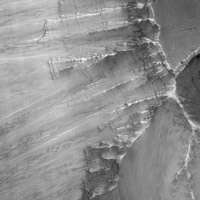
Exposed layers in Central Valles Marineris. Image credit: NASA/JPL/University of Arizona

Diagnostic tests and months of stable, successful operation have resolved concerns raised early this year about long-term prospects for the powerful telescopic camera on NASA's Mars Reconnaissance Orbiter.

The High Resolution Imaging Science Experiment (HiRISE) camera on the orbiter has now taken more than 3,000 images of Mars, resolving features as small as a desk in targeted areas covering thousands of square miles of the Martian surface. Already, this is the largest Mars data set ever acquired by a single experiment. The camera is one of six instruments on the orbiter.

During the first three months after the orbiter's primary science phase began in November, researchers saw an increase in noise and pixel dropouts in data from seven of the camera's 14 detectors. The effects on image quality were small in all but two detectors, but the trend raised concerns.

Tests have yielded an explanation for the earlier pattern, and the camera's performance record shows the noise stopped getting worse after about three to four months of the science phase.

Alfred McEwen of the University of Arizona, Tucson, principal investigator for the camera, said, "I'm happy to report that there has been no detectable degradation over the past five months."

A team at Ball Aerospace & Technologies Corp., Boulder, Colo., designer and builder of the instrument, has used an engineering model of the camera's focal-plane system to successfully duplicate the problem. This has helped in understanding causes and in testing a procedure for warming the focal-plane electronics prior to each image. One cause is that an electrical interface lacked extra capability beyond minimum requirements. Another cause is an unexpected change in performance of another electronic component over the course of the first thousand or so large images. With pre-warming, the camera acquires good data from all detectors, though minor noise remains an issue in data from one of two channels of one detector collecting infrared imagery.

McEwen said, "Given the stability we've seen and understanding the nature of the problem, we now expect HiRISE to return high-quality data for years to come."

Images from the High Resolution Imaging Science Experiment are online at http://hirise.lpl.arizona.edu .

Source: NASA


print this article email this article download pdf blog this article bookmark this article     Stumble it Digg this share on Facebook retweet share on Reddit add to delicious
Rate this story - 4.3 /5 (6 votes)


August 27, 2007 all stories

Comments: 0

4.3 /5 (6 votes)
  • Stumble this up

  • Digg this

  • share this

  • hide
  • Related Stories

  • Scientists see water ice in fresh meteorite craters on Mars
    created Sep 24, 2009 | popularity not rated yet | comments 0
  • Biosphere 2 Opens Phoenix Mars Lander Exhibit
    created Sep 18, 2009 | popularity not rated yet | comments 0
  • Dust Storm Passing Over Spirit
    created Aug 26, 2009 | popularity not rated yet | comments 0
  • Mars data published in Science this week
    created Jul 02, 2009 | popularity not rated yet | comments 0
  • Better looks at Mars minerals for ASU instrument on NASA's Mars Odyssey orbiter
    created Jun 22, 2009 | popularity not rated yet | comments 0


  • hide
  • Relevant PhysicsForums posts

  • Some help with a X-Ray astronomy question please!
    created 13 hours ago
  • Help with Images and Optical Instrument Question..
    created Nov 26, 2009
  • Redshift as a distance indicator
    created Nov 26, 2009
  • Question about 2-body gravity
    created Nov 24, 2009
  • More from Physics Forums - General Astronomy

Other News

Fermi Telescope Peers Deep into Microquasar

Fermi Telescope Peers Deep into Microquasar (w/ Video)

Space & Earth / Astronomy

created 7 hours ago | popularity 4.3 / 5 (3) | comments 0

(PhysOrg.com) -- NASA's Fermi Gamma-ray Space Telescope has made the first unambiguous detection of high-energy gamma-rays from an enigmatic binary system known as Cygnus X-3. The system pairs a hot, massive ...


The Energy Sources of Ultraluminous Galaxies

The Energy Sources of Ultraluminous Galaxies

Space & Earth / Astronomy

created 7 hours ago | popularity 4.3 / 5 (7) | comments 0

(PhysOrg.com) -- Ultraluminous infrared galaxies ((ULIRGs) are galaxies whose luminosity exceeds that of a trillion suns; for comparison, the Milky Way galaxy has a typical (and much more modest) luminosity ...


Space shuttle Atlantis, 7 astronauts back on Earth (AP)

Space shuttle Atlantis, 7 astronauts back on Earth

Space & Earth / Space Exploration

created 8 hours ago | popularity not rated yet | comments 0

(AP) -- Space shuttle Atlantis and its seven astronauts returned to Earth with a smooth touchdown Friday to end an 11-day flight that resupplied the International Space Station.


Herschel takes a peek at the ingredients of the galaxies

Herschel takes a peek at the ingredients of the galaxies

Space & Earth / Astronomy

created 6 hours ago | popularity 5 / 5 (1) | comments 0

(PhysOrg.com) -- The European Space Agency has today released spectacular new observations from the Herschel Space Observatory, including the UK-led SPIRE instrument. Spectrometers on board all three Hershel ...


China is set to launch its second moon orbiter next October, state media have reported

China to launch second lunar probe: state media

Space & Earth / Space Exploration

created 12 hours ago | popularity 5 / 5 (3) | comments 0

China will launch its second moon orbiter next October, state media reported Friday, as it powers ahead with a space programme that has sparked concerns abroad.