Fasten your seat belts -- turbulent lessons from Titan
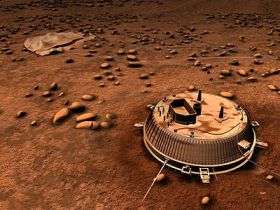
Have you spilled your drink on an airliner? Researchers on both sides of the Atlantic are finding new ways to understand turbulence, both in the Earth's atmosphere and that of Saturn's moon Titan.
Turbulence is an important process in our weather, and can be more than an inconvenience; causing hundreds of injuries on commercial flights. Working together, researchers have shown that Huygens had a bumpy ride to Titan and improved the instrumentation that will be used to measure such effects on Earth in future.
Keith Mason, CEO of the Science and Technology Facilities Council said “All planets and moons are subject to the same principles of physics, so working together researchers looking at the Earth and those looking at our planetary neighbours can really test their models of the processes taking place and gain new insights into both.”
Giles Harrison, an atmospheric physicist in the Department of Meteorology at the University of Reading in the UK, devised an inexpensive way of measuring turbulence effects using weather balloons. He extended the standard weather balloon instrument package to include a magnetic field sensor sensitive to the Earth’s magnetic field. With colleague Robin Hogan at Reading, they compared magnetic observations made during a balloon ascent with cloud measurements of turbulence obtained using the nearby Doppler Cloud Radar at Chilbolton, Hampshire.
“We found that turbulent regions observed using the Chilbolton radar coincided with where our balloon’s measurements showed large magnetic changes. As the earth’s magnetic field is very stable, the measurements were showing that the balloon itself was moving violently, in response to air turbulence.” Harrison explained.
Planetary scientist Ralph Lorenz, at the Johns Hopkins University Applied Physics Laboratory in Laurel, Maryland, found Harrison's results the key to making sense of data from the ESA Huygens probe which descended by parachute through Titan's atmosphere in January 2005. An experiment led by The Open University in the UK, the Surface Science Package (SSP), included a set of tilt sensors which measured the motions of the probe during its descent.
In fact, these tilt sensors act much like a drink in a glass, using a small slug of liquid to measure tilt angle. As the probe plummeted at high speed on Titan, there was a lot of buffeting even though the air itself was fairly still. By knowing the particular signature of cloud-induced turbulence in Harrison's Earth balloon data, where the nearby weather radar could document what was causing the turbulence; Lorenz was able to find this signal at Titan despite the buffeting during the Huygens descent.
“The Huygens tilt history was just this long squiggly complex mess, but seeing the fingerprint of cloud turbulence in Harrison's work showed me what to look for” said Lorenz.
Armed with that information, Lorenz found that a 20-minute period of Huygens' 2.5-hour descent, around an altitude of 20km, was affected by this kind of in-cloud turbulence.
Mark Leese, Project Manager for the SSP on Huygens at The Open University said “We knew Huygens had a bumpy ride down to Titan’s surface, now we can separate out twenty minutes of air turbulence – probably due to a cloud layer- from other effects such as cross winds or air buffeting due to the irregular shape of the probe.”
Lorenz had experimented with instrumentation on small models, and even on Frisbees, to understand the dynamics of aerospace vehicles like the probe, and was thus very familiar with the sensors that Harrison was using. He identified a way that Harrison's balloon sensor arrangement could be improved, simply by changing its orientation.
“We went to Titan to learn about that mysterious body and its atmosphere: it's neat that there are lessons from Titan that can be usefully applied here on Earth” said Lorenz.
Source: Science and Technology Facilities Council


