Rovers begin new observations on changing Martian atmosphere
Mars rover scientists have launched a new long-term study on the Martian atmosphere with the Alpha Particle X-ray Spectrometer, an instrument that was originally developed at the University of Chicago.
Thanasis Economou, Senior Scientist at Chicago's Enrico Fermi Institute, suggested the new study after observing that the APXS instruments aboard NASA's twin Mars rovers, Spirit and Opportunity, had recorded fluctuations in the argon composition of the Martian atmosphere. "The amount of argon in the atmosphere is changing constantly," Economou said.
During warmer seasons, approximately 95 percent of the Martian atmosphere consists of carbon dioxide. Nitrogen accounts for almost 3 percent and argon for less than 2 percent. But when winter sets in at one of the poles, carbon dioxide freezes out of the atmosphere to form a polar cap, causing a low-pressure system that moves air toward the pole.
Argon stays in the atmosphere and becomes enhanced because it freezes at a much lower temperature, Economou said. An instrument on NASA's Odyssey orbiter around Mars found that on the Mars south pole during the winter, the argon concentration is six times higher than during the warmer seasons.
"The amount of argon that comes with the air mass stays in the atmosphere," he explained. "Carbon dioxide drops, so the ratio of argon to carbon dioxide is increasing constantly until the next season."
With the onset of warmer spring and summer temperatures, the frozen carbon dioxide evaporates back into the atmosphere, causing a high-pressure system that pushes the air mass back toward the equator.
"The fact that we see a signal at all means there's a lot of mixing between the polar air and the air at the tropics," said Ray Pierrehumbert, the Louis Block Professor in Geophysical Sciences at the University of Chicago, who specializes in the evolution of climate on Earth and Mars. "It gives you a way of inferring aspects of the Martian circulation that you can't observe at all with any other instrument that's out there," he said.
Scientists are coupling the APXS measurements with additional data collected by the orbiting Mars Odyssey spacecraft. The APXS measures the number of argon atoms at the rover's location between the instrument and the ground-a distance of a couple of centimeters (a few inches). Odyssey's gamma-ray spectrometer, meanwhile, measures the argon in a column of air extending from the upper atmosphere to the Martian surface, but over an area spanning several hundred kilometers (a couple hundred miles)
Spirit and Opportunity landed on Mars in January 2004. Until now, their APXS instruments have focused on measuring the chemical content of rocks and dust sitting on the ground. During the mission's first 90 days, for example, Opportunity's APXS contributed to the identification and analysis of abundant sulfate salts and other minerals suggestive of once-moist environments on the vast plain known as Meridiani Planum.
"It means that at some point the site was soaked with liquid water," Economou said.
Opportunity's APXS also performed a key analysis of the first meteorite ever discovered on Mars. When Opportunity encountered Heat Shield rock in 2005, "it looked like a meteorite, but it was confirmed with the APXS," Economou said. It was the first of at least four meteorites that Opportunity has discovered.
"If you go to Antarctica you find lots of them because you can spot them," he said. "On Mars also, when you have these large, flat areas that have just sand and sand dunes, nothing else, and you now see some suspicious rock, you know that it's not from there." Either it is debris that has been ejected from an impact crater, or a meteorite.
In recent months, the APXS on the Spirit rover measured the composition of soils consisting of 90 percent pure silica, which could have formed in a hot-spring environment or some other process involving water. The finding presents some of the best evidence yet that water once existed at Gusev crater.
"This is a remarkable discovery," said Cornell University's Steve Squyres, who heads the Mars rovers' science instruments team. "The fact that we found something this new and different after nearly 1,200 days on Mars makes it even more remarkable. It makes you wonder what else is still out there."
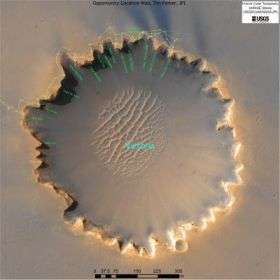
Opportunity now has traveled more than six miles through some difficult sandy terrain to reach Victoria Crater, which measures half a mile in diameter. Rolling up to the edge of the crater, the rover has taken images of the layered sediments, various rock types and accumulations of sand visible at the base of the walls.
NASA engineers have scouted a possible route that Opportunity could safely follow onto the crater floor. A dust storm in the region has delayed plans to send Opportunity into the crater.
Source: University of Chicago


