Greece suffers more fires in 2007 than in last decade, satellites reveal
August 29, 2007
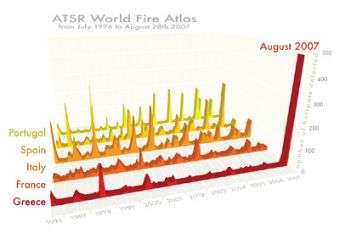
Number of fires occurring monthly for France, Italy, Spain, Portugal and Greece from July 1996 to August 2007. These data are based on results from the Along Track Scanning Radiometer (ATSR) on ESA’s ERS-2 satellite, launched in 1995, and the Advanced Along Track Scanning Radiometer (AATSR) on ESA’s Envisat satellite, launched in 2002. These twin radiometer sensors work like thermometers in the sky, measuring thermal infrared radiation to take the temperature of Earth's land surfaces. Temperatures exceeding 308º K at night are classed as burning fires. Credits: ESA
Greece has experienced more wildfire activity this August than other European countries have over the last decade, according to data from ESA satellites. The country is currently battling an outbreak of blazes, which began last Thursday, that have spread across the country killing more than 60 people.
ESA’s ERS-2 and Envisat satellites continuously survey fires burning across the Earth’s surface with onboard sensors – the Along Track Scanning Radiometer (ATSR) and the Advanced Along Track Scanning Radiometer (AATSR) respectively, known as the ATSR Word Fire Atlas, which is available to users online in near-real time.
The ATSR World Fire Atlas is the longest worldwide fire atlas available. Even if the atlas is not supposed to pick up all fires due to satellite overpass constraints and cloud coverage, it is statistically representative from one month to the other and from one year to the other.
Working like thermometers in the sky, the sensors measure thermal infrared radiation to take the temperature of Earth's land surfaces. Temperatures exceeding 308ºK at night are classed as burning fires. Data gathered from July 1996 to 28 August 2007 was used to plot the number of fires occurring monthly and show Greece has had four times the number of fires this August compared to its July and August 1998 records.
Weather conditions, including record summer temperatures and hot dry winds, in 2007 made parts of the Mediterranean – including Greece and southern Italy – a tinderbox, the United Nations Food and Agriculture Organization said.
The ATSR World Fire Atlas provides data approximately six hours after acquisition. All available satellite passes are processed to create the ATSR World Fire Atlas. In addition to maps, the time, date, longitude and latitude of the hot spots are provided. The data are used for research in atmospheric chemistry, land use change, global change ecology, fire prevention and management and meteorology.
Quantifying fires is important for the ongoing study of climate because they have a significant impact on global atmospheric pollution, with biomass burning contributing to the global budgets of greenhouse gases, like carbon dioxide. The 1998 El Niño, for example, helped encourage fires across Borneo which emitted up to 2.5 billion tonnes of carbon into the atmosphere, equivalent to Europe's entire carbon emissions that year.
One of the biggest problems during and after fires is obtaining an overall view of the damage and its evolution. With fires visible from space, Earth Observation is also being used to detect and monitor the active spots over affected areas. In October 2000, ESA and the French space agency (CNES) initiated the International Charter Space and Major Disasters, a joint initiative with now ten members, aiming at rapidly tasking Earth Observation satellites and delivering spacemaps to users concerned with emergency response, such as civil protection authorities, anywhere in the world.
Such a capacity can help monitor fire hazard by integrating imagery into geographic information systems used by decision makers and actors in the field. On 29 August, the National Cadastral Organisation of Greece requested support from the International Charter in response to the fire events affecting the country.
Source: European Space Agency
-
Engineers build first sub-10-nm carbon nanotube transistor
Feb 01, 2012 |
4.9 / 5 (31) |
30
-
Something old, something new: Evolution and the structural divergence of duplicate genes
Jan 31, 2012 |
4.6 / 5 (7) |
1
-
The hidden nanoworld of ice crystals: Revealing the dynamic behavior of quasi-liquid layers
Jan 30, 2012 |
5 / 5 (3) |
1
-
Stock market network reveals investor clustering
Jan 27, 2012 |
3.9 / 5 (23) |
8
-
Of microchemistry and molecules: Electronic microfluidic device synthesizes biocompatible probes
Jan 26, 2012 |
5 / 5 (1) |
0
-
Do some geologists actually act a lot like Randy Marsh?
Feb 11, 2012
-
Discrepancy between oxygen and carbon-dioxide levels
Feb 09, 2012
-
where gems are found in the world
Feb 09, 2012
-
Wind Waves in Reservoir ~ Wind run-up and Wind set-up
Feb 08, 2012
-
Balance of oxygen in the atmosphere
Feb 01, 2012
-
The case for a methanol-based economy
Jan 30, 2012
- More from Physics Forums - Earth
More news stories
Latin America mining boom clashes with conservation
Latin America is experiencing a mining boom as prices rise fuelled by a hike in global demand, but the region is also being hit by a wave of violent protests, strikes and rallies by environmentalists.
6 hours ago |
not rated yet |
0
Political leaders play key role in how worried Americans are by climate change: study
More than extreme weather events and the work of scientists, it is national political leaders who influence how much Americans worry about the threat of climate change, new research finds.
Feb 06, 2012 |
5 / 5 (6) |
73
NASA budget will axe Mars deal with Europe: scientists
US President Barack Obama's budget proposal to be submitted next week for 2013 will cut NASA's budget by 20 percent and eliminate a major partnership with Europe on Mars exploration, scientists said Thursday.
Space & Earth / Space Exploration
Feb 10, 2012 |
5 / 5 (3) |
55
Humans may have helped the decline of African rainforests 3000 years ago
(PhysOrg.com) -- Large areas of rainforests in Central Africa mysteriously disappeared over three thousand years ago, to be replaced by savannas. The prevailing theory has been that the cause was a change ...
Study shows global glaciers, ice caps, shedding billions of tons of mass annually
Earth's glaciers and ice caps outside of the regions of Greenland and Antarctica are shedding roughly 150 billion tons of ice annually, according to a new study led by the University of Colorado Boulder.
Space & Earth / Earth Sciences
Feb 08, 2012 |
4.4 / 5 (9) |
14
|
Injured boomers beware: Know when to see doctor
(AP) -- It happened to nurse Jane Byron years after an in-line skating fall, business owner Haralee Weintraub while doing "men's" push-ups, and avid cyclist Gene Wilberg while lifting a heavy box.
Google might launch Drive for cloud storage soon
(PhysOrg.com) -- Google's next big move, according to the Wall Street Journal, is a cloud storage service called Drive. Hardly first to the plate, Google is simply catching up to introducing its cloud reposi ...
Love a click away in Indonesia's Twitter Republic
He was a geeky kid from Yogyakarta, she a glamorous city girl in Jakarta. In a country with one of the world's most vibrant social networking scenes they fell in love on Twitter.
Europeans protest controversial Internet pact
Tens of thousands of people marched in protests in more than a dozen European cities Saturday against a controversial anti-online piracy pact that critics say could curtail Internet freedom.
Walney offshore wind farm is world's biggest (for now)
(PhysOrg.com) -- The Walney wind farm on the Irish Sea--characterized by high tides, waves and windy weather--officially opened this week. The farm is treated in the press as a very big deal as the Walney ...
Navy to begin tests on electromagnetic railgun prototype launcher
The Office of Naval Research (ONR)'s Electromagnetic (EM) Railgun program will take an important step forward in the coming weeks when the first industry railgun prototype launcher is tested at a facility ...