Physicists aim to predict volcano eruption
August 29, 2007
University of St Andrews scientists have been awarded a three year grant to create an on-site life-saving device to help predict volcano eruption.
The work is funded by nearly £400K from the Natural Environment Research Council (NERC), bringing the team's recent research funding to just over £1 million, following a £700K sub-contract from ERA Technology Limited for new work on military security.
The unmanned monitoring instrument, to be trialled at Montserrat in the West Indies, will be developed by the Millimetre Wave and High-Field ESR Group in the School of Physics and Astronomy.
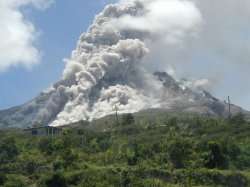
The new volcano radar project builds on the success of the Group's previous NERC funded project which developed the unique portable volcano mapping instrument 'AVTIS' (All-weather Volcano Topography Imaging Sensor). AVTIS uses millimetre waves to see through the smoke, gas and cloud that frequently cover volcanoes for months at a time to measure the size, shape and temperature of a growing volcanic lava dome. The Scots team will continue to work with a team of volcanologists from the Universities of Reading and Lancaster and the Montserrat Volcano Observatory (MVO) on the new AVTIS project, with the aim of helping MVO provide round the clock coverage of volcanic activity.
Dr David Macfarlane, lead scientist on the project explained, "AVTIS was the first millimetre wave instrument to ever be used on a volcano, proving the concept that a small battery powered radar could be used to map the lava dome from distances of up to six kilometres. We worked on the only active UK volcano, the lava dome at the Soufrière Hills in Montserrat. This type of volcano can change pretty quickly and the local observatory needs to know what is happening up on the mountain on a daily, if not hourly, basis. AVTIS measured the 3D shape of the lava dome, showing 60 metres growth over a ten day interval as well as gathering thermal images of the dome through thick cloud. It is the all-weather capability that sets this technology apart, allowing us to monitor the volcano from a safe distance all of the time".
He added, "The first instrument had to be manned, using a laptop computer to control the scanning, and could only operate for about eight hours before the batteries ran out. This new funding will allow us to build an unmanned version that lives on the volcano crater rim with its own power supply, beaming the radar images and data back to the observatory every few minutes using WiFi technology. With constant coverage of the evolving lava dome we aim to capture the all of the significant activity leading up to an eruption and eventually we hope to be able to help predict where and when the volcano might explode. In Montserrat, where we'll trial the instrument, people are continuing to be evacuated from their homes as the volcano continues to grow and becomes ever more dangerous so there is a real need for this technology".
Dr Duncan Robertson, also of the Millimetre Wave and High-Field ESR Group said, "We're absolutely delighted to have won this funding which will allow us to expand significantly our activities in electromagnetics research. The awards reflect our continuing capability to deliver state-of-the-art instruments for tackling novel measurement problems".
Dr Graham Smith, group leader added, "Much of this has been made possible by leveraging expertise and technology developed during our other successful research projects, in particular the £2.6m HIPER Basic Technology project, building a next-generation, ultrafast, millimetre wave spectrometer used for probing electron structure, particularly in chemical and biological samples".
Source: University of St Andrews
-
'Atlantis' volcano gives tips for mega-eruptions
Feb 01, 2012 |
4.8 / 5 (6) |
2
-
Project to pour water into volcano to make power
Jan 14, 2012 |
3.5 / 5 (18) |
27
-
China, India to jump forward with Hawaii telescope
Jan 12, 2012 |
4.8 / 5 (6) |
2
-
Tiny particles may illuminate reactor cores
Jan 09, 2012 |
not rated yet |
0
-
Sensing the deep ocean
Dec 20, 2011 |
5 / 5 (1) |
0
-
Engineers build first sub-10-nm carbon nanotube transistor
Feb 01, 2012 |
4.9 / 5 (33) |
30
-
Something old, something new: Evolution and the structural divergence of duplicate genes
Jan 31, 2012 |
4.6 / 5 (7) |
1
-
The hidden nanoworld of ice crystals: Revealing the dynamic behavior of quasi-liquid layers
Jan 30, 2012 |
5 / 5 (4) |
1
-
Stock market network reveals investor clustering
Jan 27, 2012 |
3.9 / 5 (23) |
8
-
Of microchemistry and molecules: Electronic microfluidic device synthesizes biocompatible probes
Jan 26, 2012 |
5 / 5 (2) |
0
-
Do some geologists actually act a lot like Randy Marsh?
Feb 11, 2012
-
Discrepancy between oxygen and carbon-dioxide levels
Feb 09, 2012
-
where gems are found in the world
Feb 09, 2012
-
Wind Waves in Reservoir ~ Wind run-up and Wind set-up
Feb 08, 2012
-
Balance of oxygen in the atmosphere
Feb 01, 2012
-
The case for a methanol-based economy
Jan 30, 2012
- More from Physics Forums - Earth
More news stories
Latin America mining boom clashes with conservation
Latin America is experiencing a mining boom as prices rise fuelled by a hike in global demand, but the region is also being hit by a wave of violent protests, strikes and rallies by environmentalists.
22 hours ago |
5 / 5 (1) |
1
Salvage workers begin pumping fuel from Italian shipwreck
Salvage workers Sunday began pumping fuel from the shipwrecked Italian cruise liner Costa Concordia, a day ahead of schedule, officials said.
14 hours ago |
5 / 5 (2) |
0
Political leaders play key role in how worried Americans are by climate change: study
More than extreme weather events and the work of scientists, it is national political leaders who influence how much Americans worry about the threat of climate change, new research finds.
Feb 06, 2012 |
5 / 5 (8) |
76
NASA budget will axe Mars deal with Europe: scientists
US President Barack Obama's budget proposal to be submitted next week for 2013 will cut NASA's budget by 20 percent and eliminate a major partnership with Europe on Mars exploration, scientists said Thursday.
Space & Earth / Space Exploration
Feb 10, 2012 |
5 / 5 (4) |
58
Humans may have helped the decline of African rainforests 3000 years ago
(PhysOrg.com) -- Large areas of rainforests in Central Africa mysteriously disappeared over three thousand years ago, to be replaced by savannas. The prevailing theory has been that the cause was a change ...
Japan's Fukushima reactor may be reheating: operator
Temperature readings at one of the crippled Fukushima nuclear reactors have risen above Japan's stringent new safety standard but there was no immediate danger, its operator said Sunday.
Integrated pest management recommendations for the southern pine beetle
The southern pine beetle, Dendroctonus frontalis Zimmermann, is a chronic insect pest within pine forests in the southeastern United States. Under favorable environmental and host conditions, it is an agg ...
Botox developer rues missing out on billions
Botox developer Alan Scott says he rues the day he handed over rights to the best-selling wrinkle-smoothing drug to a US company for just $4.5 million, saying he might have become a billionaire.
Australian women reject 'I love u' texts
Australian women may have embraced the digital era, but they prefer a face-to-face declaration of affection to an "I love u" text and find men addicted to their mobile phones a major turnoff.
Many lung cancer patients get radiation therapy that may not prolong their lives
A new study has found that many older lung cancer patients get treatments that may not help them live longer. Published early online in CANCER, a peer-reviewed journal of the American Cancer Society, the findings suggest that p ...
Scientists discover molecular secrets of 2,000-year-old Chinese herbal remedy
For roughly two thousand years, Chinese herbalists have treated Malaria using a root extract, commonly known as Chang Shan, from a type of hydrangea that grows in Tibet and Nepal. More recent studies suggest that halofuginone, ...