Saturn's atmosphere shares strange feature with Earth, say scientists
February 10, 2006 Aurora

A feature of the Earth's atmosphere which has long puzzled scientists is replicated in the atmosphere of Saturn, according to new research.

Saturn, like Earth, produces electron beams which not only accelerate towards its auroral region but also away from it, say scientists this week in Nature. These 'anti-planetward' electrons puzzle scientists because they do not produce auroral light and do not fit into the current understanding of how auroras, which are usually found around a planet's poles, are created.

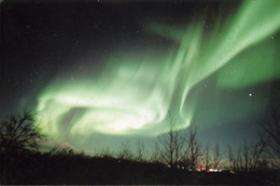
Auroras are an effect of light emitted from the upper atmosphere. The aurora on Earth, sometimes known as the Northern Lights, is a bright and colourful glow sometimes seen in the night sky in parts of the northern hemisphere. Auroras are usually generated when atmospheric atoms become excited by the electrons that are accelerating towards the planet.

The fact that there are also anti-planetward auroral electrons on Saturn just as on Earth, suggests that such electrons are a universal feature of all auroras. It was previously unclear whether anti-planetward electrons were a unique feature of the aurora on Earth. Auroras similar to the one on Earth are found on most planets in our Solar System.

Professor Michele Dougherty, of the Space and Atmospheric Physics group at Imperial College London and one of the authors of the research, said: "Auroras are still very mysterious and we dont fully understand what the connection is between the auroras and the electrons accelerating away from the Earth. The fact that we have now observed the same thing happening on Saturn means that we are even more curious about why this is taking place."

Scientists discovered anti-planetward electrons on Saturn using measurements taken by the Magnetospheric Imaging Instrument on the Cassini spacecraft. Magnetic field data from the magnetometer onboard Cassini was used to analyse the electron beams and Professor Dougherty is Principal Investigator for the magnetometer.

Source: Imperial College London


print this article email this article download pdf blog this article bookmark this article     Stumble it Digg this share on Facebook retweet share on Reddit add to delicious
Rate this story - 4.3 /5 (23 votes)


February 10, 2006 all stories

Comments: 0

4.3 /5 (23 votes)
  • Stumble this up

  • Digg this

  • share this

  • hide
  • Related Stories

  • Mystery Source of Solar Wind Heating Identified
    created Jul 17, 2009 | popularity not rated yet | comments 0
  • Novel spots found on Jupiter
    created Mar 17, 2008 | popularity not rated yet | comments 0
  • THEMIS probes view auroral substorms, bowshock explosions
    created Dec 11, 2007 | popularity not rated yet | comments 0
  • Scientists report first findings on key astrophysics problem
    created Nov 28, 2007 | popularity not rated yet | comments 0
  • Cluster and double star uncover more on bright aurorae
    created Sep 11, 2007 | popularity not rated yet | comments 0


Other News

Deep creep means milder, more frequent earthquakes along Southern California's San Jacinto fault

Deep creep means milder, more frequent earthquakes along Southern California's San Jacinto fault

Space & Earth / Earth Sciences

created 1hour ago | popularity 4 / 5 (1) | comments 0

With an average of four mini-earthquakes per day, Southern California's San Jacinto fault constantly adjusts to make it a less likely candidate for a major earthquake than its quiet neighbor to the east, the ...


Success in 'space elevator' competition (AP)

Success in 'space elevator' competition (Update 3)

Space & Earth / Space Exploration

created Nov 05, 2009 | popularity 4.3 / 5 (33) | comments 50

(AP) -- A robot powered by a ground-based laser beam climbed a long cable dangling from a helicopter on Wednesday to qualify for prize money in a $2 million competition to test the potential reality of the ...


'Dropouts' pinpoint earliest galaxies

'Dropouts' pinpoint earliest galaxies

Space & Earth / Astronomy

created Nov 06, 2009 | popularity 4.1 / 5 (9) | comments 12

Astronomers, conducting the broadest survey to date of galaxies from about 800 million years after the Big Bang, have found 22 early galaxies and confirmed the age of one by its characteristic hydrogen signature ...


Space hotel taking bookings for 2012 opening

Space hotel taking bookings for 2012 opening

Space & Earth / Space Exploration

created Nov 05, 2009 | popularity 4.4 / 5 (20) | comments 11

(PhysOrg.com) -- The first orbiting space hotel is on track to open for its first customers in 2012, but hurry, as bookings are filling fast.


In a Galaxy Far, Far Away...

In a Galaxy Far, Far Away...

Space & Earth / Astronomy

created Nov 06, 2009 | popularity 4.8 / 5 (4) | comments 11

(PhysOrg.com) -- Astronomers have published the discovery of the farthest known object in the cosmos: a star that exploded when the universe was only 630 million years old -- only 4.6% of its current age. ...