Fireproofing homes dramatically reduces forest fire size, according to new study
August 30, 2007 Fireproofing homes dramatically reduces forest fire size, according to new study

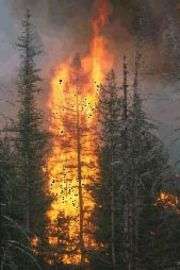
The size and intensity of forest fires is directly linked to the density and flammability of houses in the wildland-urban interface, according to a new study involving CU-Boulder researchers. Credit: U.S. Forest Service

A new study involving the University of Colorado at Boulder that modeled the spread of forest fires in Colorado and other western states indicates the size and intensity of fires is directly linked with the density and flammability of houses built in the so-called “wildland-urban interface.”

The study, which will be published in the Sept. 4 print edition of the Proceedings of the National Academy of Sciences, concluded that fireproofing houses in forests can dramatically reduce the size and spread of wildfires. Since houses are much more flammable per square yard than forests, homes that erupt in flames can propel forest fires to a critical intensity threshold much more quickly, said Patrick Bourgeron, a fellow at CU-Boulder’s Institute of Arctic and Alpine Research and co-author of the study.

The study, which also involved UCLA Professor Michael Ghil and graduate student Vassilis Spyratos of the French university Ecole Normale Superieure, used computers to model the spread of fires in forest ecosystems in Colorado, Montana Utah, New Mexico, Washington and Wisconsin. The PNAS study is the first to systematically look at both houses and trees in forest fire scenarios, said Bourgeron.

“The message here is that fireproofing homes not only preserves structures, but limits the size of forest fires,” said Bourgeron. “So fireproofing one’s home not only protects the people that live in it, it also protects their neighbors and ultimately the forests.”

Bourgeron said the U.S. government spends millions of dollars annually on forest thinning and the removal of excess fuel on the forest floor in an attempt to limit the size and intensity of forest fires. “But if the growing number of homes built in this wildland-urban interface aren’t fireproofed, it is essentially a waste of money,” he said.

Source: University of Colorado at Boulder


print this article email this article download pdf blog this article bookmark this article     Stumble it Digg this share on Facebook retweet share on Reddit add to delicious
Rate this story - 4 /5 (4 votes)


August 30, 2007 all stories

Comments: 0

4 /5 (4 votes)
  • Stumble this up

  • Digg this

  • share this

  • hide
  • Related Stories

  • NASA Aircraft Flies Calif. Wildfire Post-Burn Mission
    created 10 hours ago | popularity not rated yet | comments 0
  • After mastodons and mammoths, a transformed landscape
    created Nov 19, 2009 | popularity not rated yet | comments 0
  • Proposal to reintroduce Iberian lynx on abandoned agricultural land
    created Sep 17, 2009 | popularity not rated yet | comments 0
  • Electrical circuit runs entirely off power in trees
    created Sep 08, 2009 | popularity not rated yet | comments 0
  • Researchers stunned by inmates' success raising endangered frogs
    created Jul 09, 2009 | popularity not rated yet | comments 0


  • hide
  • Relevant PhysicsForums posts

  • The IPCC and the term "most"
    created Nov 23, 2009
  • Is global warming a fact?
    created Nov 23, 2009
  • Random variability of wind patterns
    created Nov 23, 2009
  • Record precipitation in the UK
    created Nov 22, 2009
  • More from Physics Forums - Earth

Other News

Monster Waves on the Sun are Real

Monster Waves on the Sun are Real (w/ Video)

Space & Earth / Astronomy

created 7 hours ago | popularity 5 / 5 (9) | comments 1

Sometimes you really can believe your eyes. That's what NASA's STEREO (Solar Terrestrial Relations Observatory) spacecraft are telling researchers about a controversial phenomenon on the sun known as the "solar ...


Cosmic 'dig' reveals vestiges of the Milky Way's building blocks

Cosmic 'Dig' Reveals Vestiges of the Milky Way's Building Blocks

Space & Earth / Astronomy

created 12 hours ago | popularity 4.9 / 5 (14) | comments 1

(PhysOrg.com) -- Peering through the thick dust clouds of our galaxy's "bulge" (the myriads of stars surrounding its center), a team of astronomers has unveiled an unusual mix of stars in the stellar grouping ...


No Wheel Stall in Diagnostic Drive

Spirit Mars Rover: No Wheel Stall in Diagnostic Drive

Space & Earth / Space Exploration

created 8 hours ago | popularity 4.5 / 5 (2) | comments 0

(PhysOrg.com) -- On Sol 2095 (Tuesday, Nov. 24), Spirit performed a set of diagnostic actions related to a stall of the right-rear wheel on the previous drive, three days earlier.


Climate experts debate strategies for reducing atmospheric carbon and future warming

Climate experts debate strategies for reducing atmospheric carbon and future warming

Space & Earth / Environment

created 8 hours ago | popularity 2.8 / 5 (6) | comments 7

(PhysOrg.com) -- Reducing carbon dioxide to safe levels may require extracting carbon from the air, says Cornell climate researcher.


Oceanic crust formation is dynamic after all

Oceanic crust formation is dynamic after all

Space & Earth / Earth Sciences

created 11 hours ago | popularity 4.6 / 5 (5) | comments 0

Imagine the Earth's crust as the planet's skin: Some areas are old and wrinkled while others have a fresher, more youthful sheen, as if they had been regularly lathered with lotion.