New research challenges previous knowledge about the origins of urbanization
August 30, 2007
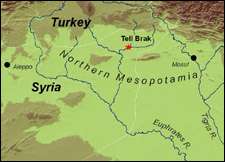
Map locating Tell Brak. Photo by Jason Ur
Ancient cities arose not by decree from a centralized political power, as was previously widely believed, but as the outgrowth of decisions made by smaller groups or individuals, according to a new study from researchers at Harvard University, the University of Cambridge, and the University of Edinburgh.
Published in the Aug. 31st Science, the research was led by Jason Ur, assistant professor of anthropology in the Faculty of Arts and Sciences at Harvard University, with Philip Karsgaard of the University of Edinburgh, and Joan Oates of the McDonald Institute for Archaeological Research of the University of Cambridge.
“The results of our work show that the existing models for the origins of ancient cities may in fact be flawed,” says Ur. “Urbanism does not appear to have originated with a single, powerful ruler or political entity. Instead, it was the organic outgrowth of many groups coming together.”
To understand patterns of population growth in the earliest urban areas, archaeologists surveyed the spatial distribution of artifacts at Tell Brak, located in northern Mesopotamia, in what is today northern Iraq and northeastern Syria. The researchers’ work was based on observation of surface objects at the site, along with satellite imagery and Geographic Information Systems (GIS) spatial analysis. Surface artifacts included bits of broken pottery and other ancient garbage, which indicated to the archaeologists where the inhabitants of the city lived. In this survey, the patterns of distribution of these objects were examined over an 800 year period.
Excavation of Tell Brak has been conducted by researchers from the University of Cambridge since 1976. While archaeologists had been aware of the large scale of Tell Brak, they had previously concentrated on excavating and observing the more densely populated “central mound.” This field survey has demonstrated that the city was much larger geographically than realized, and had also been populated by settlement clusters surrounding the “central mound.”
According to the survey of distribution of artifacts, around 4200 BCE the “central mound” was suddenly surrounded by these clusters, suggesting immigration to the city. These clusters were separated from one another, indicating social distance among the groups, possibly because the social mechanisms that allow strangers to live together in an urban environment had not yet evolved. The patterns of settlement and distance from the “central mound” also signified autonomy from the political center of the city.
The theory of a singular leader as the catalyst for urbanization has been widely supported in part because it is reinforced by the story of Gilgamesh, who “built” the city of Uruk. Uruk, located in what is today southern Iraq, had been considered the world’s oldest city. The field survey, along with recent related excavation by the University of Cambridge has shown that the urban development of Tell Brak was concurrent, or may have been earlier, than the development of Uruk.
“Ours is a largely urban society, and the nascent urbanization of Tell Brak tells us about the formation of the very first cities in the world,” says Ur.
Source: Harvard University
-
New community health approach aims to combats chronic disease, empower patients, reduces costs
17 hours ago |
5 / 5 (1) |
0
-
New tool for analyzing solar-cell materials
Feb 07, 2012 |
not rated yet |
0
-
Transmission of Clostridium difficile in hospitals may not be through contact with infected patients
Feb 07, 2012 |
4 / 5 (1) |
0
-
Online dating research shows cupid's arrow is turning digital
Feb 06, 2012 |
not rated yet |
0
-
Spectator rage: The dark side of professional sports
Feb 06, 2012 |
not rated yet |
0
-
Engineers build first sub-10-nm carbon nanotube transistor
Feb 01, 2012 |
4.9 / 5 (31) |
30
-
Something old, something new: Evolution and the structural divergence of duplicate genes
Jan 31, 2012 |
4.6 / 5 (7) |
1
-
The hidden nanoworld of ice crystals: Revealing the dynamic behavior of quasi-liquid layers
Jan 30, 2012 |
5 / 5 (3) |
1
-
Stock market network reveals investor clustering
Jan 27, 2012 |
3.9 / 5 (23) |
8
-
Of microchemistry and molecules: Electronic microfluidic device synthesizes biocompatible probes
Jan 26, 2012 |
5 / 5 (1) |
0
-
Protease cleavage
6 hours ago
-
Pertubance in a model
13 hours ago
-
Cancer drugs and Alzheimer's, Oh my!
21 hours ago
-
Squishing cells
22 hours ago
-
Any books/articles for evolutionary stable strategy models in humans?
Feb 09, 2012
-
Science behind the bore feeling?
Feb 09, 2012
- More from Physics Forums - Biology
More news stories
Employers feel no love for unscrupulous practice of 'service sweethearting'
A new study led by two Florida State University marketing professors finds that some frontline service employees who are rewarded for hikes in customer loyalty and satisfaction also may engage in "service ...
Other Sciences / Economics & Business
7 hours ago |
4 / 5 (1) |
4
A frank discussion of the power law and linking correlation to causation
(PhysOrg.com) -- Michael Stumpf a mathematics professor at Imperial College in London, and Mason Porter a lecturer at Oxford have teamed together to write and publish a perspective piece in Science regarding the in ...
The question of life in the ancient world
Theres a general feeling that we dont get the Greeks ancient or modern. Many, including heads of state like Angela Merkel, visibly shake their head in exasperation, rightly or wrongly, at ...
Other Sciences / Archaeology & Fossils
12 hours ago |
1.3 / 5 (3) |
4
Sonic Cradle lands spot in TED exhibition
A Simon Fraser University graduate student project that melds music, meditation and modern technology has landed a rare spot as an exhibit at TEDActive 2012 in Palm Springs, California this month.
9 hours ago |
not rated yet |
0
Chilean miners' rescue capsule on show in London
The capsule used to rescue Chilean miners trapped underground for two months goes on display Saturday at the Science Museum in London -- the first time it has been seen in Europe.
11 hours ago |
not rated yet |
0
Google users warned of threat to smartphone wallets
Users of Google smartphone wallets were being warned on Friday that there is a way to crack pass codes intended to thwart thieves from going on illicit shopping sprees.
Anonymous knocks CIA website offline (Update)
The website of the Central Intelligence Agency was inaccessible on Friday after the hacker group Anonymous claimed to have knocked it offline.
Complex wiring of the nervous system may rely on a just a handful of genes and proteins
Researchers at the Salk Institute have discovered a startling feature of early brain development that helps to explain how complex neuron wiring patterns are programmed using just a handful of critical genes. ...
New error-correcting codes guarantee the fastest possible rate of data transmission
Error-correcting codes are one of the triumphs of the digital age. Theyre a way of encoding information so that it can be transmitted across a communication channel such as an optical fiber o ...
The power of estrogen -- male snakes attract other males
A new study has shown that boosting the estrogen levels of male garter snakes causes them to secrete the same pheromones that females use to attract suitors, and turned the males into just about the sexiest ...
Putting the squeeze on planets outside our solar system
(PhysOrg.com) -- Using high-powered lasers, scientists at Lawrence Livermore National Laboratory and collaborators discovered that molten magnesium silicate undergoes a phase change in the liquid state, abruptly ...