Sharp unveils ultra-sensitive touch-screen LCD
August 31, 2007
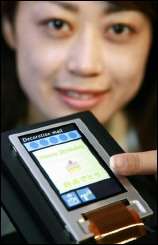
A Sharp employee demonstrates how to send an e-mail with a touch screen during a press conference in Tokyo. Sharp -- a leading producer of liquid crystal displays -- has unveiled a new LCD system equipped with an ultra-sensitive touch screen.
Japan's Sharp Corp, a leading producer of liquid crystal displays, on Friday unveiled a new LCD system equipped with an ultra-sensitive touch screen.
Sharp Corporation has developed a new System LCD equipped with touch screen and scanner functions.
An optical sensor is built into each pixel of the LCD panel, eliminating the need to bond a film to the panel for touch screen functions, and providing beautiful images without losing display image quality.
Today, touch screen functions are becoming indispensable on displays for mobile devices such as smartphones, digital cameras, PDAs, and UMPCs. However, conventional methods to provide such functions mainly involve laminating or bonding a film on top of the LCD panel, leading to problems with reduced display image quality and increased thickness for the display section.
In this light, Sharp developed its proprietary System LCD technology to successfully embed an optical sensor used in devices like scanners in each pixel of the LCD panel.
This technology eliminates the need for films, resulting in a thinner, beautifully clear screen display compared to conventional touch screens.
In addition, tactile recognition based on simultaneously touching multiple points on the screen is now possible, a feature previously difficult to implement. For example, users can easily tap the screen with two fingers to enlarge or reduce a displayed map.
Also, the scanner function can be used to scan in a business card placed on top of the screen, and further improvements to this function are expected to enable fingerprint authentication in the future.
Sample shipments will begin in September of this year, with volume production slated to start next spring.
Source: Sharp
-
Touchscreen table computer SUR40 starts pre-orders
Nov 21, 2011 |
5 / 5 (5) |
11
-
Review: Sifteo a fun but pricey new way to play
Aug 25, 2011 |
not rated yet |
0
-
Review: 5 e-book readers for less than $175
Jun 15, 2011 |
2 / 5 (1) |
5
-
Pioneer previews integrated floating image display technology
May 26, 2011 |
5 / 5 (2) |
2
-
Computerized table lets students do virtual dissection
May 10, 2011 |
not rated yet |
0
-
Engineers build first sub-10-nm carbon nanotube transistor
Feb 01, 2012 |
4.9 / 5 (33) |
30
-
Something old, something new: Evolution and the structural divergence of duplicate genes
Jan 31, 2012 |
4.6 / 5 (7) |
1
-
The hidden nanoworld of ice crystals: Revealing the dynamic behavior of quasi-liquid layers
Jan 30, 2012 |
5 / 5 (4) |
1
-
Stock market network reveals investor clustering
Jan 27, 2012 |
3.9 / 5 (23) |
8
-
Of microchemistry and molecules: Electronic microfluidic device synthesizes biocompatible probes
Jan 26, 2012 |
5 / 5 (2) |
0
-
How to tilt a object
3 hours ago
-
How to calculate total compressibility in liquid porous solid system
8 hours ago
-
Need help reading 3-D
Feb 11, 2012
-
A way to send and receive wireless data
Feb 11, 2012
-
Calling function with no input argument
Feb 10, 2012
-
Force free body diagram problem on gym equipment
Feb 10, 2012
- More from Physics Forums - General Engineering
More news stories
Japan scientist makes 'Avatar' robot
A Japanese-developed robot that mimics the movements of its human controller is bringing the Hollywood blockbuster "Avatar" one step closer to reality.
Feb 10, 2012 |
5 / 5 (9) |
12
Intel packs performance and reliability into its latest SSD 520 series
Intel Corporation announced today its fastest, most robust client/consumer solid-state drive (SSD) to date, the Intel Solid-State Drive 520 Series (Intel SSD 520), a 6 gigabit-per-second (gbps) SATA III SSD ...
Feb 07, 2012 |
5 / 5 (1) |
4
Google rumored to have built Heads-Up-Display glasses prototype
(PhysOrg.com) -- 9to5Google is reporting that they have received a tip from someone they believe to be a reliable source saying that Google is working on a Heads-Up-Display (HUD) pair of eye-glasses. The per ...
New Kindle Touch is an impressive e-reader
When it comes to reading digital books, tablets are all the rage. But there's a lot to like about simple e-readers, which over the past year have become both a lot cheaper and a lot less clunky.
Electronics / Consumer & Gadgets
Feb 09, 2012 |
5 / 5 (4) |
1
Apple to debut 'iPad 3' in March: report
Apple will unveil a new version of its market-ruling iPad table computer in March, according to a report in Dow Jones-owned technology blog All Things D.
Electronics / Consumer & Gadgets
Feb 09, 2012 |
1.9 / 5 (21) |
0
Scientists discover molecular secrets of 2,000-year-old Chinese herbal remedy
For roughly two thousand years, Chinese herbalists have treated Malaria using a root extract, commonly known as Chang Shan, from a type of hydrangea that grows in Tibet and Nepal. More recent studies suggest that halofuginone, ...
New method to examine batteries -- MRI from the inside
There is an ever-increasing need for advanced batteries for portable electronics, such as phones, cameras, and music players, but also to power electric vehicles and to facilitate the distribution and storage of energy derived ...
Google might launch Drive for cloud storage soon
(PhysOrg.com) -- Google's next big move, according to the Wall Street Journal, is a cloud storage service called Drive. Hardly first to the plate, Google is simply catching up to introducing its cloud reposi ...
A mitosis mystery solved: How chromosomes align perfectly in a dividing cell
Although the process of mitotic cell division has been studied intensely for more than 50 years, Whitehead Institute researchers have only now solved the mystery of how cells correctly align their chromosomes during symmetric ...
Lab study raises questions over nano-particle impact
Tests involving chickens have raised questions about the impact on health from engineered nano-particles, the ultra-fine grains commonly used in drugs and processed foods, scientists said on Sunday.
Starve a virus, feed a cure? Findings show how some cells protect themselves against HIV
A protein that protects some of our immune cells from the most common and virulent form of HIV works by starving the virus of the molecular building blocks that it needs to replicate, according to research published online ...