Researcher Finds Ancient Science and Math Are Timely
Two UC Davis researchers are cracking both the hieroglyphic code and cultural and mathematical understandings behind a 5,000-year calendar that is still used today in Mexico and Central America.
Native American studies professor Martha Macri and graduate student Michael Grofe say their study of the Mesoamerican calendar is revealing how Native Americans were able to calculate with computer-like accuracy the movements of the sun, planets and the moon through time.
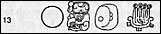
Macri, a linguistic anthropologist who studies ancient and contemporary languages, used her expertise to match the hieroglyphs -- pictorial characters used in Mayan writing -- to the 260-day ritual calendar.
With this knowledge, Macri created a theory that says the 260-day Mesoamerican calendrical cycle is based on various segments of the lunar cycle.
Her work is published in "Current Studies in Archaeoastronomy: Conversations Across Time and Space," edited by John W. Fountain and Rolf M. Sinclair, and published late in 2005.
Because Central America is located between the tropics of Cancer and Capricorn, the area is an ideal place to develop an accurate calendar, Macri points out. Only in these latitudes is it possible to observe precise solar zeniths, or when the sun is at the center of the sky at noon.
By about 200 B.C., people living along the Gulf Coast in Central America developed the Long Count through their observations of the solar zeniths. The count forms the basis of the more extensive Mesoamerican calendar. The Long Count, with its 13 full cycles of 400 years each, accurately extends back to 3114 B.C., which is when the current era was supposed to have begun.
To handle the uneven counting during leap years, the Long Count developers created an elegant mathematical solution, Macri says.
"They saw how leap years shifted over thousands of days," Macri says. "So, to deal with the fractions, they expressed the numbers by multiplying to get a full number, thus allowing for a more accurate calendar over a long period."
In their observations of solar, lunar and planetary movements over time, the Native Americans were able to create complex mathematical tables. To this day, "daykeepers" in the Guatemala highland serve as Mesoamerican calendar priests by continuing to observe the skies and note their observations, Macri says.
Graduate student Grofe has examined the complex tables used to record the counting cycles that the Mayans used to create accurate projections thousands of years into the past and the future.
"Although computers can calculate time now, these people were very capable of observation and empirical science," says Grofe, who also holds biology and anthropology degrees. "Using complex tables, they recorded unbroken counting cycles over thousands of years."
But Grofe is also interested in how the Native Americans then and now incorporate scientific observations of the empirical universe into their sacred world.
"While in the Western world science and religion are separated," Grofe says, "you can see that even way back when these calendars were first created, scientific observations were interwoven into their religious knowledge."
Source: UC Davis


