Male deer are born to live fast, die young
August 31, 2007 Iberian Red Deer

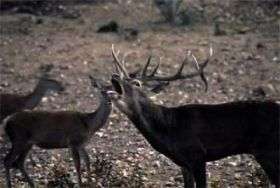
Roaring male Iberian red deer with females (photograph by Juan Carranza).

In the September issue of The American Naturalist, Juan Carranza (Biology and Ethology Unit, University of Extremadura, Spain) and Javier Pérez-Barbería (Macaulay Institute, United Kingdom) offer a new explanation for why males of ungulate species subjected to intense competition are born with lower survival expectancies than females.

The research reveals that male ungulates have smaller molars relative to their body size – and hence less durable teeth that will wear out sooner, which might contribute to their shorter lives compared with females.

Natural selection favors reproduction rather than survival; the cost of reproduction compromises survival. Males of species subjected to intense male-male competition for access to females are known to have shorter life expectancies than females. Earlier aging in males might be related to higher reproductive costs, especially when lifetime reproductive success in males takes place within the few years when they can win contests and maintain their dominance.

By comparing body and dental size of males and females of 123 species of ungulates, the authors offer another compelling explanation for why male ungulates lead shorter lives. They estimated the pattern of change of these traits along the evolutionary development of the group and found that for species where a single male has many females and where the males and females are different sizes, the rate of increase of dental size was lower than that of body size.
As a result, smaller teeth (in comparison to body size) are produced in males. It is possible that natural selection did not produce larger, more durable teeth because there was no reproductive return from it, since males in these species do not generally increase their success by living longer after prime age.

“These findings,” the authors state, “provide us with interesting insights into how natural and sexual selection design our bodies and their longevity.”

Citation: Juan Carranza and F. Javier Pérez-Barbería, "Sexual selection and senescence: male size-dimorphic ungulates evolved relatively smaller molars than females", The American Naturalist (2007) volume 170:370–380. DOI: 10.1086/519852

Source: University of Chicago Press Journals


print this article email this article download pdf blog this article bookmark this article     Stumble it Digg this share on Facebook retweet share on Reddit add to delicious
Rate this story - 4.8 /5 (4 votes)


August 31, 2007 all stories

Comments: 0

4.8 /5 (4 votes)
  • Stumble this up

  • Digg this

  • share this

  • hide
  • Related Stories

  • Scientists Unravel Evolution of Highly Toxic Box Jellyfish
    created Nov 18, 2009 | popularity not rated yet | comments 0
  • Studies suggest males have more personality
    created Nov 18, 2009 | popularity not rated yet | comments 0
  • For fish, bigger doesn’t always mean healthier
    created Nov 17, 2009 | popularity not rated yet | comments 0
  • In the war between the sexes, the one with the closest fungal relationship wins
    created Nov 10, 2009 | popularity not rated yet | comments 0
  • The bizarre lives of bone-eating worms
    created Nov 09, 2009 | popularity not rated yet | comments 0


Other News

Fish food fight: Fish don't eat trees after all, says new study

Fish food fight: Fish don't eat trees after all, says new study

Biology / Ecology

created 1hour ago | popularity not rated yet | comments 0

(PhysOrg.com) -- What constitutes fish food is a matter of debate. A high-profile study a few years ago suggested that fish get almost 50 percent of their carbon from trees and leaves, evidence for a very ...


Computational microscope peers into the working ribosome

Computational microscope peers into the working ribosome (w/ Video)

Biology / Cell & Microbiology

created 21 hours ago | popularity 4.9 / 5 (8) | comments 0

Two new studies reveal in unprecedented detail how the ribosome interacts with other molecules to assemble new proteins and guide them toward their destination in biological cells. The studies used molecular ...


New chameleon species discovered in East Africa

New chameleon species discovered in East Africa (w/ Podcast)

Biology / Plants & Animals

created 23 hours ago | popularity 5 / 5 (1) | comments 0

A new species of chameleon has been discovered in Tanzania by a team of scientists.


Spider secrets decoded in world-first database

Biology / Plants & Animals

created 15 hours ago | popularity not rated yet | comments 0

(PhysOrg.com) -- Queensland scientists have developed a world-first database that catalogues the venom components from hundreds of spiders.


A year after discovery, Congo's 'mother lode' of gorillas remains vulnerable

A year after discovery, Congo's 'mother lode' of gorillas remains vulnerable

Biology / Plants & Animals

created 18 hours ago | popularity 5 / 5 (1) | comments 0

A new study by the Wildlife Conservation Society says that western lowland gorillas living in a large swamp in the Republic of Congo—part of the "mother lode" of more than 125,000 gorillas discovered last ...