Ancient yucca chaws yield ancient DNA
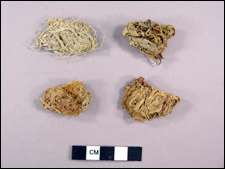
In a groundbreaking study, two Harvard scientists have for the first time extracted human DNA from ancient artifacts. The work potentially opens up a new universe of sources for ancient genetic material, which is used to map human migrations in prehistoric times.
Before this, archaeologists could only get ancient DNA from relics of the human body itself, including prehistoric teeth, bones, fossilized feces, or — rarely — preserved flesh. Such sources of DNA are hard to find, poorly preserved, or unavailable because of cultural and legal barriers.
By contrast, the genetic material used in the Harvard study came from two types of artifacts — 800 to 2,400 years old — that are found by the hundreds at archaeological sites in the American Southwest.
“Quids” — small fibrous bundles of stripped yucca leaves — are the spit-out remnants of a kind of ancient chewing gum. Cells from long-dried saliva yield usable DNA. And “aprons” were thong-like woven garments worn by women. They are stained with traces of apparent menstrual blood, a source of DNA.
The Harvard study, featured in the summer 2007 issue of the Journal of Field Archaeology, “opens up the possibility of utilizing a much larger variety of human-handled artifacts” for DNA evidence, said project co-director Steven LeBlanc, director of collections at Harvard’s Peabody Museum of Archaeology and Ethnology.
Among the likely future sources of ancient DNA, he said, are “sandals, textiles, and cane cigarettes,” a reedlike smoke favored by early humans. LeBlanc’s co-director in the project was Thomas Benjamin, a professor of pathology at Harvard Medical School.
LeBlanc and others sampled 48 quids from four Southwestern archaeological sites — some of them on Harvard museum shelves for nearly 100 years — and 18 aprons found in Canyon de Chelly, a National Park Service site in Arizona still occupied by the Navajo Nation.
Aprons, and especially quids, are very common in archaeological collections, and are recovered from rock shelters or caves in the Southwest, Utah, Texas, California, and central Mexico. The DNA is preserved by the extreme dryness of such sites.
The Harvard study brings other good news for historians of ancient times. LeBlanc said the DNA captured from quids and aprons shows — in a preliminary way — that early farming populations in the Southwest descended from farmers in what is now central Mexico. That helps answer an old question among those who study the ancient Southwest: Was the idea of farming imported, or was it adopted by indigenous populations?
More broadly, archaeologists interested in migration patterns anywhere now have a new source for the DNA that can be used to track the movement of ancient people — though LeBlanc cautioned that the methods have to be retested and refined.
The origins of the earliest North American farmers are still officially a puzzle, and center on a now-lost tribe known as the Western Basketmakers. More than 2,000 years ago, these indigenous Americans started growing corn in what is now southeastern Utah and northern Arizona.
In what is now a boon to archaeologists who look at DNA, early farmers rested in the shade of rock formations, and spit out quids of chewed yucca leaves.
“The team was as surprised as everyone else that we could learn something about a possible migration over 2,000 years ago from ancient spit,” said LeBlanc. “Every artifact that we recover from such ancient sites now needs to be thought of in a new light, and handled in new ways, to ensure we preserve this DNA for future studies.”
To make sure the DNA was from ancient farmers and not from modern handlers, samples were taken from the cores of the quids and not from their surfaces.
Peabody Museum experts say future studies of ancient DNA from quids, aprons, and other appropriate artifacts are needed to test and refine Harvard’s preliminary findings.
The study was a collaborative project. Harvard researchers worked with genetic anthropologist Shawn W. Carlyle at the University of Utah; pathologist Lori S. Cobb Kreisman at Case Western Reserve University School of Medicine; curator Anna N. Dhody at the Mütter Museum at the College of Physicians of Philadelphia; anthropologist Brian M. Kemp at Vanderbilt University; and Francis E. Smiley, an anthropologist at Northern Arizona University. Ancient DNA expert David Glenn Smith offered his advice and the use of his laboratory at the University of California, Davis.
Some of the artifacts used in the DNA analysis were from collections at the Brooklyn Museum of Art, the Southwest Museum, and Northern Arizona University.
Source: Harvard University


