Scientists develop low-cost recipe for patterning microchips
September 2, 2007 Fracture-induced Structuring Process

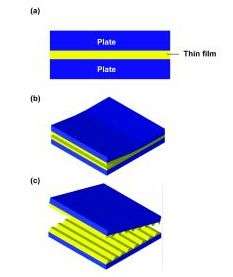
Fracture-induced structuring results in the self-formation of periodic lines, or gratings, separated by as few as 60 nanometers -- less than one ten-thousandth of a millimeter -- on microchips. First, a thin polymer film is painted onto a rigid plate, such as a silicon wafer. Then, a second plate is placed on top, creating a polymer sandwich that is heated to ensure adhesion. Finally, the two plates are pried apart. As the film fractures, it automatically breaks into two complementary sets of nanoscale gratings, one on each plate. Credit: Stephen Chou/Princeton University

Creating ultrasmall grooves on microchips -- a key part of many modern technologies -- is about to become as easy as making a sandwich, using a new process invented by Princeton engineers.

The simple, low-cost technique results in the self-formation of periodic lines, or gratings, separated by as few as 60 nanometers -- less than one ten-thousandth of a millimeter -- on microchips. Features of this size have many uses in optical, biological and electronic devices, including the alignment of liquid crystals in displays. The researchers will publish their findings Sept. 2 in the online version of Nature Nanotechnology.

“It’s like magic,” said electrical engineer Stephen Chou, the Joseph C. Elgin Professor of Engineering. “This is a fundamentally different way of making nanopatterns.”

The process, called fracture-induced structuring, is as easy as one-two-three. First, a thin polymer film is painted onto a rigid plate, such as a silicon wafer. Then, a second plate is placed on top, creating a polymer sandwich that is heated to ensure adhesion. Finally, the two plates are pried apart. As the film fractures, it automatically breaks into two complementary sets of nanoscale gratings, one on each plate. The distance between the lines, called the period, is four times the film thickness.

The ease of creating these lines is in marked contrast to traditional fabrication methods, which typically use a beam of electrons, ions, or a mechanical tip to “draw” the lines into a surface. These methods are serial processes which are extremely slow and therefore only suitable for areas one square millimeter or smaller. Other techniques suitable for larger areas have difficulties achieving small grating periods or producing a high yield, or they require complex and expensive processes. Fracture-induced structuring is not only simple and fast, but it enables patterning over a much larger area. The researchers have already demonstrated the ability of the technique to create gratings over several square centimeters, and the patterning of much large areas should be possible with further optimization of the technique.

“It’s remarkable – and counterintuitive – that fracturing creates these regular patterns,” said chemical engineering professor and dean of Princeton’s graduate school William Russel. Russel and his graduate student Leonard Pease III teamed with Chou and his graduate students Paru Deshpande and Ying Wang to develop the technique.

A patent application has been filed on the process, which the researchers say is economically feasible for large-scale use in industry. The gratings generated by the fracturing process also could be used in conjunction with existing patterning methods. For example, the nanoimprinting method invented by Chou in the 1990s can use the gratings generated by fracture-induced structuring to create a mold that enables mass duplication of patterns with high precision at low cost.

As with many scientific discoveries, the fracture-induced structuring process was happened upon accidentally. Graduate students in the Chou and Russel groups were trying to use instabilities in various molten polymers (in essence, melted plastic) to create patterns when they discovered instead that fracturing a solid polymer film can generate the gratings automatically. The team seized upon this finding and established the optimal conditions for grating formation.

Next, the group plans to explore the fundamental science behind the process and investigate the interplays of various forces at such a small scale, according to Chou.

“And, we want to push the limit and see how small we can go,” he said.

Source: Princeton University, Engineering School


print this article email this article download pdf blog this article bookmark this article     Stumble it Digg this share on Facebook retweet share on Reddit add to delicious
Rate this story - 4.6 /5 (36 votes)


September 2, 2007 all stories

Comments: 0

4.6 /5 (36 votes)
  • Stumble this up

  • Digg this

  • share this

  • hide
  • Related Stories

  • Neural noise created during binocular rivalry
    created Jun 19, 2009 | popularity not rated yet | comments 0
  • Research into the contrast sensitivity of persons with varying levels of visual acuity
    created Dec 17, 2008 | popularity not rated yet | comments 0
  • 'Edible optics' could make food safer
    created Aug 07, 2008 | popularity not rated yet | comments 0
  • Michigan laser beam believed to set record for intensity
    created Feb 15, 2008 | popularity not rated yet | comments 0
  • Mimicking How the Brain Recognizes Street Scenes
    created Feb 06, 2007 | popularity not rated yet | comments 0


  • hide
  • Relevant PhysicsForums posts

  • Bodies in motionÂ…..
    created 2 hours ago
  • Refraction optics help
    created 2 hours ago
  • A basketball Jump Shot
    created 2 hours ago
  • help with accelerometer
    created 4 hours ago
  • More from Physics Forums - General Physics

Other News

Engineers image nanostructure of a solid acid catalyst and boost its catalytic activity

Nanotechnology / Nanomaterials

created 1hour ago | popularity not rated yet | comments 1

The catalytic processes that facilitate the production of many chemicals and fuels could become much more environmentally friendly thanks to a breakthrough achieved by researchers from Lehigh and Rice Universities.


New transparent insulating film could enable energy-efficient displays

New transparent insulating film could enable energy-efficient displays

Nanotechnology / Nanomaterials

created 5 hours ago | popularity 4.8 / 5 (6) | comments 0

Johns Hopkins materials scientists have found a new use for a chemical compound that has traditionally been viewed as an electrical conductor, a substance that allows electricity to flow through it. By orienting ...


Ideal nanoparticle cancer therapies surf the bloodstream

Nanotechnology / Bio & Medicine

created 5 hours ago | popularity 5 / 5 (1) | comments 0

Eric Shaqfeh studies blood at Stanford University, using computer models that simulate how the fluid and the cells it contains move around. On November 11 at a meeting of the scientific society AVS, he will present his latest ...


New Digital 'Electronics' Concept May Continue Moore's Law

New Digital 'Electronics' Concept May Continue Moore's Law

Nanotechnology / Nanophysics

created Nov 05, 2009 | popularity 4.6 / 5 (56) | comments 9

(PhysOrg.com) -- Computers of the future could be operating not on electrons, but on tiny waves traveling through an electron "fluid," if a new proposal is successful. The new circuit design, recently introduced ...


Findings show nanomedicine promising for treating spinal cord injuries

Findings show nanomedicine promising for treating spinal cord injuries

Nanotechnology / Bio & Medicine

created Nov 08, 2009 | popularity 4.5 / 5 (4) | comments 0

(PhysOrg.com) -- Researchers at Purdue University have discovered a new approach for repairing damaged nerve fibers in spinal cord injuries using nano-spheres that could be injected into the blood shortly ...