Landslide threat to Pakistan earthquake survivors
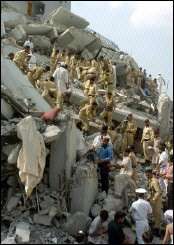
February 13, 2006 Pakistani policemen and rescuers remove debris from a collapsed building hit by a massive earthquake in Islamabad

A landslide expert at Durham University, UK, is warning that further disasters are waiting to happen in North Pakistan because of the unstable ground conditions created by last October’s earthquake.

Professor Dave Petley, of the International Landslide Centre in Durham's top-rated Geography Department, has returned from the earthquake zone after a reconnaissance mission with an US colleague. They have sent an urgent report to the Pakistan authorities with warnings and a list of actions required.

He says: “Although the national and international response to the disaster has been highly impressive there is a real need for the international community to take steps to help national organisations to prevent further tragedies in the coming months. The camps where people have lived since the earthquake could be hit by further landslips dislodged by the summer rains.”

The report warns about:
- A massive rock landslide in the Hattian area that has blocked two valleys to a depth of 250 metres. It was probably the largest earthquake-triggered landslip anywhere in the world during 2005. Two lakes are forming behind it and pose a serious threat. Previous studies show that 70 % of such landslide dams collapse and fail. Prof Petley recommends quick action to assess the stability of the dam, and the creation of a spillway to channel water safely before the July monsoons fill the lakes, causing overflow and possible collapse of the dam with potentially disastrous results.

- many other slopes in the area, left cracked and unstable by the earthquake. Monitoring equipment should be installed as soon as possible to assess the hazard. It may be advisable to move people out of some areas during the monsoon season.

- some of the tented villages for refugees built on the low terraces and 'alluvial fans'. These, say Prof Petley, are "highly dangerous positions". They are located at the bottom of slopes and close to rivers. The report adds: "These are near-perfect conditions for the generation of debris flows and flash-floods. Clearly the resistance of the tented villages to such events is effectively nil. We anticipate the potential for large-scale loss of life if this issue is not addressed."

Source: University of Durham


print this article email this article download pdf blog this article bookmark this article     Stumble it Digg this share on Facebook retweet share on Reddit add to delicious
Rate this story - 2.7 /5 (7 votes)


February 13, 2006 all stories

Comments: 0

2.7 /5 (7 votes)
  • Stumble this up

  • Digg this

  • share this

  • hide
  • Related Stories


Other News

Astronauts finish another spacewalk, still no baby (AP)

Astronauts finish another spacewalk, still no baby

Space & Earth / Space Exploration

created 6 hours ago | popularity 3 / 5 (2) | comments 0

(AP) -- A spacewalking astronaut put aside the impending birth of his daughter and blazed through his first-ever venture outside the International Space Station on Saturday.


Unseasonably hot and dry weather combined with strong winds to fan scores of blazes in the country's southeastern states

Australia issues 'catastrophic' alerts as fires rage

Space & Earth / Environment

created 12 hours ago | popularity 4.5 / 5 (2) | comments 0

Australia has issued "catastrophic" alerts after record-breaking temperatures and wild lightning storms sparked more than 100 fires across the country, officials said Saturday.


Commuters wait on the platform shrouded by fog in London

Climate change not man-made, say majority of Britons: poll

Space & Earth / Environment

created Nov 15, 2009 | popularity 3.3 / 5 (15) | comments 45

Less than half of Britons believes that human activity is to blame for global warming, according to a poll carried out for The Times newspaper and published on Saturday.


Mysteriously warm times in Antarctica

Mysteriously warm times in Antarctica

Space & Earth / Earth Sciences

created Nov 18, 2009 | popularity 4.2 / 5 (21) | comments 28

(PhysOrg.com) -- A new study of Antarctica's past climate reveals that temperatures during the warm periods between ice ages (interglacials) may have been higher than previously thought. The latest analysis ...


UN: Fight climate change with free condoms (AP)

UN: Fight climate change with free condoms

Space & Earth / Environment

created Nov 18, 2009 | popularity 3.1 / 5 (11) | comments 22

(AP) -- The battle against global warming could be helped if the world slowed population growth by making free condoms and family planning advice more widely available, the U.N. Population Fund said Wednesday.