Stellar Firework in a Whirlwind
September 3, 2007 Stellar Firework in a Whirlwind

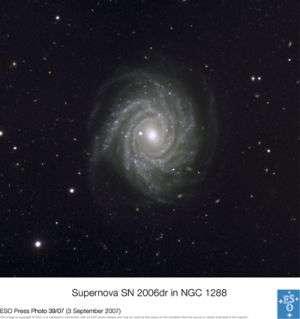
Colour-composite image of the Type Ia supernova SN 2006dr in the spiral galaxy NGC 1288, as observed with ESO's Very Large Telescope. It is based on images acquired through several filters (B, V, R, I and H-alpha) for a total exposure time of 5 minutes. The supernova is the bright object visible to the left of the centre of the galaxy. Many distant galaxies are also seen in the vicinity of NGC 1288, of which some are behind. The data were acquired by ESO's Paranal Science team. The final image was made by Henri Boffin (ESO).

Stars do not like to be alone. Indeed, most stars are members of a binary system, in which two stars circle around each other in an apparently never-ending cosmic ballet. But sometimes, things can go wrong.

When the dancing stars are too close to each other, one of them can start devouring its partner. If the vampire star is a white dwarf – a burned-out star that was once like our Sun – this greed can lead to a cosmic catastrophe: the white dwarf explodes as a Type Ia supernova.

In July 2006, ESO’s Very Large Telescope took images of such a stellar firework in the galaxy NGC 1288. The supernova - designated SN 2006dr - was at its peak brightness, shining as bright as the entire galaxy itself, bearing witness to the amount of energy released.

NGC 1288 is a rather spectacular spiral galaxy, seen almost face-on and showing multiple spiral arms pirouetting around the centre. Bearing a strong resemblance to the beautiful spiral galaxy NGC 1232, it is located 200 million light-years away from our home Galaxy, the Milky Way. Two main arms emerge from the central regions and then progressively split into other arms when moving further away. A small bar of stars and gas runs across the centre of the galaxy.

The first images of NGC 1288, obtained during the commissioning period of the FORS instrument on ESO's VLT in 1998, were of such high quality that they have allowed astronomers to carry out a quantitative analysis of the morphology of the galaxy. They found that NGC 1288 is most probably surrounded by a large dark matter halo. The appearance and number of spiral arms are indeed directly related to the amount of dark matter in the galaxy's halo.

The supernova was first spotted by amateur astronomer Berto Monard. On the night of 17 July 2006, Monard used his 30-cm telescope in the suburbs of Pretoria in South Africa and discovered the supernova as an apparent 'new star' close to the centre of NGC 1288, which was then designated SN 2006dr. The supernova reached magnitude 16, that is, it was about 10 000 times fainter than what the unaided eye can see.

Using spectra obtained with the Keck telescope on 26 July 2006, astronomers from the University of California found SN 2006dr to be a Type Ia supernova that expelled material with speeds up to 10 000 km/s.

Citation: "Morphological structure and colors of NGC 1232 and NGC 1288" by C. Moellenhoff et al., A&A 352, L5 (1999) and "Quantitative interpretation of the morphology of NGC 1288" by B. Fuchs and C, Moellenhoff, A&A 352, L36 (1999)

Source: ESO


print this article email this article download pdf blog this article bookmark this article     Stumble it Digg this share on Facebook retweet share on Reddit add to delicious
Rate this story - 4.2 /5 (39 votes)


September 3, 2007 all stories

Comments: 0

4.2 /5 (39 votes)
  • Stumble this up

  • Digg this

  • share this

  • hide
  • Related Stories

  • Maps Unveil the Source of Starburst Galaxy's Winds
    created Nov 18, 2009 | popularity not rated yet | comments 0
  • NGC 4710 galaxy: Baffling boxy bulge (w/ Video)
    created Nov 18, 2009 | popularity not rated yet | comments 0
  • Mysterious X-rays from a Nearby Galaxy
    created Nov 13, 2009 | popularity not rated yet | comments 0
  • Swift, XMM-Newton satellites tune into a middleweight black hole
    created Nov 10, 2009 | popularity not rated yet | comments 0
  • Rapid supernova could be new class of exploding star
    created Nov 05, 2009 | popularity not rated yet | comments 0


  • hide
  • Relevant PhysicsForums posts

  • Are there green, purple and pink stars?
    created 6 hours ago
  • Sideral question
    created Nov 21, 2009
  • Doppler shifted blackbody spectrum
    created Nov 21, 2009
  • Earth v. Moon
    created Nov 21, 2009
  • More from Physics Forums - General Astronomy

Other News

The shore of Deception Island in Antarctica, in 2008

Antarctic ice loss vaster, faster than thought: study

Space & Earth / Earth Sciences

created 11 hours ago | popularity 2.6 / 5 (12) | comments 10

The East Antarctic icesheet, once seen as largely unaffected by global warming, has lost billions of tonnes of ice since 2006 and could boost sea levels in the future, according to a new study.


Denmark: 65 world leaders for UN climate summit (AP)

Denmark: 65 world leaders for UN climate summit

Space & Earth / Environment

created 11 hours ago | popularity 1 / 5 (2) | comments 2

(AP) -- Sixty-five world leaders have said they will attend the Copenhagen climate summit in December, and several more have responded positively to invitations, Danish officials said Sunday.


Astronaut's baby daughter born as he circles Earth (AP)

Astronaut's baby daughter born as he circles Earth

Space & Earth / Space Exploration

created 11 hours ago | popularity 5 / 5 (1) | comments 0

(AP) -- Astronaut Randolph Bresnik jubilantly welcomed his new daughter into the world Sunday as he floated 220 miles above it.


Commuters wait on the platform shrouded by fog in London

Climate change not man-made, say majority of Britons: poll

Space & Earth / Environment

created Nov 15, 2009 | popularity 3.4 / 5 (16) | comments 46

Less than half of Britons believes that human activity is to blame for global warming, according to a poll carried out for The Times newspaper and published on Saturday.


Mysteriously warm times in Antarctica

Mysteriously warm times in Antarctica

Space & Earth / Earth Sciences

created Nov 18, 2009 | popularity 4.2 / 5 (21) | comments 31

(PhysOrg.com) -- A new study of Antarctica's past climate reveals that temperatures during the warm periods between ice ages (interglacials) may have been higher than previously thought. The latest analysis ...