500 days at Venus, and the surprises keep coming
September 3, 2007
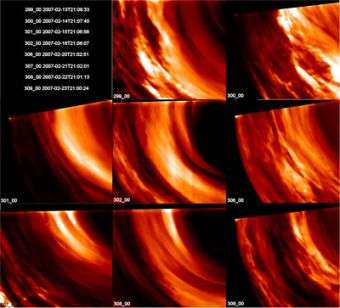
These images were taken in eight orbits within 10 consecutive Earth days (between orbits 299 and 309) with VIRTIS, in February 2007. The chosen wavelength was approximately 2.3 micrometres. The images were all taken on the night side, in the evening sector. The quarter that is observed is that which is experiencing late evening, or pre-midnight hours. It should be taken into account that Venus rotates very slowly as compared to Earth (one venusian day is 243 Earth days). The distances from the spacecraft to the region observed span 50 000 to 65 000 km. The contrast seen results from deeper cloud layers, at an altitude of about 50 km. The south pole is just outside the image, in the upper right hand side. It seems that the mid latitudes form a sort of transition region with mostly laminar flow. Moving equatorward, there is more convective flow in the atmosphere, whereas the polar region or the ‘black hole’ in the upper right hand side is where the vortex dominates. The meteorology of the planet, also its deep atmosphere, is highly variable. The images in the bottom row as well as the leftmost image in the middle row show laminar flow. The rest of the images show turbulent flow. Intense, bright colours show less cloudy areas, while darker, black areas, show more cloudy regions. This is because radiation coming from hotter regions below the clouds is blocked by thicker clouds. Credits: ESA/ VIRTIS/ INAF-IASF/ Obs. de Paris-LESIA
Venus Express has now orbited Earth’s twin for 500 Earth days, completing as many orbits. While the satellite maintains steady and excellent performance, the planet continues to surprise and amaze us.
In spite of experiencing a challenging environment, Venus Express is in an excellent condition. It receives four times the amount of solar radiation as compared to its sister spacecraft, Mars Express, but modifications to the spacecraft design have worked just as intended and operation has been very stable.
Many different activities transpire on board with each orbit: instruments are switched on and off, they change modes and targets and the spacecraft checks out and monitors its subsystems more or less continuously. The few anomalies that occurred were quickly resolved by vigilant spacecraft controllers.
An impressive amount of data - about 1 Terabits, or one million million bits - has been transmitted to Earth over the first 500 days.
Håkan Svedhem, Venus Express Project Scientist says, "The scientists analysing the data have a challenging but exciting task ahead.” They will have to archive the data and extract the most important detail from this immense collection of images, spectra and profiles of temperature, pressure and chemical composition.
Some of the first detailed analyses are now being completed and will soon be published in acclaimed scientific journals. Among many other findings that have surprised scientists, Venus’ atmosphere seems extremely fickle. Recent observations with the Visible and Near-Infrared Mapping Spectrometer (VIRTIS), the atmospheric structure changes quite rapidly, from day to day.
Source: ESA
-
Scientists still searching for the Beagle 2 crash site on Mars
Jan 16, 2012 |
5 / 5 (3) |
1
-
Russian spacecraft delivers 3 to orbiting station
Dec 25, 2011 |
5 / 5 (2) |
5
-
MARSIS completes measurement campaign over Martian North Pole
Dec 20, 2011 |
2 / 5 (2) |
3
-
US-Russian crew blasts off for space station
Nov 14, 2011 |
5 / 5 (3) |
0
-
Battered Tharsis Tholus volcano on Mars
Nov 09, 2011 |
3.7 / 5 (3) |
0
-
Engineers build first sub-10-nm carbon nanotube transistor
Feb 01, 2012 |
4.9 / 5 (30) |
30
-
Something old, something new: Evolution and the structural divergence of duplicate genes
Jan 31, 2012 |
4.6 / 5 (7) |
1
-
The hidden nanoworld of ice crystals: Revealing the dynamic behavior of quasi-liquid layers
Jan 30, 2012 |
5 / 5 (3) |
1
-
Stock market network reveals investor clustering
Jan 27, 2012 |
3.9 / 5 (23) |
8
-
Of microchemistry and molecules: Electronic microfluidic device synthesizes biocompatible probes
Jan 26, 2012 |
5 / 5 (1) |
0
-
Titan's lack of impact craters
18 hours ago
-
Real pictures of black hole eating a star?
Feb 08, 2012
-
Hypothetical way to travel faster than light, but not technically exceed lightspeed
Feb 06, 2012
-
How do scientists monitor the Sun's activity?
Feb 05, 2012
-
Search patterns in observational studies
Feb 05, 2012
-
Derivation of Pogson's law
Feb 03, 2012
- More from Physics Forums - General Astronomy
More news stories
New views show old NASA Mars landers
(PhysOrg.com) -- The High Resolution Imaging Science Experiment (HiRISE) camera on NASA's Mars Reconnaissance Orbiter recorded a scene on Jan. 29, 2012, that includes the first color image from orbit showing ...
Space & Earth / Space Exploration
21 hours ago |
4.9 / 5 (7) |
9
|
Black holes and star formation
(PhysOrg.com) -- It has long been recognized that galaxy mergers or even close interactions can play a vital role in shaping the morphology of galaxies. One way they can do so, it is thought, is by triggering ...
20 hours ago |
4.1 / 5 (7) |
5
|
Deconstructing a mystery: What caused Snowmaggedon?
In the quiet after the storms, streets and cars had all but disappeared under piles of snow. The U.S. Postal Service suspended service for the first time in 30 years. Snow plows struggled to push the evidence ...
Space & Earth / Earth Sciences
13 hours ago |
4.7 / 5 (3) |
1
|
Ocean microbe communities changing, but long-term environmental impact is unclear
As oceans warm due to climate change, water layers will mix less and affect the microbes and plankton that pump carbon out of the atmosphere but researchers say it's still unclear whether these processes ...
Space & Earth / Earth Sciences
15 hours ago |
5 / 5 (2) |
2
|
Researchers create 3-D laser maps that show how earthquake changes landscape
Geologists have a new tool to study how earthquakes change the landscape down to a few inches, and it's giving them insight into how earthquake faults behave. In the Feb. 10 issue of the journal Science, a team ...
Space & Earth / Earth Sciences
15 hours ago |
5 / 5 (4) |
0
|
Fighting crimes against biodiversity: How to catch a killer weed
Invasive species which have the potential to destroy biodiversity and influence global change could be tracked and controlled in the same way as wanted criminals, according to new research from Queen Mary, University of London.
A novel method for simultaneously measuring blood pressure and arterial stiffness
Arterial stiffness due to is a major contributor to cardiovascular disease but is very difficult to measure. It also can influence blood pressure readings since these rely on the time taken for arteries to return to normal ...
Study finds that red blood cell transfusion decreases fatigue in women with acute postpartum anemia
In a study to be presented today at the Society for Maternal-Fetal Medicine's annual meeting, The Pregnancy Meeting , in Dallas, Texas, researchers will report findings that show that in women with acute postpartum ...
Study weighs risks and benefits of birthing facilities
In a study to be presented today at the Society for Maternal-Fetal Medicine's annual meeting, The Pregnancy Meeting , in Dallas, Texas, researchers will report findings that indicate that the risk of obstetric intervention ...
FDA-approved drug rapidly clears amyloid from the brain, reverses Alzheimer's symptoms in mice
Neuroscientists at Case Western Reserve University School of Medicine have made a dramatic breakthrough in their efforts to find a cure for Alzheimer's disease. The researchers' findings, published in the journal Science, show t ...
'Dark plasmons' transmit energy
Microscopic channels of gold nanoparticles have the ability to transmit electromagnetic energy that starts as light and propagates via "dark plasmons," according to researchers at Rice University.