Cosmic Cockroaches

September 3, 2007 Cosmic Cockroaches

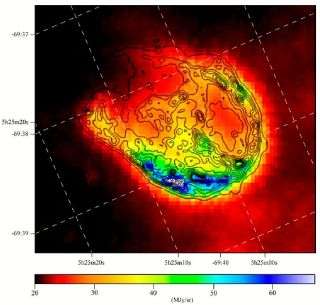
Supernova remnant N132D. Contours trace hot gas observed by the Chandra X-ray Observatory. Colors denote IR radiation mapped by the Spitzer Space Telescope. Image credit: Achim Tappe and colleagues.

Starved. Stomped. Radiated. Poisoned. It's all in a day's work for the common household cockroach. The abuse these creatures can withstand is amazing.

But astronomers have found something even tougher—"polycyclic aromatic hydrocarbons," says Achim Tappe of the Harvard Center for Astrophysics. "They can survive a supernova."

Polycyclic aromatic hydrocarbons (PAHs for short) are ring-shaped molecules made of carbon and hydrogen. They're about as well loved as roaches: PAHs are a widespread organic pollutant, appearing in auto exhaust, oil spills and cigarette smoke. The EPA has classified seven PAH compounds as human carcinogens.

But even PAHs have their virtues: Ring-shaped molecules similar to PAHs are found in DNA, and there's a growing consensus among biologists that PAHs were present on Earth 4.5 billion years ago when life began. By serving as building blocks for larger molecules of life, PAHs may have played an essential role in the chemical process of genesis.

That's why Tappe's recent discovery may be so important.

The story begins 3000 years ago when a massive star in the Large Magellanic Cloud exploded. It was, in most respects, a typical supernova explosion, releasing in a just few days the energy our sun produces in about 10 billion years. Hot gas and deadly radiation blasted through nearby star systems, while the exploding star itself was mostly (and perhaps completely) destroyed.

The supernova's expanding shell, catalogued by astronomers as "N132D", remains visible from Earth after all these years. It spans 80 light years and has swept up some 600 Suns worth of mass. Images from the Chandra X-ray Observatory reveal the still-hot outlines--see the diagram below.

Last year "we scanned N132D using the Spitzer Space Telescope," says Tappe. Spitzer is an infrared (IR) telescope, and it has a spectrometer onboard sensitive to the IR emissions of PAHs. One look at N132D revealed "PAHs all around the supernova's expanding shell. They appear to be swept up by a shock wave of 8 million degree gas. This is causing some damage to the molecules, but many of the PAHs are surviving."

Astronomers have long known that PAHs are abundant not only on Earth but throughout the cosmos—they've been found in comet dust, meteorites and many cold interstellar clouds—but who knew they were so tough? "This is our first evidence that PAHs can withstand a supernova blast," he says.

Their ability to survive may be key to life on Earth. Many astronomers are convinced that a supernova exploded in our corner of the galaxy 4-to-5 billion years ago just as the solar system was coalescing from primitive interstellar gas. In one scenario of life's origins, PAHs survived and made their way to our planet. It turns out that stacks of PAHs can form in water—think, primordial seas—and provide a scaffold for nucleic acids with architectural properties akin to RNA and DNA.

"It's an exciting and promising theory," says Tappe. "But more experiments and observations are needed to decide its ultimate success or failure." Tappe is doing his part with a new round of Spitzer observations: "We're mapping the distribution of PAHs around N132D, comparing the locations of the molecules to the arc of shock waves revealed by Chandra," he explains. From this "we hope to learn how PAHs are 'processed' by the blast, and how many survive."

In the end, PAHs may prove tough enough for genesis itself. Cockroaches, eat your hearts out.

Source: by Dr. Tony Phillips, Science@NASA


print this article email this article download pdf blog this article bookmark this article     Stumble it Digg this share on Facebook retweet share on Reddit add to delicious
Rate this story - 4.3 /5 (22 votes)


September 3, 2007 all stories

Comments: 0

4.3 /5 (22 votes)
  • Stumble this up

  • Digg this

  • share this

  • hide
  • Related Stories

  • Scientists Reproduce a Building Block of Life in Laboratory
    created Nov 06, 2009 | popularity not rated yet | comments 0
  • Component of mothballs is present in deep-space clouds
    created Sep 02, 2009 | popularity not rated yet | comments 0
  • Pavement sealcoat a source of toxins in stormwater runoff
    created Apr 08, 2009 | popularity not rated yet | comments 0
  • Mars Rover device gets new mission on Earth
    created Feb 05, 2009 | popularity not rated yet | comments 0
  • Laser fluorescence could find life on Mars
    created Jun 23, 2008 | popularity not rated yet | comments 0


  • hide
  • Relevant PhysicsForums posts

  • Consistency of Meteor Shower Dates (i.e. the peak of Perseids always on Aug 13th)
    created Nov 10, 2009
  • Favourite Astronomy Book?
    created Nov 10, 2009
  • dark energy
    created Nov 10, 2009
  • The shape of our solar system's orbits.
    created Nov 07, 2009
  • More from Physics Forums - General Astronomy

Other News

Exoplanets Clue to Sun's Curious Chemistry

Exoplanets Clue to Sun's Curious Chemistry

Space & Earth / Astronomy

created 7 hours ago | popularity 4.8 / 5 (11) | comments 7

(PhysOrg.com) -- A ground-breaking census of 500 stars, 70 of which are known to host planets, has successfully linked the long-standing "lithium mystery" observed in the Sun to the presence of planetary systems. ...


Earth's early ocean cooled more than a billion years earlier than thought: Stanford study

Earth's early ocean cooled more than a billion years earlier than thought (w/ Video)

Space & Earth / Earth Sciences

created 7 hours ago | popularity 4.8 / 5 (4) | comments 0

(PhysOrg.com) -- The scalding-hot sea that supposedly covered the early Earth may in fact never have existed, according to a new study by Stanford University researchers who analyzed isotope ratios in 3.4 ...


A Tale of Planetary Woe

A Tale of Planetary Woe (w/ Video)

Space & Earth / Space Exploration

created 4 hours ago | popularity 5 / 5 (3) | comments 1

Once upon a time — roughly four billion years ago — Mars was warm and wet, much like Earth. Liquid water flowed on the Martian surface in long rivers that emptied into shallow seas. A thick atmosphere blanketed ...


Researchers Discover Use for Carbon Dioxide in Conversion of Biomass Into Biofuel

Researchers Discover Use for Carbon Dioxide in Conversion of Biomass Into Biofuel

Space & Earth / Environment

created 4 hours ago | popularity 3.6 / 5 (5) | comments 1

(PhysOrg.com) -- Researchers at Columbia University have successfully discovered a beneficial use for carbon dioxide in the conversion of organic materials, such as grass and bark, into fuel. Their findings ...


A bubbling ball of gas

A bubbling ball of gas (w/ Video)

Space & Earth / Space Exploration

created 8 hours ago | popularity 5 / 5 (10) | comments 3

The Sun is a bubbling mass. Packages of gas rise and sink, lending the sun its grainy surface structure, its granulation. Dark spots appear and disappear, clouds of matter dart up - and behind the whole thing ...