Ultraconserved Elements in the Genome: Are They Indispensable?
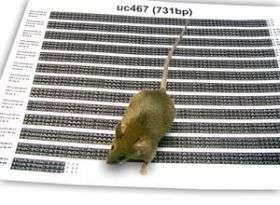
Three years ago, "ultraconserved elements" were discovered in the genomes of mice, rats, and humans. These are DNA sequences 200 base pairs in length or longer — some are over 700 base pairs long — showing 100-percent identity among the three species. They have been perfectly conserved since the last common ancestor of mice, rats, and humans, which lived some 85 million years ago.
These and other highly conserved sequences are thought to have persisted with little or no change because they are indispensable, performing functions vital for viability or reproduction. Scientists in the Genomics Division of the Department of Energy's Lawrence Berkeley National Laboratory and DOE's Joint Genome Institute set out to test this hypothesis by engineering four different "knockout" mice, each lacking one selected ultraconserved element.
If truly indispensable, mice lacking an ultraconserved element should either die or be unable to produce viable offspring. Remarkably, as the researchers report in the September, 2007 issue of PLoS Biology, the knockout mice in this study showed almost no ill effects at all.
"For us, this was a really surprising result," says Nadav Ahituv of Berkeley Lab's Genomics Division and DOE's JGI, a human geneticist who led the experiment. "We fully expected to demonstrate the vital role these ultraconserved elements play by showing what happens when they are missing. Instead, our knockout mice were not only viable and fertile but showed no critical abnormalities in growth, longevity, pathology, or metabolism."
Edward Rubin, Director of the Joint Genome Institute and Berkeley Lab's Genomics Division, who directed the study, said, "Many scientists had speculated that the reason for absolute identity of sequences over the 80 million years since humans and rodents diverged was that these sequences are crucial for life: if a base changes, the organism would die, so that's why we see absolutely no sequence changes in these regions. The results of this study clearly show that this is not the case. While I don't think we can conclude that the mice we created with the ultraconserved elements deleted are normal, we can confidently conclude that the presence of the ultraconserved elements are not required for the viability of the organism."
Choosing the sequences
Some of the 481 ultraconserved sequences in humans, rats, and mice are coding sequences, genes that code for proteins, but over half, termed noncoding ultraconserved elements, are not. Previous studies by the Berkeley Lab researchers and their colleagues have suggested an important role for these noncoding sequences in gene regulation; because they act to promote the expression of genes they are known as "enhancers."
For this study the team specifically chose four ultraconserved noncoding elements, thought to be enhancers of nearby genes that when mutated lead to severe developmental abnormalities or fertility problems.
For example, noncoding ultraconserved element number 467 (uc467) has 731 base pairs of sequence that are identical among human, mouse, and rat; it is one of the longest of all ultraconserved elements within our genome. Uc467 is thought to be an enhancer for ARX, a gene that, when defective in mice, disturbs male sexual development and causes lethal brain abnormalities, and in humans causes a wide range of neurological and sexual-development disorders.
Using standard mouse genetic-engineering techniques, the researchers prepared four lines of knockout mice, each type lacking one of the chosen ultraconserved elements.
"We knew that knocking out the genes themselves leads to lethality or sexual abnormalities in mice, and sometimes other problems," says Ahituv. "So we expected that mice lacking the ultraconserved sequences that are thought to regulate these genes would produce a similar result: lethality or infertility."
Instead of the expected drastic results, however, all four lines produced normal litters of healthy mice. Their weight was normal during 10 weeks of monitoring; the mice were watched for six months (and by now, many have been watched much longer) and not only survived but thrived. They were subjected to numerous clinical assays with no signs of abnormality, and no significant differences compared to the wild-type controls.
If not crucial, why conserved?
"There is plenty of evidence that highly conserved sequences do perform vital functions," says Ahituv. "Indeed, locating noncoding sequences that have been unchanged by evolution is one of the main tools scientists use to find important functional elements in a genome."
While it's conceivable that conserved sequences are somehow immune to mutations for reasons that have nothing to do with evolutionary pressures, the mechanism of such "sequence armoring" is hard to imagine. The 731-base pair sequence, uc467, should normally have accumulated some 334 nucleotide changes in the more than 80 million years that mice, rats, and humans have been evolving along separate paths.
Much more plausible is the assumption that these identical DNA sequences persist because nucleotide substitutions in them would render the organism less fit; thus evolution selects against them. So why don't problems show up immediately in mice that are missing a conserved sequence?
"Evolution and natural selection do not happen overnight," says Len Pennacchio, a Berkeley Lab senior scientist who is one of the primary authors of the study. "The deletion of these elements likely has relatively mild effects on fitness that are gradually selected against over time — several or more generations from when they arise — but not on observable time scales. The observation is that ultraconserved elements do not tolerate substitions since their last common ancestor over 80 million years ago — but this tells us nothing about when such changes were selected against. Surely they did occur and were removed on an evolutionary time scale. Exactly when is not known."
Redundancy is another possibility, says Ahituv, analogous to gene redundancy that can rescue the organism from expected abnormalities when vital genes are knocked out. "It may be that we saw no deleterious effects in the knockouts because nature provides a backup for these ultraconserved elements. We know that for one of the elements we chose, there are other noncoding ultraconserved elements positioned near it in the genome that show similar enhancer activity. These may rescue the organism from the abnormalities we speculated would be caused by the missing ultraconserved sequences — though this still does not explain why they are so ultimately conserved."
The discovery that deletion of ultraconserved elements does not render mice unviable or infertile is a major challenge to our understanding of how highly conserved elements of the genome persist and what their functions are, says Ahituv. He and his colleagues are pursuing research aimed at answering these compelling new questions.
"Deletion of ultraconserved elements yields viable mice," by Nadav Ahituv, Yiwen Zhu, Axel Visel, Amy Holt, Veena Afzal, Len A. Pennacchio, and Edward M. Rubin, appears in the September, 2007 issue of PLoS Biology and is available online at dx.doi.org/10.1371/journal.pbio.0050234 .
Source: Berkeley Lab


