Software enables 'thoroughly modern milling'
September 4, 2007
Software enables 'thoroughly modern milling'

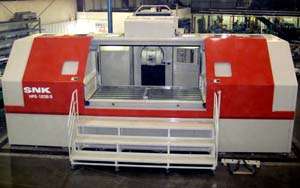
Software developed using a concept discovered at WUSTL may be used to optimize high-speed machining processes, leading to lighter, stronger, and more accurate parts for the aircraft or medical device industry. Credit: WUSTL

An engineer at Washington University in St. Louis has helped find a way to "cut the chatter" in high-speed machining of aluminum and titanium aircraft parts.

Chatter in milling is an instability that arises because the cutting tool vibrates, making oscillating patterns on the work piece. The tool goes over the patterns, making the tool vibrate even more, yielding deeper patterns in the work piece, worsening until eventually the chatter destroys the tool or work piece.

Now researchers including Philip V. Bayly, Ph.D., Washington University Hughes Professor of Mechanical Engineering, and Washington University alumnus Jerry Halley, of Tech Manufacturing, Wright City, Missouri, have developed software that predicts when chatter is going to occur as well as the accuracy of the cut. The software is based on a technique called time finite element analysis (TFEA).

Avoiding chatter allows much faster machining, makes the tool last longer, and increases the quality of the parts. Lighter, stronger, and more accurate parts lead to faster, more durable, and more affordable aircraft.

"This analytical technique helps get accurate machining processes and can play a major role in businesses creating higher quality parts that are less costly to make," said Bayly. "You can get a big pay off in stability and accuracy just by changing the speed at which the tools cut. That's one of the key things that TFEA finds out."

TFEA simulations are performed before the milling process, using a computer model of the machining system. The analysis predicts good and bad speeds for stability and accuracy of the cuts.

Bayly and several colleagues have applied for a patent on a concept that will take advantage of TFEA to design machining processes. The computations can be done so speedily that the hope is that the software will be used widely in advanced aerospace, automotive, and medical machine shops.

Source: Washington University in St. Louis

4.8 /5 (6 votes)  

Rank 4.8 /5 (6 votes)
Tags

Relevant PhysicsForums posts
  • How to calculate total compressibility in liquid porous solid system
    created3 hours ago
  • Need help reading 3-D
    created23 hours ago
  • A way to send and receive wireless data
    createdFeb 11, 2012
  • Calling function with no input argument
    createdFeb 10, 2012
  • Force free body diagram problem on gym equipment
    createdFeb 10, 2012
  • Empirical data regarding shower heads and water
    createdFeb 10, 2012
  • More from Physics Forums - General Engineering

More news stories

Google might launch Drive for cloud storage soon

(PhysOrg.com) -- Google's next big move, according to the Wall Street Journal, is a cloud storage service called Drive. Hardly first to the plate, Google is simply catching up to introducing its cloud reposi ...

Technology / Internet

created 11 hours ago | popularity 4.8 / 5 (5) | comments 4 | with audio podcast report

Iran blocks email, restricts net access: reports

Iran has further restricted access to the Internet and blocked popular email services for the past few days, in a move a top lawmaker said could "cost the regime dearly," media reports said on Sunday.

Technology / Internet

created 4 hours ago | popularity 5 / 5 (1) | comments 3

Love a click away in Indonesia's Twitter Republic

He was a geeky kid from Yogyakarta, she a glamorous city girl in Jakarta. In a country with one of the world's most vibrant social networking scenes they fell in love on Twitter.

Technology / Internet

created 12 hours ago | popularity 4 / 5 (1) | comments 0

Walney offshore wind farm is world's biggest (for now)

(PhysOrg.com) -- The Walney wind farm on the Irish Sea--characterized by high tides, waves and windy weather--officially opened this week. The farm is treated in the press as a very big deal as the Walney ...

Technology / Energy & Green Tech

created Feb 11, 2012 | popularity 4.2 / 5 (13) | comments 45 | with audio podcast weblog

Navy to begin tests on electromagnetic railgun prototype launcher

The Office of Naval Research (ONR)'s Electromagnetic (EM) Railgun program will take an important step forward in the coming weeks when the first industry railgun prototype launcher is tested at a facility ...

Technology / Engineering

created Feb 06, 2012 | popularity 4.5 / 5 (17) | comments 94 | with audio podcast


Overeating may double risk of memory loss

New research suggests that consuming between 2,100 and 6,000 calories per day may double the risk of memory loss, or mild cognitive impairment (MCI), among people age 70 and older. The study was released today and will be ...

Scientists discover molecular secrets of 2,000-year-old Chinese herbal remedy

For roughly two thousand years, Chinese herbalists have treated Malaria using a root extract, commonly known as Chang Shan, from a type of hydrangea that grows in Tibet and Nepal. More recent studies suggest that halofuginone, ...

New method to examine batteries -- MRI from the inside

There is an ever-increasing need for advanced batteries for portable electronics, such as phones, cameras, and music players, but also to power electric vehicles and to facilitate the distribution and storage of energy derived ...

Injured boomers beware: Know when to see doctor

(AP) -- It happened to nurse Jane Byron years after an in-line skating fall, business owner Haralee Weintraub while doing "men's" push-ups, and avid cyclist Gene Wilberg while lifting a heavy box.

Lab study raises questions over nano-particle impact

Tests involving chickens have raised questions about the impact on health from engineered nano-particles, the ultra-fine grains commonly used in drugs and processed foods, scientists said on Sunday.

A mitosis mystery solved: How chromosomes align perfectly in a dividing cell

Although the process of mitotic cell division has been studied intensely for more than 50 years, Whitehead Institute researchers have only now solved the mystery of how cells correctly align their chromosomes during symmetric ...