Early California: A killing field
Research shatters utopian myth, finds Indians decimated bird
"The wild geese and every species of water fowl darkened the surface of every bay � in flocks of millions�. When disturbed, they arose to fly. The sound of their wings was like that of distant thunder."
When explorers and pioneers visited California in the 1700s and early 1800s, they were astonished by the abundance of birds, elk, deer, marine mammals, and other wildlife they encountered. Since then, people assumed such faunal wealth represented California's natural condition � a product of Native Americans' living in harmony with the wildlife and the land and used it as the baseline for measuring modern environmental damage.
That assumption now is collapsing because University of Utah archaeologist Jack M. Broughton spent seven years � from 1997 to 2004 � painstakingly picking through 5,736 bird bones found in an ancient Native American garbage dump on the shores of San Francisco Bay. He determined the species of every bone, or, when that wasn't possible, at least the family, and used the bones to reconstruct a portrait of human bird-hunting behavior spanning 1,900 years.
Broughton concluded that California wasn't always a lush Eden before settlers arrived. Instead, from 2,600 to at least 700 years ago, native people hunted some species to local extinction, and wildlife returned to "fabulous abundances" only after European diseases decimated Indian populations starting in the 1500s.
Broughton's study of bird bones, published in Ornithological Monographs, mirrors earlier research in which he found that fish such as sturgeon, mammals such as elk, and other wildlife also sustained significant population declines at the hands of ancient Indian hunters.
Biologists long assumed that the abundant wildlife in California some 200 years ago had existed for thousands of years � an assumption "that is ultimately used to make decisions about how to manage and conserve threatened or endangered species," says Broughton, an associate professor of anthropology.
"Since European discovery, California has been viewed by scholars and scientists, as well as the general public � as a kind of utopia or a land of milk and honey, a super-rich natural environment," he says. "This perception has long colored anthropological research on the state's native peoples. The harvesting methods and strategies of native peoples have been suggested to have promoted the apparent superabundance of wildlife, and have been proposed as models for the management of wilderness areas and national parks today."
Broughton says his study challenges "a common perception about ancient Native Americans as healthy, happy people living in harmony with the environment. That clearly was not always the case. Depending on when and where you look back in time, native peoples were either living in harmony with nature or eating their way through a vast array of large-sized, attractive prey species."
The study may have broader implications. Broughton speculates that "utopian perceptions" of a pristine California teeming with wildlife "probably even influence how Californians view themselves, and how the world views the Golden State. The dream world of Disneyland, the glamour and glimmer of Hollywood, the Baywatch fun-in-the-sun culture � all of this may trace a link to early historic descriptions of the land that now appear to be worlds apart from pre-European conditions."
Himself a product of sunny California, Broughton grew up in rural Camarillo in the southern part of the state, "collecting butterflies, watching birds, and skinning skunks."
While earning bachelor's and master's degrees at California State University, Chico, he studied bones from archaeological sites in California's Sacramento Valley and began to recognize that early natives had a strong impact on elk, deer, and sturgeon � "anything big and juicy," he says.
For his doctoral dissertation at the University of Washington, Broughton analyzed fish and mammal bones taken from the Emeryville shellmound, an ancient Indian site on the east shore of San Francisco Bay between Oakland and Berkeley.
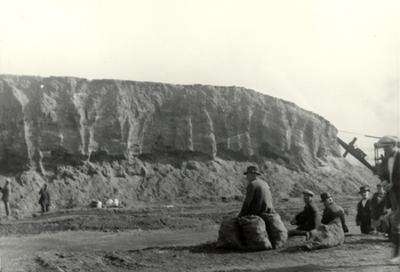
About 2,600 years ago, California's native people started living on the site and using it to dump residential waste such as shellfish remnants, bones, soil, rocks, ash and charcoal, and artifacts such as stone tools. The mound slowly grew until it was more than 30 feet tall, as long as three football fields, and as wide as the length of one football field. Then, in the 1800s, the top layers were flattened to make way for a dance pavilion, eliminating debris from recent centuries. What was left was a record of refuse containing the kinds of things native Californians hunted and ate from 2,600 to 700 years ago.
Emeryville was the largest of some 425 shellmounds identified along San Francisco Bay by 1900. It was made up of distinct layers, which allowed dating of its bones. In 1902, 1906, and 1924, scientists excavated thousands from the shellmound, recording the layer in which each bone was found. The shellmound then was destroyed by a steam shovel to make way for a paint factory, which was razed in the 1990s and replaced by retail stores. The shellmound bones were stored for decades at the Phoebe Apperson Hearst Museum of Anthropology at the University of California, Berkeley.
After finishing his dissertation on Emeryville mammal and fish bones, Broughton joined the University of Utah faculty in 1995. Two years later, he started examining the Hearst Museum's bird bones from the shellmound, alternating between that project and other research during the next seven years.
Analyzing 5,736 bones was a labor of love for him. "It's fun and relaxing," Broughton says. "It's a real challenge when you've got a broken bird bone and it could be any of 100 species. It may take hours or a day to identify a single bone. So you can imagine the excitement when you finally nail it."
To identify the shellmound bones, Broughton painstakingly compared them with bird bones kept in the University of Utah's Zooarchaeology Laboratory, which includes specimens from numerous sources, ranging from road kill to victims of Alaska's Exxon Valdez oil tanker spill.
Broughton found that the Hearst Museum's bones represented 64 species: 45 species of waterbirds, including ducks, geese, cormorants, and shorebirds; 15 species of raptors such as red-tailed hawks and bald eagles; and two species each from the groups that include grouse and quail, and crows and ravens. In terms of the number of specimens, waterbirds were most abundant, particularly ducks, geese, and cormorants.
By analyzing the relative abundances of the birds, Broughton showed that the bird population diminished throughout the entire 1,900-year period represented by the shellmound. Species with the most significant population reductions were those most attractive to hunters: large birds and birds that lived closer to humans. Among waterfowl, large geese on land and in marshes declined sooner than smaller geese and ducks, but as the supply of large geese waned, an increasing number of small geese and ducks from estuaries were hunted and their bones dumped in the shellmound.
As nearby food sources diminished, native peoples increasingly hunted birds at greater distances--particularly cormorant chicks on island breeding colonies--and depleted their populations. The bones also show increased hunting over time of sea ducks, found only in open water and on the outer coast, as duck populations lessened on land and in marshes. After depleting larger shorebirds � marbled godwits, long-billed curlews, and whimbrels � natives then hunted smaller shorebirds such as sandpipers.
Broughton's conclusion that hunting by native peoples depressed bird populations came only after he rejected possible alternative causes, such as changes in prehistoric climate and reductions in bird habitat. For example, the decline in cormorants might have been caused by the climate disruption known as El Ni�o. If true, the species most affected should be Brandt's and pelagic cormorants, which depend on food in ocean currents altered by El Ni�o. Instead, the population decline was most pronounced in double-crested cormorants, which lived closer to Indian hunters.
Broughton believes the Bay Area harbored a prehistoric native population of 50,000 to 150,000 before Europeans arrived in the 1500s. He believes that birds and other wildlife rebounded only after early European explorers came into contact with natives, infecting them with fatal diseases such as smallpox, malaria, and influenza and killing off as much as 90 percent of the Indian population.
As a result, hunting pressure diminished, and by the mid-1800s, geese and ducks "were so abundant you could kill them with a club or stick," he says.
Until Broughton's study, "the general consensus was that pre-European humans living in North America had little or no effect on continental wildlife populations," says a commentary by John Faaborg, editor of Ornithological Monographs and a wildlife biology professor at the University of Missouri-Columbia.
Except for "special cases" of ancient natives decimating bird populations on islands � such as Hawaii 1,000 years ago � many scientists view "negative effects on bird populations as a modern phenomenon, one that came along with burgeoning populations virtually throughout the globe," he adds.
But now, Faaborg writes, "We need to reconsider our impressions about human impacts on bird populations in the distant past. Jack Broughton makes an excellent case that native peoples living in the San Francisco Bay area harvested enough birds to deplete populations and even cause some local extinction, perhaps as long as 2,000 years ago."
While bird researchers emphasize human-caused environmental damage when discussing modern loss of birds, they often "do not consider that similar processes may have been occurring for thousands of years," Broughton concludes. Although visitors in the 1700s and early 1800s "witnessed an astonishing abundance of wildlife, the region had been characterized by human-induced faunal poverty only decades before and would nearly return to that condition with the wave of human consumers that came with the Gold Rush."
Source: University of Utah


