Hot Ice to Lubricate Artificial Joints
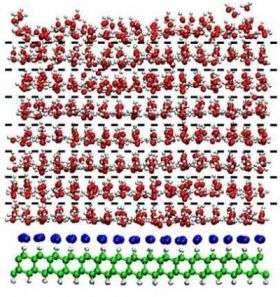
A recent simulation has shown that thin layers of ice could persist on specially treated diamond coatings at temperatures well above body temperature, which could make ice-coated-diamond films an ideal coating for artificial heart valves, joint replacements, and wear-resistant prosthetics.
Physicists Alexander D. Wissner-Gross and Efthimios Kaxiras of Harvard modeled water ice on top of a diamond surface coated with sodium ions. They found that ice layers should persist on the treated diamond up to temperatures of 108 degrees Fahrenheit (42 Celsius), and in some circumstances could remain frozen beyond the boiling point of water.
Because of the gem's strength and other unusual characteristics, artificially grown diamond films are among the most promising candidates for applications ranging from medical implants to solar cells. Adding a layer of high-temperature ice could make the diamond even more suitable for medical devices by reducing its abrasiveness and inhibiting protein build-up.
Among other promising applications, the physicists believe that the ice layer could enhance the efficiency of diamond film-based solar collectors, while being much more environmentally friendly than lithium-ion batteries and other energy storage devices.
A short film that the researchers made from of some of their simulations was a finalist in the 2007 Materials Research Film Festival (www.alexwg.org/DiamondIce.mov). The work also earned Wissner-Gross the 2007 Dan David Prize Scholarship from Tel Aviv University and the 2007 Graduate Student Silver Award from the Materials Research Society.
Citation: Alexander D. Wissner-Gross and Efthimios Kaxiras, Physical Review E (August 2007)
Source: American Physical Society


