Lovers and liars: How many sex partners have you really had?
Lovers and public health officials want an answer to the following question: How many opposite-sex partners have you had in your lifetime?
The answer, statisticians say, ought to be the same, on average, for any large group of men and women. But most surveys in the United States, the United Kingdom and other nations find that men report two-to-four times as many sexual partners as do women.
Are men lying to inflate their sexual reputations? Are women lying to downplay their sexual experience?
Psychologist Norman R. Brown believes this "macho and maiden" hypothesis is the wrong explanation. Most men and women don't intentionally misrepresent their sexual histories, he maintains. Instead, his studies show that male-female differences in the methods used to estimate the number of partners one has had is the major reason for the discrepancy.
"Women are more likely to rely on enumeration," said Brown, a visiting research scientist at the University of Michigan Institute for Social Research. "They tend to say, ‘I just know,' and if you ask them to explain how they know, they say, ‘Well, there was John, Tom, etc.' This is a strategy that typically leads to underestimation.
"Men are twice as likely to use rough approximation to answer the question. And rough approximation is a strategy known to produce over-estimation."
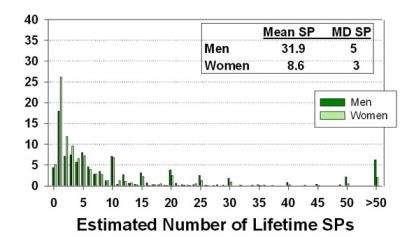
Brown, a professor of psychology at the University of Alberta, and colleagues Robert Sinclair of Laurentian University and Sean Moore of the Augustana College, have conducted several studies of this issue. The largest and most recent is a Web-based survey conducted in fall 2005. The researchers polled a Knowledge Networks panel of 2,065 heterosexual, U.S. non-virgins with a median age in their late 40s. The average number of sexual partners the women reported was 8.6. The average number the men reported was 31.9.
"The men in this survey were producing egregiously elevated responses," Brown said.
To try to sort out how much the discrepancy was due to the use of different estimating methods and how much was due to flat-out lying, Brown and colleagues first asked respondents how many sexual partners they had in their lifetimes and how they generated their partner estimates. Later in the survey, they asked them to rate the truthfulness of their answers to that question.
To Brown's surprise, 5 percent of the men and 4 percent of the women indicated they had not been truthful when they answered the sexual-partners question, and an additional 16 percent of the men and 11 percent of the women indicated they provided a response that they knew to be inaccurate. Thus, in total, 21 percent of the men and 15 percent of the women admitted they had lied and/or they had provided an inaccurate partner count.
"They gave an answer and then two minutes later admitted they had lied about the answer," Brown said.
Analyzing the responses of these admitted liars, whom Brown calls "self-incriminators," compared to other respondents who said they were telling the truth, he found that self-incriminators composed more than half of all respondents who said they had had more than 50 lifetime sex partners. More concretely, there were 39 self-incriminators among the 76 men who claimed that they had had more than 50 partners, and there were 11 self-incriminators among the 17 women who indicated the same thing.
Brown also found that self-incriminators were more likely than other respondents to use rough approximation as a method of identifying the number of sex partners and that removing these self-incriminators from the sample significantly reduced the gender discrepancy in reports of sex partners. However, removing the self-incriminators did not eliminate the discrepancy nor did it alter the relationship between gender and strategy use. Brown and his colleagues concluded that "bad-faith" responding is one part of the story and that cognitive factors also play an important role.
Brown and colleagues are now analyzing data from a large-scale telephone survey designed to see if Web-based surveys encourage or support extreme response patterns.
Maybe the high-count, self-incriminators are just "flaming trolls," Brown said. "They could be liars who lie about lying."
Source: the University of Michigan


