Hubble, Spitzer find 'Lego-block' galaxies in early universe
September 6, 2007
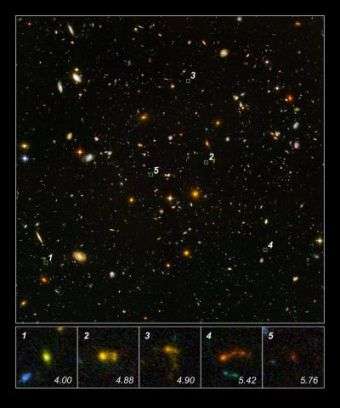
In this image of the Hubble Ultra Deep Field, several objects are identified as the faintest, most compact galaxies ever observed in the distant Universe. They are so far away that we see them as they looked less than one billion years after the Big Bang. Blazing with the brilliance of millions of stars, each of the newly discovered galaxies is a hundred to a thousand times smaller than our Milky Way Galaxy. The bottom row of pictures shows several of these clumps (distance expressed in redshift value). Three of the galaxies appear to be slightly disrupted. Rather than being shaped like rounded blobs, they appear stretched into tadpole-like shapes. This is a sign that they may be interacting and merging with neighboring galaxies to form larger structures. The detection required joint observations between Hubble and NASA's Spitzer Space Telescope. Blue light seen by Hubble shows the presence of young stars. The absence of red light from Spitzer observations conclusively shows that these are truly young galaxies without an earlier generation of stars. Credit: NASA, ESA, and N. Pirzkal (European Space Agency/STScI)
The conventional model for galaxy evolution predicts that small galaxies in the early Universe evolved into the massive galaxies of today by coalescing. Nine Lego-like “building block” galaxies initially detected by Hubble likely contributed to the construction of the Universe as we know it. “These are among the lowest mass galaxies ever directly observed in the early Universe” says Nor Pirzkal of the European Space Agency/STScI.
Pirzkal was surprised to find that the galaxies’ estimated masses were so small. Hubble’s cousin observatory, NASA’s Spitzer Space Telescope was called upon to make precise determinations of their masses. The Spitzer observations confirmed that these galaxies are some of the smallest building blocks of the Universe.
These young galaxies offer important new insights into the Universe’s formative years, just one billion years after the Big Bang. Hubble detected sapphire blue stars residing within the nine pristine galaxies. The youthful stars are just a few million years old and are in the process of turning Big Bang elements (hydrogen and helium) into heavier elements. The stars have probably not yet begun to pollute the surrounding space with elemental products forged within their cores.
“While blue light seen by Hubble shows the presence of young stars, it is the absence of infrared light in the sensitive Spitzer images that was conclusive in showing that these are truly young galaxies without an earlier generation of stars,” says Sangeeta Malhotra of Arizona State University in Tempe, USA, one of the investigators.
The galaxies were first identified by James Rhoads of Arizona State University, USA, and Chun Xu of the Shanghai Institute of Technical Physics in Shanghai, China. Three of the galaxies appear to be slightly disrupted – rather than being shaped like rounded blobs, they appear stretched into tadpole-like shapes. This is a sign that they may be interacting and merging with neighbouring galaxies to form larger, cohesive structures.
The galaxies were observed in the Hubble Ultra Deep Field (HUDF) with Hubble’s Advanced Camera for Surveys and the Near Infrared Camera and Multi-Object Spectrometer as well as Spitzer’s Infrared Array Camera and the European Southern Observatory’s Infrared Spectrometer and Array Camera. Seeing and analysing such small galaxies at such a great distance is at the very limit of the capabilities of the most powerful telescopes. Images taken through different colour filters with the ACS were supplemented with exposures taken through a so-called grism which spreads the different colours emitted by the galaxies into short “trails”. The analysis of these trails allows the detection of emission from glowing hydrogen gas, giving both the distance and an estimate of the rate of star formation. These “grism spectra” - taken with Hubble and analysed with software developed at the Space Telescope-European Coordinating Facility in Munich, Germany - can be obtained for objects that are significantly fainter than can be studied spectroscopically with any other current telescope.
Source: ESA
-
The turbulent birth of super star clusters in galaxy mergers
Feb 10, 2012 |
5 / 5 (3) |
0
-
'Proplyd-like' objects discovered in Cygnus OB2
Jan 16, 2012 |
5 / 5 (1) |
0
-
Hubble pinpoints furthest protocluster of galaxies ever seen
Jan 10, 2012 |
4.8 / 5 (12) |
42
-
Mysterious red galaxies
Dec 12, 2011 |
4.7 / 5 (11) |
36
-
Image: Active Galaxy Centaurus A
Jan 04, 2012 |
4.8 / 5 (4) |
0
-
Engineers build first sub-10-nm carbon nanotube transistor
Feb 01, 2012 |
4.9 / 5 (33) |
30
-
Something old, something new: Evolution and the structural divergence of duplicate genes
Jan 31, 2012 |
4.6 / 5 (7) |
1
-
The hidden nanoworld of ice crystals: Revealing the dynamic behavior of quasi-liquid layers
Jan 30, 2012 |
5 / 5 (4) |
1
-
Stock market network reveals investor clustering
Jan 27, 2012 |
3.9 / 5 (23) |
8
-
Of microchemistry and molecules: Electronic microfluidic device synthesizes biocompatible probes
Jan 26, 2012 |
5 / 5 (2) |
0
-
Never ending outer space.....
21 hours ago
-
Neutron Star fragments?
23 hours ago
-
stationary or not?
Feb 11, 2012
-
Scale of the Universe
Feb 10, 2012
-
Titan's lack of impact craters
Feb 09, 2012
-
Real pictures of black hole eating a star?
Feb 08, 2012
- More from Physics Forums - General Astronomy
More news stories
Salvage workers begin pumping fuel from Italian shipwreck
Salvage workers Sunday began pumping fuel from the shipwrecked Italian cruise liner Costa Concordia, a day ahead of schedule, officials said.
6 hours ago |
5 / 5 (1) |
0
Latin America mining boom clashes with conservation
Latin America is experiencing a mining boom as prices rise fuelled by a hike in global demand, but the region is also being hit by a wave of violent protests, strikes and rallies by environmentalists.
14 hours ago |
5 / 5 (1) |
1
Political leaders play key role in how worried Americans are by climate change: study
More than extreme weather events and the work of scientists, it is national political leaders who influence how much Americans worry about the threat of climate change, new research finds.
Feb 06, 2012 |
5 / 5 (7) |
73
NASA budget will axe Mars deal with Europe: scientists
US President Barack Obama's budget proposal to be submitted next week for 2013 will cut NASA's budget by 20 percent and eliminate a major partnership with Europe on Mars exploration, scientists said Thursday.
Space & Earth / Space Exploration
Feb 10, 2012 |
5 / 5 (3) |
58
Humans may have helped the decline of African rainforests 3000 years ago
(PhysOrg.com) -- Large areas of rainforests in Central Africa mysteriously disappeared over three thousand years ago, to be replaced by savannas. The prevailing theory has been that the cause was a change ...
Scientists discover molecular secrets of 2,000-year-old Chinese herbal remedy
For roughly two thousand years, Chinese herbalists have treated Malaria using a root extract, commonly known as Chang Shan, from a type of hydrangea that grows in Tibet and Nepal. More recent studies suggest that halofuginone, ...
New method to examine batteries -- MRI from the inside
There is an ever-increasing need for advanced batteries for portable electronics, such as phones, cameras, and music players, but also to power electric vehicles and to facilitate the distribution and storage of energy derived ...
Overeating may double risk of memory loss
New research suggests that consuming between 2,100 and 6,000 calories per day may double the risk of memory loss, or mild cognitive impairment (MCI), among people age 70 and older. The study was released today and will be ...
A mitosis mystery solved: How chromosomes align perfectly in a dividing cell
Although the process of mitotic cell division has been studied intensely for more than 50 years, Whitehead Institute researchers have only now solved the mystery of how cells correctly align their chromosomes during symmetric ...
Lab study raises questions over nano-particle impact
Tests involving chickens have raised questions about the impact on health from engineered nano-particles, the ultra-fine grains commonly used in drugs and processed foods, scientists said on Sunday.
Google might launch Drive for cloud storage soon
(PhysOrg.com) -- Google's next big move, according to the Wall Street Journal, is a cloud storage service called Drive. Hardly first to the plate, Google is simply catching up to introducing its cloud reposi ...