New system helps aircraft avoid turbulence
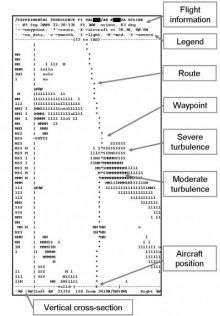
A new turbulence detection system now being tested is successfully alerting pilots to patches of rough air as they fly through clouds. The system, designed by the National Center for Atmospheric Research (NCAR) and tested by United Airlines on commercial flights, is designed to better protect passengers from injuries caused by turbulence while reducing flight delays and lowering aviation costs.
The new system uses a mathematical method developed by NCAR scientists, known as the NEXRAD Turbulence Detection Algorithm, or NTDA, to analyze data obtained from the National Weather Service's network of Next-Generation (NEXRAD) Doppler radars. The resulting real-time snapshot of turbulence can be transmitted to pilots in the cockpit and made available to airline meteorologists and dispatchers via a Web-based display.
The research is funded by the Federal Aviation Administration (FAA) in partnership with the National Science Foundation, NCAR's primary sponsor.
"Pinpointing turbulence in clouds and thunderstorms is a major scientific challenge," says NCAR scientist John Williams. "Our goal is to use these radar measurements to create a three-dimensional mosaic showing turbulence across the country that can help pilots avoid hazardous areas, or at least give them enough warning to turn on the 'fasten seat belt' sign."
The NTDA is being tested until October by a group of United Airlines pilots who fly routes east of the Rockies. The pilots, who receive information in their cockpits about turbulence detected ahead, report that the system provides them with accurate information about turbulence that is not available from any other source.
"The messages I've received in the cockpit gave a very accurate picture of turbulence location and intensity," says Captain Rocky Stone, chief technical pilot for United Airlines. "The depiction of turbulence intensity provides an unprecedented and extremely valuable new tool for pilot situational awareness."
Depending on the results of this year's tests, the next step may be to expand the system to additional United aircraft or other airlines. Williams anticipates that, by 2011, the NTDA will provide input to a system over the contiguous United States that will update comprehensive turbulence "nowcasts" for pilots and air traffic managers every 15 minutes.
"We hope this will provide a significant boost to the aviation industry in terms of passenger comfort, safety, and reduced costs," Williams says.
New data from existing radars
Pilots in the past have lacked accurate measurements of turbulence that develops in clouds and thunderstorms, partly because turbulent areas may be small, evolve quickly, and occur outside the most intense parts of the storm. As a result, FAA guidelines suggest that planes avoid thunderstorms by at least 20 miles when possible, even though large sections of that area may contain relatively calm air.
The NTDA captures turbulence in storms by peering into clouds to analyze the distribution of winds. It reprocesses radar data to remove factors that can contaminate measurements, such as sunlight, nearby storms, or even swarms of insects flying near the radar dish. It also averages a series of measurements to improve the reliability of its turbulence estimates.
This year's tests build on smaller-scale tests with United Airlines in the summers of 2005 and 2006 that showed it was possible to successfully detect moderate-or-greater turbulence more than 80 percent of the time. NCAR scientists have refined the NTDA since then, and expect that this year's demonstration will show additional improvements to the system's accuracy.
Source: National Center for Atmospheric Research/University Corporation for Atmospheric Research


