Quantum Criticality Found in a Simple Liquid
September 7, 2007
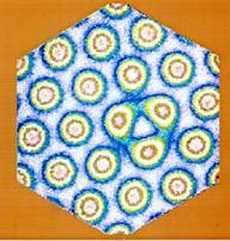
The 3He layer L1 solidifies into a two dimensional quantum solid on a triangular lattice. The atoms move in this solid even at absolute zero, due to quantum exchange. Shown is the ring exchange of three atoms. The solid is a two dimensional frustrated magnet. Credit: University of London
A team from the Low Temperature Laboratory, Royal Holloway, University of London, has discovered a breakdown of the standard theoretical model of strongly interacting fermions in liquid 3He films.
The findings, which are published in Science on 7 September 2007, have implications for the understanding of metallic systems near so called ‘quantum critical points’. In these ‘strange’ metals, electric currents no longer seem to be carried by electrons, but rather by some more complex excitations, the nature of which are not fully understood.
Metals have been important materials to humankind for millennia, yet it seems that we still do not have a complete understanding of the full richness of the metallic state. In this sense the implications of these new phenomena are potentially far-reaching.
Professor Saunders explains: ‘Heavy fermion behaviour and quantum criticality are usually associated with rather complex materials, and have defied definitive explanation. Our observation of the breakdown of Fermi liquid behaviour in a two dimensional variant of bulk liquid 3He, the Fermi liquid paradigm, is unexpected and exciting’.
He adds: ‘Helium has always been a fertile playground for fundamental condensed matter physics. Liquid 4He was the first Bose-Einstein Condensate and superfluid 3He the first p-wave superfluid. There is even the suggestion that solid 4He may be a supersolid. We need simple systems to test candidate theories for explaining complex systems.’
This fundamental research at Royal Holloway underpins the huge international programme of ‘materials discovery’ which is currently underway. New materials with new properties drive important new device applications.
This research was supported by the Engineering and Physical Sciences Research Council, UK.
Source: by Alison Denyer, University of London
-
Life in Antarctic lake? It's everywhere else
4 minutes ago |
not rated yet |
0
-
High planetary tilt lowers odds for life?
Feb 06, 2012 |
4.8 / 5 (12) |
14
-
Scientists make strides toward fixing infant hearts
Feb 06, 2012 |
4.7 / 5 (3) |
0
-
Elements of ExoPlanets
Feb 02, 2012 |
4.9 / 5 (8) |
0
-
Under the electron microscope -- A 3-D image of an individual protein
Jan 25, 2012 |
4.9 / 5 (12) |
0
-
Engineers build first sub-10-nm carbon nanotube transistor
Feb 01, 2012 |
4.9 / 5 (29) |
30
-
Something old, something new: Evolution and the structural divergence of duplicate genes
Jan 31, 2012 |
4.6 / 5 (7) |
1
-
The hidden nanoworld of ice crystals: Revealing the dynamic behavior of quasi-liquid layers
Jan 30, 2012 |
5 / 5 (3) |
1
-
Stock market network reveals investor clustering
Jan 27, 2012 |
3.9 / 5 (23) |
8
-
Of microchemistry and molecules: Electronic microfluidic device synthesizes biocompatible probes
Jan 26, 2012 |
5 / 5 (1) |
0
-
Orbital Decay Question
1 hour ago
-
Pure energy
6 hours ago
-
How to remove the magnetic property for screw driver?
9 hours ago
-
How to magnetize a concrete wall?
13 hours ago
-
Upward speed of an object in water
14 hours ago
-
flipping quarks
14 hours ago
- More from Physics Forums - General Physics
More news stories
Physics research suggests new pathways for cancer progression
Observing that certain cancer cells may exhibit greater flexibility than normal cells, some scientists believe that this capability promotes rapid tumor growth. Now computer simulations developed by Boston University Biomedical ...
1 hour ago |
5 / 5 (1) |
0
Borexino Collaboration succeeds in spotting pep neutrinos emitted from the sun
(PhysOrg.com) -- To learn more about how the sun works, scientists study particles that are emitted from it into space due to thermonuclear reactions that occur inside; by applying known physics principles, ...
Transparent iron? For the first time, an experiment shows that atomic nuclei can become transparent
At the high-brilliance synchrotron light source PETRA III, a team of DESY scientists headed by Dr. Ralf Röhlsberger has succeeded in making atomic nuclei transparent with the help of X-ray light. At the ...
22 hours ago |
5 / 5 (9) |
3
|
Physicists build highly efficient 'no-waste' laser
A team of University of California, San Diego researchers has built the smallest room-temperature nanolaser to date, as well as an even more startling device: a highly efficient, "thresholdless" laser that ...
22 hours ago |
5 / 5 (17) |
4
|
Explained: Sigma
It's a question that arises with virtually every major new finding in science or medicine: What makes a result reliable enough to be taken seriously? The answer has to do with statistical significance -- but ...
3 hours ago |
5 / 5 (4) |
2
Apple to debut 'iPad 3' in March: report
Apple will unveil a new version of its market-ruling iPad table computer in March, according to a report in Dow Jones-owned technology blog All Things D.
Physically abused children report higher levels of psychosomatic symptoms
Children who display multiple psychosomatic symptoms, such as regular aches and pains and sleep and appetite problems, are more than twice as likely to be experiencing physical abuse at home than children who do not display ...
Facebook sees slowing growth
Few experts were surprised when Facebook disclosed in its recent IPO filing that its user growth had slowed in the U.S. and Canada. But a deeper look at Facebook's user numbers shows its growth is also slowing ...
New technology platform for molecule-based electronics
Researchers at the Nano-Science Center at the University of Copenhagen have developed a new nano-technology platform for the development of molecule-based electronic components using the wonder material graphene. At the same ...
60 percent of Spanish adolescents state they do not take drugs and rarely drink alcohol
Despite the clichés surrounding the habits of adolescents, the results of a study by the University of Seville show that most young people do not fit the risk profile of taking substances. Some 60% of ...
NFC aid for the visually and hearing impaired
As the proportion of senior citizens grows, their special needs are gaining momentum. Human eyesight, for example, weakens with age. VTT Technical Research Centre of Finland has been developing new NFC-based applications ...